Monstera Deliciosa Care Guide
The Monstera deliciosa, or Swiss cheese plant, is a rewarding tropical climber prized for its dramatic split leaves. This guide covers everything from light and watering to moss poles and the secrets behind those iconic fenestrations.
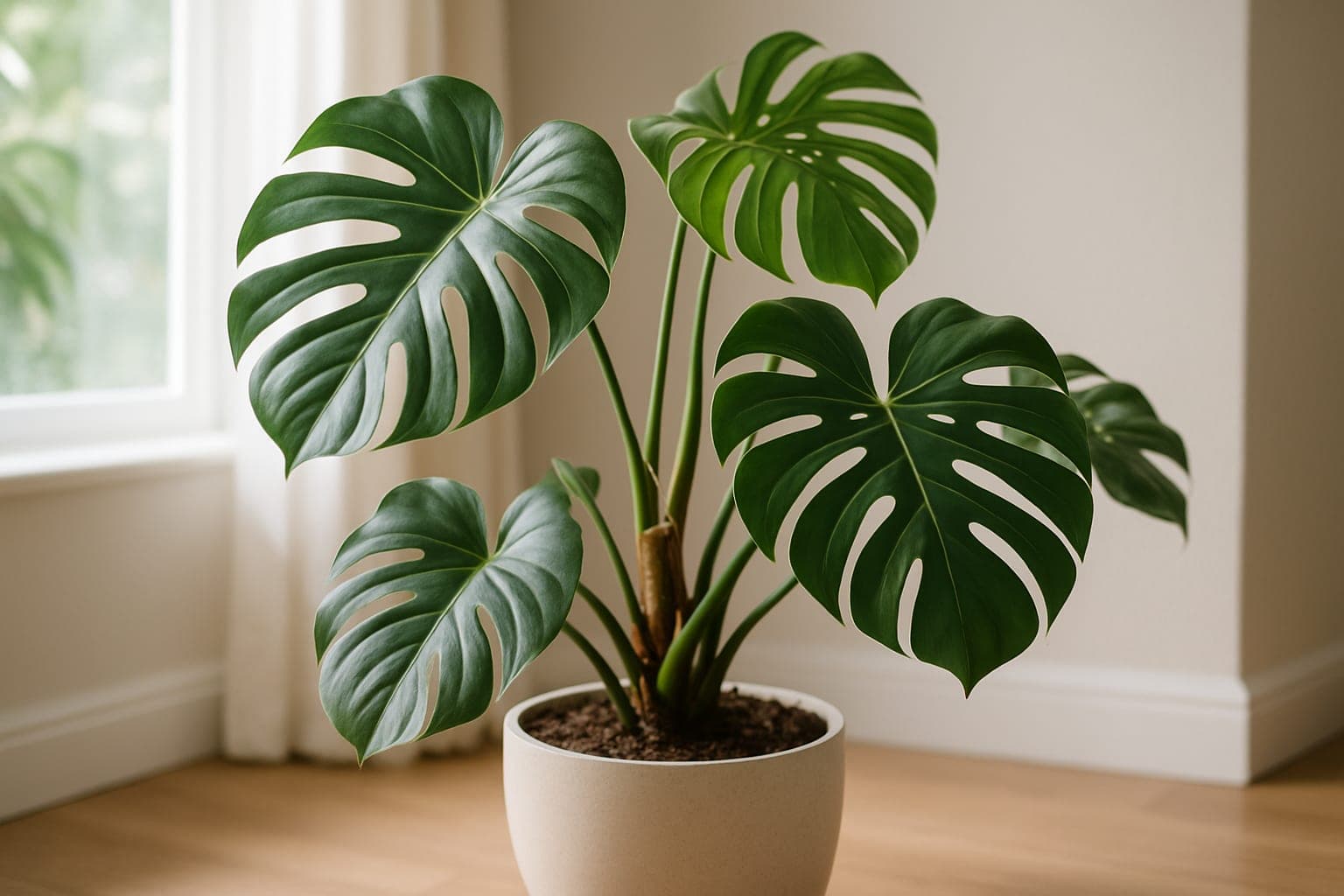
Native to the rainforests of Central America, Monstera deliciosa has become one of the most beloved houseplants in the world. With its glossy, hole-punched leaves and vigorous climbing habit, it brings a true jungle feel indoors. Give it the right conditions and it will reward you with ever-larger, more dramatic foliage year after year.
Light Requirements
Monstera deliciosa thrives in bright, indirect light. In its natural habitat it climbs tree trunks beneath the forest canopy, so it is adapted to filtered sunshine rather than harsh direct rays. A spot a metre or two back from a south- or west-facing window, or directly beside an east-facing one, tends to suit it well.
Too little light is the most common reason for a sulky Monstera. In dim corners it will survive but produce small, undivided leaves on weak stems. A few hours of gentle morning sun are tolerated and often encouraged, but midday summer sun through glass can scorch the foliage, leaving pale or crispy patches.
Signs your light is wrong
- Too dark: small leaves, no new fenestrations, leggy stems reaching toward the window.
- Too bright: bleached yellow patches, brown crispy edges, leaves curling inward.
Watering
Monsteras like a consistent rhythm of soaking and partial drying. Water thoroughly when the top 3-4 cm of compost feels dry to the touch, letting excess drain freely from the bottom of the pot. In a warm, bright spot this might mean watering once a week; in cooler months it could stretch to every two or three weeks.
Avoid letting the plant sit in a saucer of water, as soggy roots quickly lead to root rot. Equally, do not let the rootball bone-dry repeatedly, or you will see drooping leaves and brown leaf edges. Tepid water is kinder than cold straight from the tap.
Humidity and Temperature
As a tropical species, Monstera deliciosa enjoys moderate to high humidity, ideally around 60% or above, though it adapts well to average household levels. If the air is very dry, leaf edges may brown and new leaves can emerge crumpled. Grouping plants together, standing the pot on a tray of damp pebbles, or running a humidifier nearby all help.
Keep your plant in a warm room, comfortably between 18°C and 27°C. Avoid cold draughts, unheated porches in winter, and proximity to radiators that dry the air dramatically. Below about 13°C growth stalls and the plant becomes vulnerable to damage.
Soil and Potting
The ideal mix is rich but free-draining. A good blend is roughly equal parts general houseplant compost, orchid bark and perlite, with a handful of coco coir or worm castings for moisture retention and nutrients. The bark mimics the chunky, airy material Monsteras root into in the wild.
Repot every two to three years, or when roots circle the bottom of the pot and push through drainage holes. Choose a container only one size larger; an oversized pot holds excess moisture and slows growth. Always use a pot with drainage.
Feeding
Feed with a balanced liquid houseplant fertiliser at half strength every three to four weeks during spring and summer. Pause feeding in autumn and winter when growth naturally slows.
Support and Moss Poles
Monstera is a hemiepiphyte: it climbs. Without support, stems flop sideways and leaves stay relatively small. Giving the plant something to climb encourages the aerial roots to anchor, mature foliage to develop and fenestrations to become more pronounced.
A moss pole, coir pole or rough wooden plank all work well. Tie new growth gently to the support with soft plant ties until the aerial roots grab on themselves. Mist the pole occasionally to keep it slightly damp, which encourages roots to attach.
Why Leaves Fenestrate
Those iconic holes and splits, called fenestrations, are a hallmark of mature Monstera growth. Young plants produce solid, heart-shaped leaves; splits appear as the plant ages and conditions improve. The leading theories suggest fenestrations allow light to filter down to lower leaves and help large foliage withstand tropical wind and rain.
To encourage fenestration:
- Provide plenty of bright, indirect light.
- Give the plant something tall to climb.
- Keep watering, feeding and humidity consistent.
- Be patient — each new leaf tends to be more divided than the last.
Propagation
Monstera is wonderfully easy to propagate from stem cuttings. Take a cutting just below a node, making sure it includes at least one aerial root or root bump. Place it in a jar of water, changing the water weekly, and pot up into compost once the new roots are 5-8 cm long. Alternatively, root cuttings directly in damp sphagnum moss or a light potting mix.
Common Problems
Yellowing leaves
Usually caused by overwatering or compacted, waterlogged compost. Check the roots and adjust your watering routine. Occasional yellowing of the oldest leaf is normal.
Brown leaf tips and edges
Often a symptom of low humidity, underwatering or a build-up of mineral salts from tap water. Try filtered or rainwater and increase humidity.
No new fenestrations
The plant is likely too young, too dark or unsupported. Move it to brighter light and add a moss pole.
Pests
Watch for spider mites, mealybugs, scale and thrips, particularly in dry indoor air. Wipe leaves regularly with a damp cloth, inspect the undersides, and treat infestations promptly with insecticidal soap or neem oil.
Final Thoughts
Monstera deliciosa is a forgiving plant that rewards attention with truly spectacular foliage. Get the basics right — bright indirect light, a steady watering rhythm, a sturdy climbing support and warm, humid conditions — and your Swiss cheese plant will grow into one of the most striking features of your home.
Tools and supplies for this
Products we'd actually buy for this job. Linking to Amazon — if you buy through these links we earn a small commission at no extra cost to you.
- Weston Mill Pottery Terracotta plant pots, 175mm (pack of 10)
Mid-size workhorse terracotta — perfect step-up for plants outgrowing their nursery pots.
- Weston Mill Pottery Terracotta plant pots, 20cm (pack of 5)
Heavyweight 20cm clay for established plants — the porous walls help prevent the soggy roots aroids hate.
- Whitefurze G04012 7.5cm Garden Pot - Terracotta (Set of 10)
Cheap, cheerful plastic propagation pots — what we actually use for cuttings and small offsets.
- Whitefurze G04013 10cm Garden Pot - Terracotta (Set of 7)
Reliable mid-size nursery pots with proper drainage holes — the boring essential every plant parent runs out of.
BotanicBuddy Editorial Team
Plant Care Team
Passionate about helping plant parents succeed with expert tips and proven techniques.
Related Articles
Seasonal Plant Care: Adjusting for the Changing Year
Adapt your plant care routine throughout the year to keep your houseplants healthy and thriving.

Understanding Plant Watering: A Complete Guide
Master the art of watering with our comprehensive guide covering frequency, techniques, and common mistakes.

Comments(529)
I've had a Monstera for about three years now, and honestly the biggest shift for me was stopping the overwatering—they really do prefer to dry out between waterings, especially in winter. The moss pole made a real difference too, though I'm curious whether you found the fenestrations actually improve with better support, or if that's mostly just marketing talk.
I think you're onto something real with the moss pole—I've noticed my *Monstera deliciosa* does seem to fenestrate more consistently when it's climbing upright versus sprawling, though I suspect that's more about the plant maturing and getting better light penetration to lower leaves than the pole itself doing magic. The drying out between waterings is definitely the game-changer though; I killed my first one by treating it like a tropical rainforest in my kitchen, when really it wants that "almost forgot to water" rhythm, especially in cold months.
I've had decent success with a Monstera in dappled afternoon light, though mine took two years before the leaves started splitting—patience is key. The moss pole made a real difference; without support it just sprawls and the new growth stays smaller. Are you finding your fenestrations show up faster in brighter conditions, or does it depend more on the plant's age?
I have to admit, I've been intimidated by tropical plants since I only grow succulents in a pretty dry climate, but your guide makes the Monstera sound less mysterious. I'm curious—do you think someone like me with limited humidity could ever keep one happy, or should I stick to what thrives in my arid conditions? The part about the moss pole was especially helpful since I didn't realize they climbed.
You can definitely grow a Monstera in dry climates—I do fine with mine in a cold apartment where humidity hovers around 30–40%. The key is watering more frequently since it dries out faster, and misting helps, but honestly I've found that consistent moisture matters more than high humidity. That said, if your space is arid *and* you're heating it heavily in winter, you might find spider mites annoying. The moss pole thing really does make a difference though; mine grew noticeably faster once I gave it something to climb.
Honest take: a Monstera will survive in low humidity, but it won't develop those signature splits reliably—you'll get smaller, less fenestrated leaves. That said, if you're only managing four plants like me, it might be worth a single trial near a bathroom or kitchen where humidity naturally climbs. The moss pole does help it climb and express itself better regardless of conditions. Have you considered just sticking with your succulents, or is there something specific drawing you to the Monstera?
I'm curious about the fenestrations claim—I've read they're linked to light availability, but I'm still not 100% sure if that's something you can actually control as a grower or if it's just genetic. I'm keeping one in my med climate apartment and it's growing fine without them, so I'm wondering if I'm just not giving it enough light, or if mine's just a less fenestrated cultivar? Either way, the moss pole tip is gold—makes such a difference with how it develops.
I think you're onto something—mine took a few years before the splits showed up noticeably, and it was honestly more about maturity than anything I did differently with light. That said, I've noticed my herbs respond so dramatically to Mediterranean sun that I'm always tempted to blame underperformance on it, so I get the wondering! The moss pole really is the game-changer though; I found it helps way more than light alone, since the plant seems to "know" it can climb and puts more energy into those dramatic leaves.
I've had my Deliciosa for a few years now and the jump in fenestration came when I finally committed to a proper moss pole—it really does make all the difference. The whole plant just seemed to "understand" it had somewhere to climb toward. Curious whether your guide addresses the humidity side of things, since that's what I find makes the biggest difference in leaf size in my mediterranean climate?
The moss pole definitely matters, though I'll admit mine took a year to really commit to climbing it—patience required. For humidity in a mediterranean climate like ours, I've found that consistent misting twice weekly does more for leaf size than anything else, but honestly, grouping plants together works just as well and requires less fussing. Are you misting or using a different method to keep humidity up?
I love this—the moss pole really is transformative! I've found the same thing with my smaller veggie plants in my dry climate; once they have structure to grow *toward*, they just seem to take off. Your point about humidity is spot-on too; I mist mine pretty regularly here in Arizona, and I swear the newer leaves come in noticeably bigger when I'm consistent with it compared to the months I slack off.
I have to admit, my three orchids get most of my attention in this arid climate, so *Monstera deliciosa* has always felt like it might resent me—but your guide is making me reconsider! I'm curious whether the fenestration advice applies indoors without the intense humidity of a tropical setting, since that's where I'd realistically need to grow one. Does the plant still develop those gorgeous splits reliably with supplemental methods, or should I accept I might end up with a beautiful but stubbornly whole-leaved specimen?
I've killed more *Monsteras* than I'd like to admit—mostly by overwatering in my drafty Minnesota home—but I've finally cracked it: let the top inch or two of soil dry out completely between waterings, especially in winter. The fenestrations do seem to come faster when the plant's slightly stressed but not actually suffering, which took me an embarrassing number of years to understand. Great to see moss poles get the attention they deserve; that's where a lot of people go wrong.
Oh wow, the "slightly stressed" thing is so helpful to know! I've got a Monstera that's been pretty happy but hasn't developed those cool split leaves yet, and I've been wondering if I'm babying it too much. I'm in a temperate climate, so winters are pretty mild for me, but I'm definitely guilty of watering too often—do you think the stress factor applies even in milder climates, or is it more about the seasonal shift that matters?
I appreciate the focus on fenestrations here—so many people think they just happen randomly, but you're right that light and maturity play huge roles. I've found that in my arid climate, getting the humidity and indirect light balance right has been key to encouraging those splits. That said, Monstera deliciosa feels worlds apart from orchids in terms of what they need, so I'm curious whether you've noticed the care shifting dramatically if someone moves from a tropical setup to drier conditions.
I really relate to that humidity-and-light balance—I've killed a monstera or two before figuring out that my cold, dry climate needed serious coddling (a pebble tray became my best friend). The shift from tropical to arid definitely changes the game; I found I had to water way less frequently but mist more often, which felt counterintuitive at first. Have you found any tricks for maintaining humidity without creating a soggy mess around the base?
I just got my first Monstera last year and I'm still figuring out the fenestrations—mine has one split leaf so far and I keep wondering if I'm doing something wrong! I've found that it actually tolerates my cold apartment pretty well as long as I keep it away from the window drafts, which was surprising since I mainly grow tropicals and usually kill them with cold. Does the guide touch on whether a moss pole is essential or more of a "nice to have"? I've got one stuffed in a corner somewhere but I'm never sure if my plant actually needs it or if I just fell for the aesthetic.
I've had my Monstera for three years now, and it wasn't until I gave it a proper moss pole that those splits really started showing up consistently. The difference between a plant that's just surviving and one that's actually thriving in your home is honestly kind of magic to watch. Thanks for putting together a guide like this—I wish I'd had something this clear when I first brought mine home.
I've had my Monstera for about six months now and it's finally starting to put out a split leaf—I'm so excited! One thing I wish I'd known earlier is how much it really does appreciate that moss pole; mine was getting leggy before I added one, and now the new growth looks much fuller. I'm still figuring out the watering schedule though—how do you know when it's actually thirsty versus just needing humidity?
I've got to admit, monsteras aren't really my thing—I'm much more into herbs—but I've been curious about what actually triggers those splits in the leaves! Is it mostly about maturity and light, or does humidity play a bigger role than people think? I've heard so many conflicting things from friends who have them. Also, how much of a pain are moss poles to actually maintain?
I've got just three plants and one of them's a struggling Monstera, so I'm really hoping this guide addresses the fenestration thing—mine's been putting out mostly whole leaves and I'm wondering if it's a light issue or just immaturity. I'm in Arizona where the humidity is basically nonexistent, which I suspect isn't helping, but I'm curious what your take is on humidifying tropical plants in arid climates. Does it actually matter that much, or am I overthinking it?
I've kept a Monstera in my cold climate apartment for a few years now, and the biggest lesson I learned was that those fenestrations really do depend on consistent bright indirect light—mine stayed mostly whole-leafed in a shadier corner until I moved it. The tropical origin means I also had to be more careful about cold drafts than I'd expect for a houseplant. What's your take on whether moss poles actually improve the fenestration development, or is it more about the plant's overall maturity?
I appreciate the breakdown on *Monstera deliciosa*, though I'll admit it's not really my focus since I lean more toward edibles in my collection of eleven—mostly leafy greens and herbs for temperate zones. That said, I've got a neighbor who's obsessed with getting those fenestrations to develop faster, and she swears the light quality makes all the difference. Have you found that consistency matters more than raw intensity, or do they really need that bright indirect sweet spot to start splitting?
Consistency definitely wins over intensity—I've learned that the hard way. My Monstera sat in mediocre light for months with barely any new splits, then I moved it closer to an east-facing window and suddenly the newest leaves came in fenestrated. It doesn't need to be blasted with light, just reliable bright indirect for most of the day. Your neighbor might also want to check that the plant's mature enough though; mine didn't start splitting until it had a few established vines, regardless of conditions.
I'd say consistency wins here—my *M. deliciosa* split reliably under steady bright indirect light, but it also fenestrated (slower, but steadily) in a moderate spot once it was established enough. The real limiting factor seems to be maturity and node count rather than chasing peak lumens. Your neighbor might see faster results just waiting for the plant to size up rather than fiddling with positioning.
I appreciate the focus on actual care rather than just aesthetics, though I'd push back a bit on "rewarding" for cold climates—mine stalls completely in winter despite decent light, and I've stopped fighting it. The moss pole section is solid though; that vertical growth really does change how the plant develops. Have you found that fenestration improves faster with more mature growth, or is it mostly just a light thing in your experience?
I'd gently push back on "tropical climber" here—*Monstera deliciosa* is an epiphytic hemiepiphyte, which changes how we think about its care. It doesn't naturally climb soil; it climbs trees in rainforests, so it actually tolerates irregular watering and drier conditions better than typical climbers. The fenestrations are less mysterious too—they're a response to shade and mature leaf development rather than a secret to unlock, so newer plants won't necessarily produce them just from ideal care.
I appreciate the focus on fenestrations here—so many guides skip over the fact that those splits are really a response to maturity and light conditions, not something you can force. I keep my Monstera deliciosa in bright indirect light and it's finally starting to show those beautiful perforations after months of solid leaves. Does your guide touch on how pot size influences growth rate, or is that something you've found doesn't matter as much as people think?
I've found pot size matters more for watering consistency than actual growth, honestly—my Monstera sat in an oversized pot for a year and the soil stayed wet too long, which slowed everything down. Once I downsized, the faster dry-out cycle seemed to push more vigorous growth and those fenestrations started appearing more reliably. Did you notice any difference in how frequently you needed to water between pot sizes, or was the light upgrade the real game-changer for you?
I've had great luck with my single Monstera in a moderately sized pot—honestly, I think people overthink the pot size thing. Mine took a while to fenestrate too, and I'm pretty sure it was all about patience and that bright indirect light you mentioned rather than squeezing it into a snug container. Have you noticed a difference in growth rate once the fenestrations started appearing, or did it take a while after that first split leaf showed up?
I've had my Monstera deliciosa climbing a moss pole for about three years now, and the fenestration really does accelerate once the plant feels established—mine stayed nearly juvenile until it had enough aerial roots anchoring into the pole. The light point you mention is critical; mine sits in bright, filtered morning sun and the leaf splits are noticeably larger than when it was in dimmer conditions. One thing I'd add is that inconsistent watering can stall fenestration development, so I try to keep the substrate evenly moist rather than cycling between soaked and dry.
I've got one of these and honestly the fenestrations took forever to show up—mine's about two years in and only the newest leaves have splits. I'm wondering if mine just needs more light or if I'm being impatient? It's doing fine otherwise, growing steadily, but I'd love to know what actually triggers those dramatic holes everyone talks about. I have a photo that shows the difference between my older and newer leaves, would be helpful to compare!
I appreciate the focus on fenestrations, but I'd gently push back on the idea that they're some mysterious secret—they're largely determined by maturity and light quality, not special tricks. I've found Monsteras honestly pretty forgiving once you stop overwatering (the biggest killer I see), but that moss pole really does make the difference in leaf size. Worth the effort if you have the space.
I'd push back gently on one thing: fenestrations aren't really a "secret" so much as a response to maturity and light conditions. I've got one that took three years before it started splitting, and the difference between my shadier corner and brighter spot is noticeable. The bigger question is whether people should actually expect those splits indoors—mine only got them once it was genuinely well-lit and established. Did you find fenestration timing varies wildly between different growing conditions?
I love hearing this—I've mostly grown herbs so far, and I'm definitely out of my depth with a Monstera, but your point about light really resonates with what I've read. It sounds like patience is key, and maybe I shouldn't assume mine will split just because it's alive! Do you think a moss pole helps coax those splits along, or is it mainly just for structural support?
I've killed *so many* Monsteras trying to figure out why mine refused to split—turns out mine was basically living in a corner getting maybe two hours of indirect light, which explains everything. Your point about the light really resonates because the difference once I moved mine was honestly night and day, and those fenestrations finally started showing up on new leaves. Do you have a preferred moss pole setup, or are you team stake-and-tie?
I'd push back slightly on the "rewarding" framing—Monsteras are forgiving, sure, but they're honestly pretty slow and take up serious space. That said, if you've got the room and patience, the moss pole recommendation is spot-on; mine climbs much faster with one than it ever did trailing. Light matters more than people think too. I keep four plants total and mine only started splitting reliably once I moved it closer to my south-facing window. Would love to see what you show for the fenestration section—that's where most folks get frustrated.
I've had my Monstera for about two years now, and the biggest game-changer for me was switching to a moss pole instead of just letting it sprawl. The leaves got noticeably bigger once it had something to climb, and those fenestrations started showing up way more consistently. It's such a forgiving plant otherwise—I was probably overwatering mine at first, but it bounced back once I let the soil dry out a bit more between waterings.
I've had my Monstera deliciosa for a few years now and it really does transform a space—those fenestrations are mesmerizing once they start appearing. I'm curious whether you touch on the humidity aspect in the full guide, since I've found that consistent moisture in the air (not just soil) makes a real difference in leaf development in my mediterranean climate. What's been your experience with that balance between humidity and air circulation?
I've had my Monstera for about six months now and I'm still figuring out the fenestrations—mine's putting out new leaves but they're not split yet, which I think means it needs more light? I'm keeping it near an east-facing window, but I'm wondering if I should try moving it closer or if I'm just being impatient. The moss pole idea sounds helpful though, so I might give that a shot soon!
Honestly, six months is still pretty early—fenestrations depend a lot on maturity and overall plant vigor, not just light. East-facing is actually solid; I'd hold off moving it closer unless you're seeing weak growth. The moss pole will help way more than tweaking light at this point, since climbing and support tend to trigger better leaf development. Just make sure the aerial roots can actually touch it.
I have to say, I'm a bit outside my usual wheelhouse here since I'm mostly a vegetable grower, but I've got one *Monstera deliciosa* in my collection of 11 and the fenestration thing is honestly wild to me—mine took forever to start splitting, and I was second-guessing myself the whole time. Are you finding in your experience that the moss pole really does make that much difference, or is it more about giving it enough bright indirect light? I'd love to know if there are any tricks I'm missing since mine's still kind of modest compared to what I see in other people's homes!
I killed my first Monstera by overwatering it—I was so eager to see those splits develop that I thought more water meant faster growth. Once I backed off and let the soil dry out between waterings, the plant finally thrived and those fenestrations started appearing naturally. This guide sounds like it has all the essentials I wish I'd known back then.
I'd love to see more on why the fenestrations actually develop—so many people assume it's automatic, but I've found they're really inconsistent on mine unless I nail the light levels *and* give it something to climb. Are you finding that's the case in your setup, or do you have plants that split happily in lower light? I'm curious because Monstera deliciosa can be so variable depending on conditions, and I think that's often left out of care guides.
I've had mixed luck with Monsteras—my current one is doing great on a moss pole by the east window, but I killed my first one by overwatering and keeping it too dark. One thing I wish I'd known earlier is that they're way more forgiving with water than people think; I now let mine dry out more between waterings and it's actually grown faster. Are you finding the fenestrations show up more readily once they're mature, or does light quality make the biggest difference in your experience?
I'd say it's mostly maturity—my three Monsteras didn't start fenestrating properly until they were established and putting out bigger leaves, regardless of light conditions. That said, I've noticed my east-facing one does produce slightly more dramatic splits than the one in a brighter west spot, so light probably matters at the margins. Your point about watering is spot-on though; I was definitely guilty of keeping mine too wet early on, and the drying-out approach has made a real difference in vigor.
I've got one of these and it's doing okay, but I'm still figuring out the watering—I keep second-guessing myself on whether the soil should dry out completely between waterings or stay slightly moist. Also, mine hasn't developed any splits yet, which is frustrating since that's the whole appeal. Is that just a patience thing, or am I missing something with light or nutrients? I'd love to see if there are specific tips in here about speeding that up, since my mediterranean apartment gets decent indirect light but I'm wondering if it needs more.
I've been eyeing a Monstera for ages but kept hesitating because I thought it'd need a greenhouse setup—turns out I was way overthinking it! My neighbor gifted me one last year and it's thriving in a bright corner of my living room with just a moss pole I rigged together. Still waiting on those famous split leaves to really show up, but seeing new growth every month feels like winning the plant lottery, especially compared to my early succulent kills.
I've had a Monstera for three years now and the biggest shift for me was realizing it doesn't actually need as much water as most people assume—I was overwatering mine at first. The moss pole does make a real difference though, both for structure and those bigger fenestrations you mention. Are you finding your Monsteras develop the splits more readily with a pole, or have you seen it happen just as well in trailing form?
I've had my *Monstera deliciosa* for about six months now and it's only just started putting out fenestrated leaves—I was starting to worry! I found that once I moved it closer to my east-facing window, the new growth came in with those beautiful splits. Does light really play that big a role in fenestration, or was I just lucky?
I appreciate the focus on fenestrations—that's where a lot of people get frustrated. I've kept a couple of succulents thriving in my cold climate, so tropical vines aren't really my wheelhouse, but I know the split-leaf development is partly about maturity and light intensity. If you're covering moss poles, it might be worth mentioning that consistent humidity matters too, since that's where I see people struggle most indoors. Would've loved to see a photo of a mature plant mid-climb.
I'm actually struggling with this same humidity issue right now—my Monstera is putting out new leaves but they're smaller than I'd hoped, and I'm wondering if that's related to the fenestrations not developing properly. You mention light intensity; do you think a grow light would help with that, or is it more about the hours of light per day? I've only got four plants total, so I'm still figuring out the balance between all these factors!
You're spot on about humidity being the overlooked piece—I'd add that without it, *Monstera deliciosa* won't really commit to climbing or develop those fenestrations reliably, even with good light. I keep mine on a moss pole in my Mediterranean climate and it took me a while to realize the splits only started showing consistently once I was misting regularly and keeping the pole damp. The maturity angle matters, sure, but humidity is what actually lets the plant express what it's genetically capable of doing.
I appreciate the focus on *Monstera deliciosa* specifically—though I'd gently push back on one thing most care guides gloss over: those fenestrations aren't really "secrets" so much as a response to maturity and light conditions. I've found mine (kept in a temperate greenhouse) only developed reliable splits once it was established enough and getting bright, indirect light, not before. The moss pole definitely helps, but I've seen people chase perfect fenestration on young plants in low light and get frustrated unnecessarily.
I appreciate the enthusiasm, but I have to say monsteras have never clicked with me the way they do for most people—maybe it's my mediterranean climate, where the humidity just isn't there naturally. I've had better luck with climbing herbs like jasmine and oregano on a pole structure instead. That said, if someone's got the right conditions, I'm curious what you recommend for preventing those brown leaf edges? I've seen it happen to friends' plants even when they're supposedly following all the watering rules.
I've had my Monstera for three years now and still can't get the fenestrations quite right—turns out mine was desperately thirsty the whole time, and I was being way too cautious with watering. The moss pole recommendation really changed the game for me too, since mine was sprawling sideways across my shelf like it owned the place. Did you find that the split leaves develop faster once they're actively climbing, or is it more about overall plant maturity?
I totally relate to the underwatering thing—I learned that lesson the hard way with my Monstera a few years back! I think maturity definitely matters, but honestly, once mine started climbing up the moss pole and getting that vertical support, the newer leaves came in with deeper fenestrations way faster than when it was trailing. Have you noticed if your plant's producing larger leaves overall now that it's happier, or is it still settling in?
I love hearing that the moss pole made such a difference for you. I've got nine plants mostly succulents, so Monsteras aren't really my thing yet, but I'm curious about what you said regarding watering since I tend to err on the cautious side too. Did you notice your plant bouncing back pretty quickly once you started watering more, or did it take a while to recover from being that thirsty?
I've had my Monstera for about four years now, and I've found that fenestration really does depend on consistent bright indirect light—mine barely split until I moved it closer to a south-facing window. One thing I'd add: in my arid climate, I've had better luck letting the soil dry slightly more than tropical guides suggest, since the air moisture is so low. The moss pole makes a real difference though, especially for that characteristic climbing behavior.
You're spot on about the light—I'd say it's the biggest factor most people miss. I've got one that went from barely a slit to proper fenestration once I stopped being cautious with brightness. The arid climate adjustment is smart; I'm in the tropics so I never had to dial back watering, but that makes total sense. Moss pole really is non-negotiable if you want it to actually climb and split well rather than just sprawl.
I've had mixed success with *Monstera deliciosa* in my cold climate—it thrives indoors near a south-facing window, but I learned the hard way that inconsistent watering tanks the fenestration development. Mine took almost two years to produce those dramatic splits, which surprised me since I thought the light was sufficient. What's your experience with how long it typically takes new growth to develop the characteristic cuts, especially in less-than-ideal conditions?
I really relate to your experience with the watering consistency—that's such an easy thing to overlook when you're juggling multiple plants. My Monstera took forever to show those splits too, and I realized I'd been letting it dry out too much between waterings, which definitely stunted the fenestration. Once I settled into a more regular schedule (not soggy, just consistently moist during growing season), the new leaves came in with better cuts. Sounds like you've cracked the code now though, especially with that south-facing window working in your favor.
I've killed exactly two monsteras trying to baby them in my dry Arizona home before I finally figured out that mine just wanted to be left alone with bright, indirect light and way less water than I thought. Now it's one of my 14 plants that actually thrives here, though I'll admit those split leaves took forever to show up—I was convinced I was doing something wrong until my local nursery told me fenestrations just happen on their own timeline. Would love to snap a photo of mine next to my struggling orchids to show the difference, since monstera has somehow become my easiest tropical plant!
Your experience mirrors what I've found too—Monstera deliciosa actually prefers drier conditions than most care guides suggest, which makes sense given its epiphytic origins in Central American forests where it clings to trees rather than sitting in moist soil. The fenestration timeline is spot-on; they're more a sign of plant maturity and adequate light than anything you can rush, so patience really does pay off. I'm curious whether your Arizona setup has helped with pest pressure as well—I've noticed my specimen stays cleaner in arid air than it ever did in more humid conditions.
I've had mixed success with my *Monstera deliciosa*—it took me two years to stop drowning it before I realized my cold basement winters needed way less water than the care guides suggested. The moss pole recommendation is spot-on though; mine finally started producing those gorgeous fenestrations once it had something to climb toward and some actual structural support. Great guide for anyone braving this tropical beauty in a colder climate!
I've had my Monstera for about three years now, and the biggest thing I learned was that those splits don't show up on a whim—mine stayed stubbornly whole until I moved it closer to a bright window. Once the light improved, the fenestrations started appearing within a few months. It's such a satisfying moment when you finally see those holes develop and realize your care is actually working.
I've got a Monstera that's been growing like crazy in my bright north-facing window here in the Mediterranean, but I'm still confused about when exactly those splits appear—is it just age, or am I missing something about light? I'd love to see better fenestrations on mine, so any specifics in your guide would help. Also, I've seen people say moss poles are essential but mine seems fine without one so far, so I'm curious what difference you've actually noticed.
I've had my Monstera for about eight months now and I'm still figuring out why some new leaves are splitting while others come in whole—is that just a maturity thing, or am I missing something about light? Mine's near a bright east-facing window and seems happy, but I'm curious if the fenestrations really do depend on how established the plant is. Also wondering if the moss pole makes that much difference, since mine is currently just sprawling along a shelf and getting pretty leggy!
I think you're onto something with the maturity angle—my Monstera took a good year before I saw consistent fenestrations, and honestly, once it got established, the new leaves just... split. But light definitely plays a role too; I've noticed my plant puts out fuller holes when it's getting that bright indirect light you've got. The moss pole thing is real, though—mine was sprawling just like yours and looked pretty sad, so I finally added one last spring and the new growth has been way more vigorous and upright. Have you considered propping it up, or are you enjoying the trailing look?
I've had a monstera for a couple years now and honestly the moss pole made *all* the difference—mine was just sprawling everywhere until I gave it something to climb, and that's when the leaves got noticeably bigger. That said, I have to respectfully push back a bit on the watering advice if you're recommending frequent schedules; mine actually prefers to dry out quite a bit between waterings, especially in my cooler temperate climate. What's your take on how that changes seasonally?
I totally agree about the moss pole—mine went from looking like it had given up on life to actually putting out those gorgeous fenestrated leaves once I gave it proper support! And you're spot on about watering variability; in my arid climate, I basically water when the top inch feels genuinely dry, which in winter might be every two weeks or longer. The key seems to be letting the soil dry between waterings rather than following a fixed schedule, since that definitely shifts with season and humidity.
I've been growing *Monstera deliciosa* for a couple of years now and it's easily become one of my favorites—something about watching those fenestrations develop never gets old. I'm curious whether your guide touches on how much patience actually matters with the splits, since I've found mine produces far more dramatic leaves now that it's climbing the moss pole rather than trailing. Do you find the fenestration development varies much depending on whether growers keep theirs more compact versus letting it climb?
I've been eyeing a monstera for a while, but I'm honestly intimidated by it since I'm still learning the basics with my other plants. My collection is mostly native desert stuff that's way more forgiving, so the whole tropical vibe feels pretty different. Does the moss pole thing actually make a big difference, or can you grow them without one if you don't have the space?
I've been growing Monsteras for years now, but I have to admit the arid climate here has taught me some humbling lessons—I killed my first one by overwatering, which feels backwards when you're in the desert! I'd love to see a photo of mine right now with those gorgeous splits finally showing up after I stopped fussing with it and just let the humidity from my other 13 plants do the work. Really appreciate guides like this that remind me why moss poles actually matter.
That's such a relatable lesson—I've definitely been guilty of the "help it by watering more" trap too. I'm curious though, since you're in an arid climate: are you misting regularly, or are those 13 other plants really creating enough ambient humidity that the Monstera doesn't need extra attention? I'm in a cold, dry region and I've found misting alone doesn't cut it, so I'm wondering if there's a setup I'm missing.
I appreciate how much you've emphasized the importance of stable humidity for M. deliciosa—it really does make the difference between reluctant fenestration and those stunning split leaves. In my arid climate, I've found that clustering my two plants together actually helps more than I expected, though I'm curious whether you've noticed a significant difference between misting and other humidity methods in your own experience.
I've had my Monstera for about three years now, and I have to admit I killed my first one by overwatering—turns out those dramatic leaves don't appreciate soggy soil! Now I'm much more mindful about letting the soil dry out between waterings, and she's rewarding me with bigger splits every season. The moss pole made such a difference too; I finally understood why mine was looking so leggy before I gave it something to climb.
I love how you're covering the fenestration angle—so many people think those splits are just random, when really they're the plant responding to light penetration and maturity. I've found that my Monstera *deliciosa* has gotten much more dramatic cuts since I moved it closer to an east-facing window, though I was worried about leaf scorch at first. Are you seeing a difference in fenestration patterns depending on how you support your moss pole, or does light seem to be the main driver for you?
I appreciate the focus on monsteras, but I'd gently push back on the "rewarding for everyone" angle—they're actually pretty fussy about humidity and light consistency in my experience. I've had four now, and the ones that developed those dramatic fenestrations reliably were the ones getting bright indirect light *and* steady moisture (not wet, but not dry either). The moss pole definitely helps, but it's not a magic fix if the basics aren't dialed in first.
I've been wanting to try a Monstera but honestly I'm worried about the arid climate here—does it really need that much humidity to get those split leaves, or is that more of a myth? I've got mostly succulents and hardy veggies so I'm still figuring out what tropical plants even want.
I've had my Monstera for about three years now and it's easily one of my favorites in my collection. The biggest thing I learned the hard way was that those splits only show up when the plant is really happy and mature—mine stayed just green leaves for the first year until I got the light right. Now it's putting out fenestrated leaves consistently, which never gets old to see.
I've got to say, I'm more of an herb person myself—my collection's mostly rosemary, basil, oregano—but I finally gave a Monstera a shot last year and it's totally changed how I think about indoor plants. The moss pole made such a difference; mine was getting leggy until I added one and suddenly it perked up. My question though: do you find the fenestrations actually show up better with certain light conditions, or is it just genetics? Mine are just starting to split and I'm curious if I'm doing something right or just got lucky.
I love the enthusiasm here, but I'd gently push back on one thing—*Rhaphidophora tetrasperma* (the mini monstera) actually shows fenestrations more readily in my experience, even in indirect light, whereas *M. deliciosa* can be finicky about splitting indoors if humidity dips. Have you found that consistent misting made a real difference with your own plants, or did you need something more?
You've touched on something I learned the hard way—my *M. deliciosa* sat stubbornly fenestration-free for ages until I stopped relying on misting alone and invested in a humidifier running nearby. The *Rhaphidophora tetrasperma* is definitely more forgiving though, and honestly, it's been the more cooperative of my two tropical climbers by a mile. I wish I'd known to lean on active humidity rather than just the spray bottle before it took months of trial and error.
I just got my first Monstera last month and I'm still figuring out why the new leaves aren't splitting yet—I've been reading they need really bright indirect light, but I'm wondering if mine just needs more time to mature? The moss pole tip is super helpful since mine is already starting to climb, though I have to admit the whole fenestration thing still feels a bit mysterious to me. Really appreciate a guide that breaks this down clearly.
I've got a Monstera in my collection of 14 that took me way too long to understand—I kept waiting for those dramatic splits and got nothing but whole leaves for ages! Turns out mine needed way more light than I realized, especially since I'm in an arid climate where humidity isn't exactly working in my favor. Would love to see your tips on encouraging those fenestrations, because I feel like that's the part most guides gloss over.
I appreciate the focus on Monsteras – they're such forgiving plants – but I'd gently push back on one thing I see often: the assumption that those fenestrations are purely about maturity. In my experience growing *Rhaphidophora tetrasperma* and a few *Monstera* varieties, light quality makes a real difference too. A young plant under strong, indirect light can develop splits faster than a mature one in low conditions. Worth experimenting with if someone's waiting for those iconic leaves to show up.
You're spot on about light mattering more than people think. I've noticed the same thing with my Monstera over the years—moved it from a north-facing window to bright, indirect east light and the fenestrations came through noticeably faster on new growth. It's easy to blame patience when really the plant's just not getting enough energy to "effort" into splitting the leaves. Have you found that certain light intensities actually slow down fenestration, or is it more just a minimum threshold you need to cross?
I've had my Monstera for about four years now and honestly the fenestration thing took me forever to figure out! Mine barely split when I first got it, but once I moved it closer to my east-facing window it really took off. I'm curious whether you touch on humidity in the full guide—I found that misting alone didn't cut it for mine, and I ended up using a pebble tray instead. Also, I'd love to see what you recommend for moss poles since I just upgraded mine and I'm still experimenting with what works best. Do you have a preference between sphagnum and coconut coir for wrapping?
I've learned the hard way that Monstera deliciosa really does demand bright indirect light to develop those fenestrations consistently—my first one spent a year in medium light and barely split at all. Once I moved it closer to an east-facing window, the new growth came in properly perforated within a couple of months. The moss pole makes a huge difference too, not just for aesthetics but because it encourages the plant to climb naturally and produce larger leaves overall.
I have to admit, my Monstera lives in a corner that gets maybe three hours of indirect light, and it's... fine? Not thriving, but it keeps me humble. I've found that the fenestrations really do seem to come more reliably once it's genuinely happy with its setup though—worth being patient with the whole light thing rather than trying to rush it.
I've always found Monsteras a bit finicky compared to my herbs, honestly—they seem to want humidity I struggle to give them in my drier Mediterranean climate. That said, I did manage to keep one alive for a few years by misting it regularly and giving it bright, indirect light. My question though: do you find that the fenestrations actually develop better with a moss pole, or is that more for the plant's overall health? I'm curious whether it's worth the effort if someone's just growing it as a trailing plant instead.
I've been wanting to try a Monstera for a while now, but I'm nervous about the tropical part since I live somewhere pretty cold. Do you think it's still possible to keep one happy indoors with grow lights, or would I be better off sticking with something more cold-hardy for now?
Monstera deliciosa does fine indoors with supplemental lighting—I keep mine under grow lights in my tropical setup and it thrives. The bigger factor is consistency: they're actually forgiving about temperature as long as you avoid cold drafts below 50°F and keep humidity moderate. If you have a warm corner and can provide bright indirect light or modest supplemental LEDs, I'd say go for it rather than waiting.
I appreciate the focus on fenestrations—those splits are so satisfying when they finally show up! I've actually got a *Raphidophora tetrasperma* (mini Monstera) that's been my gateway into these aroids, and I'm dying to eventually graduate to a full deliciosa. Since you mention moss poles, how finicky are they about humidity in temperate climates? I keep most of my herbs indoors under pretty controlled conditions, so I'm genuinely curious if a deliciosa would be fussier than say, basil or oregano in terms of the air it needs.
I'd skip the moss pole unless you've got space—mine does fine on a trellis in a bright corner, and it's honestly easier to manage. The real game-changer for me was backing off on watering; I killed my first one by treating it like a tropical plant needs constant moisture. They're tougher than people think, especially in cooler climates where mine sits. Good detailed guide though, the fenestration stuff is spot on.
I completely agree about the watering—that's where so many people stumble, especially coming from more humid climates. A trellis is a smart alternative too, and I appreciate that you're pointing out they don't *need* the moss pole to thrive. Since you're in a cooler climate, have you noticed whether your Monstera's fenestration developed differently than what you see in tropical-grown specimens, or does it still split readily?
I've had my Monstera for a few years now and it's been one of my most forgiving plants, though I found the moss pole made a real difference once mine got tall enough to need support. I'm curious what you recommend for someone in a drier climate—mine seems happy enough, but I've read fenestration can be slower when humidity is lower, and I'd rather not run a humidifier if I don't have to.
I've had my Monstera for two years now and only recently figured out that those gorgeous fenestrations actually *need* good light to develop—I spent the first year wondering why mine stayed stubbornly whole! Have you found that moss poles make a real difference in leaf size, or is that more of a nice-to-have for people with the space?
I appreciate the focus on fenestrations here—so many people think they're automatic, but light and maturity really do make all the difference. I've only got two plants in my collection at the moment, and while I'm usually drawn to edibles, I've been curious about Monstera deliciosa since the leaves are actually edible once they mature. What's your take on when they're genuinely safe to harvest, or do you tend to grow them purely as ornamentals?
I've had my Monstera for about three years now, and honestly the biggest game-changer for me was upgrading to a moss pole—those split leaves really do explode once they have something to climb! My only struggle living somewhere cold is keeping it happy through winter when the radiator kicks on. I've learned to mist it way more often during those months or it gets pretty crispy. Are you finding that fenestrations show up more reliably on mature plants, or is there anything specific about light that pushes them along?
I've had my Deliciosa for about four years now and the fenestration game really changed once I committed to a sturdy moss pole—it's wild how much the leaf splits depend on maturity and those aerial roots having somewhere to cling. My mediterranean climate actually works in its favor since the dry air keeps rot at bay, though I do miss how aggressively they vine in true tropical conditions. Are you finding the fenestrations develop better with a specific light intensity, or is maturity really the main driver?
I've had my *Monstera deliciosa* for about eight months now, and I'm still figuring out the watering schedule—I keep second-guessing myself on whether the soil is actually dry enough. The fenestrations on my newer leaves are starting to show, which is exciting, but I'm curious whether those splits develop faster with a moss pole, or if that's more about overall plant maturity? Either way, this is really helpful for understanding what mine actually needs.
I'd push back gently on one thing—I've found that the fenestrations develop far more reliably when the plant has consistent humidity and strong indirect light, rather than just maturity alone. Mine sat for two years with only partial splits until I moved it closer to an east-facing window and started misting weekly, and the new growth came in dramatically different. Worth mentioning since people often blame themselves for "not waiting long enough" when really the conditions just weren't quite there.
Humidity definitely makes the difference—I learned that the hard way too. Mine stayed pretty plain until I moved it away from the kitchen heat vent, and the next flush of leaves came in with proper splits. The tricky part is that people see mature plants at the nursery with full fenestrations and assume it's just a waiting game, when really those were grown in ideal conditions from the start. Did you find the misting was enough, or did you need to do something else to keep humidity up consistently?
I've been wanting to try a Monstera for a while now, but I'm worried about the tropical requirements since I'm in a cold climate. Would this guide address how to grow one indoors under lights, or is it mainly for people with naturally warm homes? I love the idea of those split leaves, but I want to make sure I'm not setting myself up for failure with my current setup.
Monsteras are honestly tougher than people think—I keep one in a temperate climate with standard indoor conditions and it thrives. You don't need special lights or a warm room; they're fine with regular household temps as long as it doesn't drop below 10°C regularly. The split leaves come with maturity and decent light, but they'll grow happily without fenestrations too, so don't stress if it takes a while.
I appreciate the focus on moss poles here—they really do make a difference in how the plant develops. Since I'm growing mostly vegetables in my tropical setup, I don't have *Monstera deliciosa* myself yet, but I've been curious whether the fenestration intensity changes much if you prioritize humidity over the moss pole structure, or if both are equally important for getting those dramatic splits.
From what I've noticed with my own *Monstera*, high humidity definitely helps, but the moss pole seems to matter more for those dramatic fenestrations—mine developed much better leaf splits once I gave it something to climb rather than just hanging around. That said, I'm still figuring out the exact balance myself, so I'd be curious if anyone else has seen fenestration improve mainly through humidity alone!
I appreciate the thorough breakdown, though I have to admit Monstera deliciosa isn't really my thing—I'm way more into vegetables and edibles, so most of my collection leans toward *Solanum lycopersicum* and *Capsicum* varieties. That said, I'm curious about your take on fenestration: do you find it's purely a maturity thing, or does light quality actually influence how pronounced those splits become? I'd love to see a photo comparison if you have one showing the difference between plants grown in varying conditions!
I've got a Monstera that's been in my collection for about eight months now, and I'm still trying to figure out the watering schedule—mine's in a terracotta pot and I keep second-guessing myself between the "water when top soil dries" advice versus what actually works in my Mediterranean climate. The split leaves are starting to show up which is exciting, but I'm curious if you touch on whether a moss pole is actually necessary or if it's just for aesthetics? I'd love to see if mine would do fine without one since space is tight in my flat.
I appreciate the focus on fenestrations—though I'd gently push back on the idea that they're some mysterious secret. In my experience, those splits are simply a response to maturity and good growing conditions; plenty of young or stressed Monsteras won't develop them no matter what you do. I've found that consistent humidity and bright (but indirect) light matter far more than any special trick. That said, I'm curious whether your guide emphasizes that they're still vigorous growers even *without* the fenestrations, since that seems to disappoint a lot of people.
I've had my Monstera for about eight months now and it's finally starting to show those splits I was waiting for—I'd love to share a photo because the first fenestrated leaf is honestly thrilling! My main confusion is whether the moss pole is really necessary or more of a preference thing? Right now mine is trailing, but I'm wondering if I'm missing out on something by not giving it vertical support. The tropical humidity in my area helps, but I'm curious if a moss pole would actually change the leaf shape or growth pattern.
That first fenestration is such a milestone! I'm still waiting on mine to show splits too, so I'm curious what finally triggered it for you. On the moss pole question—I've been wondering the same thing. From what I've read, it seems like the pole mainly helps with climbing growth and bigger leaves, but trailing can work fine if that's the look you want. Since you're in a humid area, maybe try one eventually just to see if the leaf size changes? I'd love to see a photo of that new leaf if you post it somewhere—that's the kind of thing that actually helps me figure out what "ready" looks like.
I'm more of a herbs person myself (basil and parsley are my go-to's), but I've always been fascinated by what triggers those fenestrations in *Monstera deliciosa*—is it really just maturity and light, or are there other factors at play? I'd love to know if your experience differs from the standard advice, since I imagine fenestration is one of those things people get wildly different results with depending on their setup!
I'd love to have a Monstera thriving in my arid climate, but mine has been stubborn about fenestrations—I think the dry air works against it! From what I've gathered the hard way with my other 13 plants, light and maturity definitely matter, but I suspect consistent humidity might be the secret ingredient people don't talk about as much. The herbs route sounds way more practical for your setup, honestly!
I've got a Monstera that took forever to split, and honestly it wasn't until I moved it closer to my east-facing window that the new leaves finally started showing those gorgeous holes. Light definitely seems to be the biggest factor in my experience, though I think plant maturity and overall vigor matter too—mine was a bit stressed from inconsistent watering when it was younger. Since you're more of a herbs person, you might appreciate that it's kind of like how basil needs good light to really thrive; the plant just performs better with the right conditions.
I'd push back a bit on "rewarding" for everyone—mine took two years to split consistently, and I see people struggling because they're overwatering in lower light. The moss pole thing is real though, makes a genuine difference in leaf size. I grow tomatoes and peppers in my tropical setup alongside a couple of other plants, and the lesson applies across the board: drainage matters more than any secret. Would love to see your photo of the fenestrations you're highlighting.
I've killed two Monsteras before finally figuring out that my "tropical climber" was actually slowly suffocating in a corner—turns out they really do need that bright, indirect light to develop those gorgeous fenestrations I was so excited about! Now mine is climbing a moss pole in my living room and finally putting out split leaves, which feels like a small victory given my cold climate. Did you find that fenestration development takes noticeably longer in less-than-ideal light, or have your readers had success pushing it along with supplemental grow lights?
I'd push back a bit on the "rewarding" angle—Monsteras are forgiving, sure, but they're honestly kind of boring to me after a few years. That said, if you're going the moss pole route, don't bother with those flimsy store ones; I've had better results just wrapping sphagnum around a sturdy stake and misting it regularly. The fenestrations thing feels overstated too—mine split fine with consistent bright indirect light, but I've also seen people obsess over it when the plant is already thriving. Solid guide for beginners though.
Great guide, though I'd gently push back on one thing—fenestrations aren't really a "secret" to unlock so much as a sign the plant is happy and mature enough to produce them. I've got a seven-year-old Monstera that took three years before the splits showed up, and honestly, it was just doing its thing once it had enough light and root space. The moss pole advice is solid though—that's where most people go wrong, thinking they can skip it.
I've had my Monstera deliciosa climbing a moss pole for three years now, and I've found that the fenestrations really do develop more reliably when the plant gets that indirect bright light—it seems to correlate with stronger aerial root development too. The watering advice matters more than people think; I learned the hard way that overwatering kills them faster than almost anything else in a tropical setup.
I love seeing *Monstera deliciosa* get the attention it deserves. Mine has thrived in my mediterranean climate once I realized the fenestrations really do intensify with proper bright, indirect light—it's not just a myth. I'm curious whether your guide touches on the humidity factor, since that's where I see a lot of people struggle, especially outside tropical regions. Do you find moss poles make a noticeable difference in leaf size, or is it more about overall plant vigor?
I appreciate this guide, though I have to say Monsteras aren't really in my wheelhouse—I'm more of an orchid person, and the dry air my collection needs wouldn't suit *Monstera deliciosa* at all. That said, your point about the moss poles is spot on; I've seen so many people struggle with those split leaves because they're not giving the plant proper structural support. Since you mention the fenestrations, do you find that adequate light makes a bigger difference than humidity when it comes to getting those dramatic splits?
I'd push back slightly on "everything" — most guides gloss over the real challenge, which is that Monsteras need serious indirect light to actually fenestrate well, not just survive. I've got one that's been perfectly healthy for years in moderate light but barely splits anymore. The moss pole helps with climbing, sure, but I've found it matters way less than people think if you're content with a bushier plant. What's your take on light levels needed for consistent fenestration?
I've got a Monstera in my cold-climate living room, and honestly the biggest game-changer for me was realizing it doesn't need as much light as I thought—mine actually started fenestrating better once I moved it away from the harsh afternoon window. That said, I'm curious what you recommend for watering frequency in winter? Mine's been finicky about moisture, and I'm wondering if it's just my chilly house or if I'm overthinking it.
Cold winters definitely slow the plant down—mine basically went dormant last season and needed way less water than I expected. I'd dial back to every 10-14 days once temps drop, and honestly just let the soil dry out more between waterings. The tricky part is that Monsteras hate sitting wet *and* being too dry, so I always check the top inch before watering rather than following a strict schedule. Have you noticed whether your plant's growth has slowed in winter, or is it still pushing new leaves?
I've had my Monstera for a few years now, and the biggest thing I wish I'd known earlier is how much those fenestrations actually *depend* on consistent, bright indirect light—mine spent its first year looking perfectly lovely and completely solid-leaved because I kept it too far from the window. Now that it's happier, the splits have finally started appearing, and honestly, it feels like I've unlocked a secret level of the plant. Curious to see what your guide says about moss poles, since mine has gotten wonderfully unruly and I'm never quite sure if I'm training it the right way!
I totally get that—I killed my one succulent by keeping it too shady (ironically, thinking I was protecting it), so I feel your pain on the delayed gratification front! The light thing really does seem to unlock something magical with these plants. I'd love to see a photo of your unruly Monstera; moss poles still feel a bit mysterious to me, though I gather they're more about giving the plant what it wants naturally than perfecting some specific technique. Sounds like yours is thriving either way!
Oh, the solid-leaf phase—I feel this in my bones! Mine did the exact same thing, and I genuinely thought I'd somehow gotten a mutant. Once I moved it closer to the window, those fenestrations started popping up like magic, and suddenly the plant made sense. I'm still figuring out the moss pole situation myself (my Monstera has become delightfully chaotic), so I'm curious what the guide suggests—have you found a training method that actually works, or is it more of a gentle guidance situation?
I appreciate this guide even though I have to admit monsteras and I haven't quite clicked—I'm much more at home with my single hardy succulent in this cold climate! That said, I've watched enough plant parent friends wrestle with theirs to know that moss pole tip is worth its weight in gold. I'd love to see a photo of a mature one with those split leaves the way you describe them, though I suspect my windowsill will stick to what actually survives below freezing!
I'd say stick with what thrives in your climate—there's no point fighting it. That said, if you ever get curious, monsteras are surprisingly forgiving indoors even outside the tropics, as long as you don't overwater. The moss pole really is the game-changer though; mine climbs steadily and the leaves are noticeably larger since I added one. Your succulent sounds like the smarter choice for your setup!
I appreciate the focus on fenestrations—that's where a lot of people go wrong, thinking they need special fertilizer or tricks when really it's just consistent bright indirect light and patience. I've had better luck with mine since I stopped fussing and let it climb naturally up a moss pole instead of pruning it back. That said, Monsteras aren't really my jam since I'm all herbs in a cold climate, but I'm curious whether your guide addresses how long people should actually expect to wait before seeing those splits, or if that varies wildly depending on conditions?
I appreciate the emphasis on moss poles—so many people overlook how much that vertical support transforms growth in *Monstera deliciosa*. Since you're clearly covering the fundamentals, I'm curious whether you touched on humidity's role in promoting fenestration, or if that's something you plan to dive into separately. In my arid climate, I've found it makes a real difference in leaf development on my specimen.
I've killed exactly zero Monsteras, which is basically my whole personality at this point—though I did nearly drown mine by confusing "tropical" with "swamp plant." Once I backed off the watering and stopped fussing, those gorgeous fenestrations finally started showing up. Great timing on this guide; I wish I'd read it before my learning curve got quite so expensive!
I've killed more Monsteras than I'd like to admit, though I've finally figured out that in my arid climate, the real challenge isn't getting it to climb—it's keeping the humidity up enough for those beautiful fenestrations to actually develop. I've had way better luck misting mine regularly and grouping it near my orchids, since they appreciate similar moisture. Definitely looking forward to the moss pole tips in your full post!
I'd actually gently push back on the misting approach—I've found it rarely raises humidity enough to matter, and wet leaves invite fungal issues. Grouping plants together works better since it creates a microclimate, but I've had more consistent fenestration success by boosting ambient humidity overall (a pebble tray, humidifier, or bathroom placement does more than misting ever did). My Monstera and orchids both sit in the same spot near a south-facing window, and the Monstera's fenestration improved noticeably once the humidity stayed consistently above 60%.
I appreciate the focus on fenestrations—that's where a lot of people go wrong by assuming it's purely a light thing. In my experience with the few tropical plants I keep in a cold climate, inconsistent watering and nutrient gaps matter just as much, if not more. Have you found that fenestration development varies much between different Monstera varieties, or is the care pretty consistent across the genus?
I've had pretty good luck with my Monsteras once I stopped second-guessing myself on watering—that soil moisture sweet spot took me a couple of killed specimens to figure out! I'm curious whether you touch on why some of mine throw fenestrated leaves readily while others stay stubbornly whole; I suspect mine might just need more maturity, but I'd love to hear your take on what actually triggers those gorgeous splits.
I appreciate the honesty about the learning curve—Monstera deliciosa definitely punishes overwatering. On the fenestrations, you're right that maturity matters, but light is the real trigger I've noticed. My specimen gets bright indirect light near an east window and the splits came readily once I moved it there; my other three stay mostly whole in medium light rooms. The plant literally has no reason to allocate energy to those energy-expensive holes if it's not getting enough light to photosynthesize efficiently anyway.
I appreciate this breakdown, though I have to say Monstera deliciosa isn't really on my radar these days—I'm pretty deep in the orchid world, especially trying to keep Cattleyas and Phalaenopsis thriving in my arid climate. That said, I'm curious whether you've found that the fenestration patterns actually respond to light intensity, or if that's more of a genetic lottery? I've heard both claims and never quite settled it in my mind.
Fenestration is largely genetic—I've kept two *Monstera deliciosa* cuttings from the same mother plant under different light conditions and they developed splits identically. That said, insufficient light will stunt the whole plant and delay maturation, so you won't see fenestrations at all if it's unhappy. It's not that light *creates* the splits, but that the plant needs enough of it to express what's already coded in. Have you noticed anything similar with your Cattleyas regarding how genetics versus conditions shape their morphology?
I appreciate the emphasis on moss poles—they really do make a difference in petiole development and leaf size. That said, I'd gently push back on the "tropical climber" framing for most home growers; mine thrives in my Mediterranean climate with bright indirect light and a drier dormancy in winter, which is closer to its natural dry-season conditions than the constant warmth most guides suggest. The fenestrations seem more reliable when I give it that seasonal variation rather than year-round heat.
I really appreciate that perspective on seasonal variation—you're touching on something I've noticed with mine too. I kept my Monstera deliciosa in steady warmth for years and the fenestration was inconsistent, but once I mimicked a genuine dry season with cooler nights and slightly reduced watering, the new leaves developed much more reliably split. It does seem the plant responds better to that rhythm than the perpetual tropical greenhouse conditions most care guides push.
I've got to admit, I killed my first Monstera by overwatering—thought those big leaves meant it needed constant moisture! Now I'm doing much better with mine (it's one of my 10 plants) by letting the soil dry out between waterings, especially since I'm in a Mediterranean climate where things naturally evaporate faster. The fenestrations finally started showing up once it got happier. Do you find that people struggle more with the watering or the light requirements when they're starting out?
I've had my Monstera for three years now, and honestly, I only recently figured out that those splits *aren't* just random—they actually respond to light quality and maturity, which completely changed how I was thinking about mine. The moss pole tip is gold; mine was looking pretty sad against a wall until I gave it something to climb. My one gentle disagreement would be that Monsteras seem way more forgiving than people think, so I wouldn't stress too hard about perfect conditions if someone's just starting out!
I've had my Monstera for about 8 months now and it's finally starting to put out split leaves, which is exciting! My main struggle has been figuring out the watering schedule—I keep second-guessing myself on whether the soil is actually dry enough. I'd love to know if there's a reliable trick beyond just sticking your finger in, since that sometimes feels inconsistent. Also, I'm in a Mediterranean climate so it gets pretty dry here; would a moss pole actually make a difference for growth, or is it more about aesthetics?
I have to admit, monsteras aren't really in my usual rotation since I'm more of a veggie gardener here in the Mediterranean—lots of tomatoes and herbs—but I picked one up on a whim last year and it's been surprisingly chill to keep alive. Mine sits in a bright corner and I only water when the soil's actually dry, which took me a while to figure out after I nearly killed a pothos with overwatering years ago. Does the moss pole really make that much difference with the fenestrations, or is that more of a bonus?
I'll admit I'm not a Monstera person—my mediterranean heart belongs to rosemary and oregano—but I've learned that they're surprisingly forgiving once you stop fussing with them. A friend kept hers in a dim corner and wondered why the splits weren't appearing, then moved it near a bright window and suddenly the new leaves came in beautifully fenestrated. Sounds like light is really the secret rather than any special tricks!
I've had my Monstera for three years now, and honestly the moss pole made *all* the difference—mine barely fenestrated until I gave it something to climb. The trickiest part for me has been the watering in winter since my apartment gets pretty cold, and I learned the hard way that it hates sitting in wet soil when it's not actively growing. Do you have any tips for encouraging those splits faster, or is it just patience and good light?
I've got to admit, I'm more of an herb person myself (basil and thyme are my comfort zone!), but I picked up a Monstera last year and it's been such a different beast than what I'm used to in my cold climate setup. The part about moss poles really clicked for me—mine was getting leggy until I actually committed to staking it properly. Do you find that the fenestrations show up faster once they're climbing, or is it more about maturity? I'm curious because mine is still pretty young and I keep wondering if I'm doing something wrong.
I've killed exactly one Monstera in my arid climate (it was dramatic), but I've finally got one thriving now after learning to treat watering like a meditation rather than a schedule. The moss pole tip is gold—mine has actually started climbing instead of just sprawling everywhere, and I swear the new leaves are bigger. I'd love to see your approach to humidity since that's my eternal struggle with fourteen plants in the desert!
I'd love to know what you say about light levels for fenestration—I've found *Monstera deliciosa* will happily grow without it in medium indirect light, but those splits really do proliferate with brighter conditions. Mine started showing proper fenestrations once I moved it closer to an east-facing window, though I'm curious whether you think that's just correlation or if there's something about light intensity triggering it physiologically. Do you cover that in the guide?
I've killed more *Monstera deliciosa* specimens than I'd like to admit before realizing mine just wanted to climb—turns out I was treating it like a tabletop plant when it really thrives as a vertical grower. The moss pole made all the difference for leaf size and those beautiful fenestrations, though I'll admit watching it suddenly take off was almost suspicious after years of lackluster growth in the cold months up here.
That's really helpful to know—I've got a monstera that's been pretty sluggish on my shelf, and I'm in a cold climate too, so maybe it's just unhappy being horizontal. Did you notice a big difference in growth speed once you added the moss pole, or was it more about leaf quality? I'm wondering if I should bother with one or if mine's just not getting enough light to split leaves anyway.
I've had Monstera deliciosa climbing my moss pole for about three years now, and the fenestration really does depend on light—mine stayed mostly whole until I moved it closer to my east-facing window, and now nearly every new leaf comes in split. One thing I'd add is that they're surprisingly forgiving about watering if your drainage is solid; I let mine dry out more than most guides suggest and it thrives, probably because my tropical humidity helps compensate.
I'm excited to see a post on Monsteras—they're such a gateway plant. My specimen has really thrived since I got serious about the moss pole, though I'm curious whether you find they develop more dramatic fenestrations with increased humidity or if it's purely a maturity thing. I've always suspected my arid climate holds mine back a bit on that front.
I killed my first Monstera through sheer neglect (turns out "tropical" doesn't mean "ignore it in a dark corner"), but this guide would've saved me! I've got one thriving now in a bright east-facing window, and I'm genuinely curious about the fenestration secrets—I swear mine splits more aggressively when it's happy, but I've never been sure if that's just luck or actual care technique.
I'd push back slightly on the "tropical climber" framing—*Monstera deliciosa* is an epiphyte, which matters practically since it wants to climb *up* support rather than sprawl, and that changes how you'd stake it. The fenestrations are genuinely fascinating though; I've noticed mine (in my arid climate setup) produces fewer splits when humidity drops below 50%, so they're not just a maturation thing—environmental stress plays a real role. Curious if your guide addresses that trade-off.
I'm curious about the fenestrations point—I've read they develop to let light through to lower leaves, but I've also seen claims that they're just a quirk of maturity with no real function. Do you lean either way on that in your guide? I'm growing one in my Mediterranean climate (it lives indoors most of the year) and mine's still a baby, so I'm wondering if I should expect splits eventually or if I need to do something specific to encourage them.
I appreciate the focus on fenestrations here. I'd gently push back on the idea that they're a "secret" though—they're really just the plant's response to maturity and light conditions, so younger specimens or those in lower light often won't show them at all, which can disappoint newcomers expecting instant drama. That said, I find Monstera deliciosa such a forgiving grower that the split leaves feel like a bonus rather than the main event. Mine climbs steadily up a moss pole without fussing, which is why I keep reaching for it over my more temperamental succulents.
I've killed exactly zero Monsteras in my collection of 14, which honestly feels like a minor miracle given my track record with more finicky plants—though I will say my arid climate keeps me humble on the watering front! I'd love to see those tips on fenestration since mine seems perfectly happy staying stubbornly whole, and I'm curious if it's just a patience game or if I'm missing something obvious. Great that you're covering the moss pole angle too, since that's where I finally figured out mine wanted to actually climb instead of just sprawl everywhere.
That's impressive with 14—I'd definitely say your arid climate is working in your favor on the watering front! I'm curious whether your Monsteras are getting enough mature growth to even consider fenestration, since I've noticed *Rhaphidophora tetrasperma* (mini Monstera) will stubbornly stay whole if it's not quite satisfied with light or maturity. Have you noticed if the ones refusing to split are the younger plants, or is it across the board?
I appreciate the focus on fenestrations—that's where most people get stuck. I've found that my Monstera actually produces more splits when it gets bright, indirect light near a window rather than in the middle of the room, and I'm curious whether that matches what you've observed. That said, these aren't really my bread and butter since I tend to gravitate toward herbs in my cold climate, so I'm always learning from guides like this. Do you find the moss pole makes a measurable difference in leaf size, or is it more about supporting the plant as it matures?
I'm definitely seeing the same thing with light and fenestration—my three orchids would probably agree that closer to a bright window beats deep room corner every time, though I'll admit my arid climate means I'm always wrestling with humidity instead. The moss pole is genuinely worth it though; I've noticed my Phalaenopsis leaves get noticeably larger when they've got something to climb toward, probably because the plant isn't expending energy on trailing. For a Monstera in particular, I'd expect that effect to be even more dramatic since they're such enthusiastic climbers!
I'm embarrassed to admit I killed my first Monstera by overwatering—it's funny how "tropical" makes people think "wet all the time." These days I let mine dry out between waterings (the top inch really does matter), and it's finally producing those gorgeous fenestrated leaves I was after. I'd add that in my arid climate, I mist the moss pole regularly since the humidity is basically nonexistent, which seems to keep it happier than the plant itself.
I've had my Monstera for about six months now and I'm still figuring out the fenestrations—mine has a few splits but mostly just new leaves coming in whole. I noticed it perked up a lot after I added a moss pole, so I'm wondering if that actually triggers more splitting, or if it's just happier overall? The tropical humidity here helps, but I'm curious whether those window-like cuts are really just a light thing or if there's more to it!
I'll be honest—I've killed more Monsteras than I'd like to admit by overthinking the watering schedule! Mine finally thrived once I stopped fussing and just let the soil dry out properly between waterings. I'm curious whether your guide touches on that balance, since it seems to be the biggest stumbling block for most people I know. They're such gorgeous plants when they're happy, though.
I've had decent success with my Monstera, though I'll say the fenestration thing is overblown—mine took years to start splitting reliably, and it had nothing to do with the tricks people peddle online. What actually mattered was consistent bright indirect light and letting it climb something sturdy. The moss pole made a real difference though, both for the plant's structure and leaf size. Did you find that older, more established plants are just naturally more prone to fenestrating, or does technique genuinely move the needle?
I've had great luck with my Monstera in a bright, indirect spot, though I'll admit the arid climate where I live means I'm watering less frequently than most guides suggest—it's really about reading your own environment. I'm curious whether you touch on humidity in the full post, since that's where so many people struggle, especially those of us not in tropical zones. Does your guide mention any tricks for encouraging fenestration earlier, or is it mostly patience and maturity?
I've had decent success with Monstera in a bright spot, but honestly the fenestrations took forever to show up—mine stayed solid-leafed for almost two years before the splits kicked in. Turned out mine just needed more consistent light and patience. Since you mentioned moss poles, did you find that training them up makes a real difference in leaf size, or is that mostly aesthetic for you?
I'm so glad to see a thorough Monstera care post—they really do thrive when people understand what makes them tick. I've found that once mine (Rhaphidophora tetrasperma gets all the attention, but the deliciosa is equally forgiving) settled into bright, indirect light with a moss pole, the fenestrations became so much more dramatic. Did you find a particular watering approach works best in your climate, or does it really depend entirely on the individual plant's environment?
I've killed two monsteras before I figured out the watering pattern—turns out my arid climate meant I was overcompensating and keeping the soil too wet. Now I let mine dry out a good inch or two between waterings, and it's finally pushing out those split leaves consistently. The moss pole made a real difference too since mine wanted to sprawl everywhere without support.
I've got a Monstera in my collection, and honestly the biggest thing that helped mine was figuring out that it *really* needs that moss pole—mine was just sprawling everywhere until I gave it something to climb on, and suddenly the leaves got way bigger. Do you find that most people skip the pole and then wonder why their plant looks sparse?
I don't have a Monstera yet, but I've got three plants right now and I'm thinking about adding one—this moss pole thing is actually what I'm most curious about. So the bigger leaves only show up when they're climbing? I've been assuming the size difference was just genetics or age, but that makes way more sense. I'd definitely set one up from the start if I grab one, since it sounds like it's not just about aesthetics but actually affects how the plant grows.
I've kept a Monstera for a couple years now, and honestly the moss pole made the biggest difference—mine stayed squat and leggy until I gave it something to climb. The fenestrations came in faster after that too. That said, in my cold climate they're slower growers than people expect, so I had to dial back watering in winter or the roots would rot. Good practical guide if you're covering those seasonal shifts.
I've had my Monstera for about eight months now and I'm still figuring out the fenestrations—mine has put out two new leaves but neither has split yet, which made me wonder if I'm doing something wrong. This guide sounds like exactly what I need, especially the part about moss poles since I've been debating whether to invest in one. Does the moss pole actually encourage the splits, or is it mainly for support as they climb?
I've had my Monstera deliciosa climbing a moss pole for about three years now, and I finally got consistent fenestration once I stopped overthinking the watering schedule—turns out mine prefers to dry out a bit more between waterings than I initially thought. The aerial roots really took off once they could grip the pole properly, and that seems to have been the turning point for leaf split development.
That's a solid observation—moisture consistency definitely matters more than most guides let on, especially in drier climates where I'm growing mine. I've noticed the same thing with my *Monstera deliciosa*; the fenestration seems to correlate more with overall plant vigor and that aerial root engagement you mentioned than with any single watering formula. The moss pole support really does unlock a different growth pattern.
I've been eyeing a Monstera for months but always worried it would be too fussy for my cold climate apartment. Does anyone else grow these indoors in colder regions, or do they really need that tropical warmth to thrive?
I've had my Monstera for about four years now and honestly the moss pole made *all* the difference—mine went from kind of droopy to actually putting out those gorgeous fenestrated leaves regularly. I'm curious though, do you find that the size of the pot matters as much as people say, or is it more about that moss pole support? I've got mine in a pretty generous container and I wonder if I'm overdoing it. Also if you have any tips on getting those splits to appear faster I'm all ears, because mine can be slow sometimes even with bright indirect light!
I just got my first Monstera three months ago and I'm still figuring out why some of my new leaves aren't splitting—I think mine might not be getting quite enough light in my apartment, which is admittedly a dim corner in a cold climate. What I *have* figured out is that these guys really do appreciate a moss pole; mine has started climbing instead of just sprawling everywhere, and the new growth already looks happier. Eager to dig into your fenestration secrets because honestly that part still feels a bit mysterious to me!
I appreciate the comprehensive approach here, though I have to say my Monsteras have thrived most when I stopped overthinking the watering schedule and just let the soil dry out between drinks. The fenestrations really do seem to respond better to consistent bright, indirect light than anything else I've tried. Have you found that moss poles make a noticeable difference in leaf size for you, or is that more about the plant's natural vining tendency?
I appreciate guides like this because Monstera deliciosa really does reward a thoughtful approach. In my arid climate, I've found that the bigger challenge isn't getting the plant to thrive—it's managing humidity without creating issues elsewhere in the home. The moss pole recommendation is spot on; I've noticed mine puts out much larger leaves when it has something to climb. Did you find any particular watering schedule worked best for your setup, or does it vary too much depending on season and pot size?
I'd skip the moss pole unless you're committed to upward growth—mine does fine on a shelf with occasional pruning, way less fuss. The fenestrations thing is overstated online; they show up when the plant's mature and happy enough, not because you've cracked some special code. Light and consistent watering matter infinitely more than chasing that perfect pole setup.
I appreciate this take—my monstera sprawls across a shelf too, and I've stopped stressing over the pole situation. That said, I *did* notice mine put out way more fenestrations once I moved it closer to the window, so I think you're onto something about light being the real game-changer. The consistent watering part I learned the messy way (overwatering disaster, 2021), so that one definitely stuck with me.
I've killed exactly two Monsteras before my third one finally thrived—turns out my "bright indirect light" was more of a dim corner situation! Now that I've got one actually splitting nicely, I'm curious how humidity plays into those fenestrations since I'm in such a dry climate. My orchid collection has taught me that arid environments need some serious coaxing, and I imagine the Monstera's the same way. Would love to see what humidity levels you're recommending, especially for someone like me trying to keep a tropical plant happy in the desert!
Humidity definitely matters for fenestration, but I wouldn't stress it as much as light—that's where most people slip up like you did initially. I'm in a cold climate with naturally low humidity, and my Monstera splits fine as long as it's getting genuinely bright indirect light (I keep mine near an east-facing window). If you want to push fenestration in arid conditions, occasional misting or grouping plants together helps more than you'd think, though it's not a dealbreaker if you skip it. The bigger win is nailing the light first.
I've had my Monstera for about four years now and I'm still learning new things—just got it on a proper moss pole last year and the growth has been wild! The fenestrations really do explode once it has something to climb. My question though: have you found that the size of the splits correlates with how mature the plant is, or does light play more of a role? I swear mine gets bigger leaves in summer but they're less split when it's a bit shadier in winter, and I'm curious if that's normal or if I'm just imagining things.
I've got to say, I'm more of a herbs person myself—basil and mint are pretty much my whole vibe—but I picked up a small Monstera a couple years ago and it's honestly been one of my easiest plants. Mine sits a few feet from an east-facing window and seems totally happy, though I'm curious whether you'd still recommend a moss pole for smaller specimens, or if it's really only necessary once they start getting leggy?
I've had my Monstera for a few years now and honestly, the fenestrations thing still surprises me—mine didn't start splitting until it was pretty mature and getting genuinely bright indirect light, so I'm curious if you mention that timing in the guide? I see a lot of people stress about their young plants not having the holes yet, but I think that's just how it goes with a climber that's still establishing itself.
I've had mine for three years now and finally got the fenestrations to really fill in once I stopped moving it around so much and committed to a bright, indirect spot. The moss pole made a huge difference too—mine climbs much faster when it has something to grip, and the leaves are noticeably bigger. Watering on a schedule was actually my mistake; I switched to checking the soil and waiting until the top inch dried out, and that's when the problems stopped.
I've had my Monstera deliciosa climbing a moss pole for about three years now, and I've found the fenestrations really do develop best with generous indirect light—mine barely splits in shadier corners of my collection. The watering advice here matters too; I learned the hard way that my tropical humidity helps, but the soil still needs to dry between waterings or the aerial roots get frustrated. Glad to see the moss pole getting proper attention, since so many people underestimate how much that setup encourages the plant's natural climbing behavior.
I've had my Monstera for about eight months now and I'm still trying to figure out the fenestrations—mine has a few split leaves but mostly just regular ones, and I keep wondering if I'm doing something wrong or if it just needs more time. The moss pole tip is really helpful though; I rigged mine up a few weeks ago and it already seems perkier. Do the splits usually start showing up after a certain size, or is there something specific I should be doing to encourage them?
I appreciate the focus on fenestrations—I've always been curious whether the splits actually show up faster or more dramatically under specific light conditions? I'm more of a herbs person myself (currently obsessed with *Ocimum basilicum* varieties), so tropical climbers aren't really my thing, but I've got a friend who swears by moss poles and I'm definitely sending this their way. Do you find the split-leaf development varies much between individual plants, or is it pretty consistent once they hit maturity?
I've always been curious about Monsteras since they seem to thrive in warmer climates than what I've got up here in the cold—mine's been a slow grower by comparison! Would love to know if you have tips for getting those splits to develop faster in less-than-ideal light, or if patience is just part of the deal when you're not in a tropical zone?
I've got three Monsteras scattered around my apartment, and honestly the moss pole was a game-changer for me—mine were getting leggy and sad until I finally gave them something to climb. The fenestrations didn't really show up on mine until they were mature enough and had that support, which I wish I'd known earlier! Are you finding that splitting happens faster in brighter conditions, or is it more about age?
I appreciate the focus on fenestrations here—though I'd push back gently on the idea that they're some mysterious secret. In my experience growing orchids in a tropical climate, I've found Monsteras split more reliably when they're genuinely thriving (strong light, consistent warmth, good air movement), not from any special trick. The moss pole helps, sure, but I've seen plenty of well-fed plants with poor light still produce mostly solid leaves.
I'm with you on that—fenestrations really do seem to follow solid growing conditions rather than any magic bullet. I've noticed the same pattern with my orchids in the Mediterranean climate; when light and vigor are there, the leaves just split naturally. That said, I'd add that Monsteras seem slightly more forgiving than say, *Phalaenopsis*, so even mediocre care often gets you partway there, which might be why so many people think they've cracked some secret. Strong air movement makes a real difference though—I don't see that mentioned nearly enough.
I've been wanting to try a Monstera since my apartment finally gets decent indirect light, but I'm worried about the humidity—I'm in a pretty dry climate and most of my collection is herbs that don't need much moisture. Does the moss pole thing actually make a difference with the fenestrations, or is that more just for keeping it upright as it climbs?
I've had my Monstera deliciosa for a few years now and it's genuinely one of the most forgiving plants I grow, even in my mediterranean climate where I have to be careful about humidity. The moss pole made such a difference once I finally committed to it—the new leaves came in noticeably larger with better fenestration. What's your experience been with getting those splits to develop, especially if you're not in a tropical zone?
I'm with you on the forgiving nature—mine thrives in my dry climate too, though I've found that fenestration depends more on maturity and light intensity than humidity alone. The moss pole definitely helped mine develop larger leaves, but I noticed the splits really accelerated once I moved it closer to a bright west-facing window. In arid zones, I think people underestimate how much stronger light can compensate for lower humidity, especially with *Monstera deliciosa*'s aerial roots anchoring into the pole.
I've killed exactly one Monstera in my arid climate—turns out it was thirsty AND humidity-starved, a combo I didn't see coming. Mine's recovered now and finally putting out those gorgeous splits, though I've definitely leaned on the moss pole trick to keep it from sprawling across my whole apartment. With fourteen plants total and most of them orchids, the Monstera actually turned out easier than I expected once I stopped second-guessing the watering schedule. Would love to see how your setup handles the humidity aspect, since that's what tripped me up initially!
I've had my Monstera for about eight months now and I'm *still* waiting for those gorgeous split leaves to show up—mine's just giving me solid ones! I'm in a pretty cold climate, so I'm wondering if that's slowing down the fenestrations, or if I'm just being impatient? Either way, this guide is exactly what I needed, especially the part about moss poles since I've been nervously eyeing mine and wasn't sure if moving her would stress her out.
The wait is so real—I had a Monstera that took nearly a year before I saw proper fenestrations, and honestly, cold climate definitely plays a role since they need warmth and maturity to really show off. Once mine got established near a bright window, the splits came faster, so you're probably doing fine! The moss pole move won't stress her out if you're gentle about it, and I found it actually encourages bushier growth with those beautiful leaves.
I've been struggling to get mine to actually split—it's just putting out whole leaves, which is frustrating. I'm wondering if it's a light issue since I have it in a bright spot but not direct sun? I'd love to see photos comparing different setups because my 6 plants are mostly doing okay, but the Monstera feels like it's missing something. Does the guide cover how long it usually takes before you see the fenestrations show up?
I've killed more *Monstera deliciosa* than I'd like to admit before realizing they actually *want* to dry out a bit between waterings—the opposite of what my overwatering instincts kept demanding. The moss pole tip is gold though; mine only started putting out those satisfying fenestrations once I gave it something to climb toward proper light, rather than sprawling across a shelf in my cold kitchen.
Ha, I totally get that overwatering trap—I've been there with mine too! It's such a counterintuitive shift when you're used to fussing over plants. The moss pole really does make a difference, doesn't it? I've got one climbing nicely now, though I'm still figuring out the sweet spot for light in my Mediterranean apartment. Did you end up moving yours to a brighter spot, or did the pole help even where it was?
I've killed exactly one Monstera in my four years of plant parenting—overwatered it in my arid climate like I thought tropical meant "keep it soggy." Since then, I've learned they're honestly some of the forgiviest plants once you stop fussing with them. Mine's finally putting out those beautiful split leaves after I backed off the water schedule, and I wish I'd read something like this earlier. The moss pole tip is gold; I'd love to see how yours looks when those vines really take off!
I really appreciate guides like this—Monstera deliciosa gets so much hype that people often overlook how much it actually thrives on neglect compared to fussier plants. The moss pole tip is crucial; I've seen too many folks try to keep theirs compact and wonder why the fenestrations don't develop. Since you mentioned the split leaves, I'm curious whether you've noticed differences in fenestration patterns depending on light intensity in your own experience?
I appreciate the focus on fenestrations, though I'd gently push back on one thing—those splits aren't purely about maturity, as is sometimes suggested. In my experience growing *Monstera deliciosa* in an arid climate, consistent bright indirect light and stable humidity are the real drivers; I've seen mature plants produce very few cuts in low-light conditions. The moss pole definitely helps, but I'd argue airflow and consistent watering matter just as much for that dramatic leaf development you mention.
I'm definitely saving this one because I've been struggling with my monstera's light situation—it's been in a medium-light spot and the new leaves aren't splitting like I'd hoped. Do you think I need to move it closer to a window, or is there something else that triggers those cool fenestrations?
I've had my Monstera for a couple of years now and the biggest thing that changed my results was giving it a moss pole to climb. Mine was just sprawling across the shelf before, but once I secured it vertically, the new leaves came in so much larger and the fenestrations actually showed up—I was starting to think mine would never get those signature splits. Great to see a guide that emphasizes this, since it's often overlooked.
I've had my Monstera for about five years now, and I still get a little thrill every time a new leaf unfurls with those holes. The one thing I'd add to any care guide is that mine really took off once I started being more deliberate about humidity—I mist mine a couple times a week here in my Mediterranean climate where the air can get pretty dry. The fenestrations came much faster after that, which honestly made me wonder how many of mine I'd been cheating out of their full potential before then!
I've had my Monstera for three years now and the biggest game-changer was ditching the idea that it needs constant moisture—mine actually thrives on the drier side between waterings, which sounds backwards but prevents the root rot I dealt with early on. The moss pole made a real difference too; mine grew way faster once I gave it something to climb. Would love to see what you say about triggering those fenestrations, since mine took forever to develop the splits and I'm still not entirely sure what finally made the difference.
I'll admit I killed my first Monstera by overwatering—thought I was being generous, but it hated sitting wet! Mine's thriving now in a bright corner, and I'm genuinely curious: does the fenestration really improve once they get older and bigger, or is that just a myth I keep hearing? I've got about ten plants total and the Monstera's probably my favorite now that it's finally putting out those split leaves.
I have to admit, I've killed more than my fair share of these beauties trying to recreate tropical humidity in my desert home—turns out they're way more forgiving of dry air than I expected! My current one finally started fenestrating after I stopped obsessing over misting and just let it climb a sturdy moss pole in bright, indirect light. If anyone else is struggling in an arid climate, I'd say focus on the pole and good drainage rather than fighting the humidity battle.
That's such a useful correction—I've been reading a lot about the humidity myth too, and it's reassuring to hear it confirmed from someone in a genuinely dry climate. I'm in the Mediterranean and definitely guilty of the same over-misting tendency. Did you find that the moss pole made the difference mainly because it gave the plant something to climb and establish aerial roots, or did the vertical growth itself change how it behaved? I'm curious whether it's really the climbing that triggers fenestration or if it's just a correlation with better light exposure at different angles.
Your experience really resonates with me—I learned the same lesson the hard way with my first Monstera. Once I gave mine a proper moss pole to climb, the growth and fenestration just took off, and I realized I'd been wasting energy on humidity rather than supporting what the plant actually needed. Sounds like you've found the sweet spot for arid conditions.
I've been wanting to understand why my Monstera isn't getting those split leaves yet, so this is really helpful. I'm in a cold climate though, so I'm keeping mine indoors year-round—do you find that indoor-grown Monsteras develop fenestrations differently than they would in warmer environments?
I don't grow Monsteras myself—they're a bit too tropical for my temperate setup, so I stick mostly to herbs like *Ocimum* and *Thymus*. But from what I understand, indoor Monsteras can absolutely get those splits with enough maturity and light; it's more about consistent bright indirect light and age than climate, so your cold location shouldn't hold you back! Have you checked how much light yours is actually getting? That tends to be the biggest factor indoors.
I've been eyeing a Monstera at my local nursery, but I'm a little nervous about it since most of my collection is succulents and they're so different! The split leaves are gorgeous though. Quick question—does the moss pole thing really make a difference, or is it just for aesthetics? I'm in a temperate zone so I'm wondering if mine would even develop those iconic fenestrations you mentioned, or if that's more of a tropical-only thing?
I've been wanting to get the fenestrations right on mine—it's been growing fine but the new leaves are coming in solid, which is frustrating. I'm wondering if it's just a light thing or if I'm missing something else, because I read conflicting stuff online. My place gets bright indirect light but maybe it's not quite enough? Would love to see if the guide has tips on that specifically, since I'd rather not just keep guessing.
I've got a soft spot for Monsteras even though they're pretty far from my usual orchid obsession—there's something satisfying about watching those fenestrations develop once the plant really settles in. The tropical vibe they bring is hard to beat, though I'll admit getting them to thrive in an arid climate like mine takes some creative humidity management. Are you finding that most people struggle more with the watering or with getting enough indirect light in their homes?
I'm so glad to see a thorough care guide for *Monstera deliciosa* — this plant deserves the attention since so many people struggle with it indoors. The way you approach fenestration is particularly helpful; I've found that consistent bright indirect light really does make the difference between a few small splits and those gorgeous full-window leaves everyone wants. Have you noticed any difference in leaf development between plants on moss poles versus those left to trail?
I've been growing a couple of Monsteras in my tropical setup, and honestly the fenestration game changed once I got serious about bright, indirect light—mine are so much more dramatic now than when they were tucked in a corner! I'm curious if your guide touches on how much the humidity affects those splits, since I've noticed my specimens seem to produce more defined fenestrations during the rainy season. Did you find that moss pole support makes a real difference in leaf size too?
I appreciate the focus on fenestrations—that's where most guides gloss over the details. In my experience, people obsess over the splits when light is really the limiting factor; I've got a Monstera that barely fenetrated until I moved it closer to a south-facing window, even though it was "thriving" in lower light. The moss pole advice matters too, since climbing support genuinely changes growth patterns. My only pushback is that these aren't really cold-climate plants, so I'm curious whether you found ways to keep one happy in cooler homes, or if it's just a non-negotiable tropical setup?
I really respect that point about light being the limiting factor—it's such a common oversight. I've found the same thing with my own M. deliciosa; fenestration is almost a symptom of proper conditions rather than the goal itself. On the cold-climate question, I think there's some wiggle room if you're patient. I keep mine in a relatively cool room (mid-60s at night) and it grows, just noticeably slower than it would in a warmer spot. It's not ideal, but it's definitely not a dealbreaker if someone can't maintain tropical temps year-round.
I'd push back slightly on the idea that Monsteras are straightforward for beginners—mine took two years before it started fenestrating properly, and I think that's pretty common. The split leaves are more about maturity and light consistency than just general "good care," so I'd be curious whether your guide emphasises how much brightness actually matters for that stage of growth.
You make such a good point about the patience required. I've found the same thing in my collection—my Monstera deliciosa didn't fenestrate until it had enough indirect bright light consistently, and even then it took longer than I expected. The maturity factor is huge and often gets glossed over. Did the guide touch much on lux levels or specific light conditions for that transition phase?
I've got to be honest—I killed my first Monstera by overwatering, which felt silly since I grow a bunch of herbs pretty successfully in my cold climate setup. The moss pole tip is gold though; mine finally started putting out those gorgeous splits once I gave it something to climb on. Do you find the fenestrations show up faster if you really nail the light, or is it more about patience and maturity?
I have to admit, I'm more of a herbs person—currently nursing a particularly fussy *Ocimum basilicum* through our temperate winters—so Monsteras have always felt a bit out of my wheelhouse! But I'm genuinely curious about that bit on fenestrations; is there any consensus on whether the split leaves actually develop differently depending on light conditions, or is it mostly genetic? I've heard conflicting things from other plant friends and would love to know what you've observed.
I've had my Monstera for about six months now and the fenestrations are finally starting to show up on new leaves—I was worried for a while that mine wasn't getting enough light! I've found that a moss pole really does make a difference; it's putting out bigger, more split leaves now than when it was just sprawling. Do the fenestrations eventually stop appearing if a plant gets too mature, or is that just a myth?
I've killed exactly one Monstera in my three-plant collection (it was *not* pretty), and I've learned the hard way that they're far thirstier than people think—especially if you're in an arid climate like mine. I now water mine when the top inch feels dry rather than waiting for the classic "droopy leaf" warning, and it's made all the difference. The moss pole tip is gold too; mine finally started putting out those beautiful fenestrations once I gave it something to actually climb toward.
I really appreciate hearing that about the watering schedule—I've got just one succulent in my cold climate setup, so I'm definitely not dealing with the thirstiness issue you describe, but it's a good reminder that tropical plants have totally different needs than what I'm used to! The moss pole point especially resonates; I've seen photos of Monsteras that just transform once they have something to climb on. Sounds like you've earned your knowledge the hard way, and I respect that.
I've got to be honest—I've never been able to keep a Monstera thriving in my cold climate setup, so I'm really curious about your take on indoor conditions. I know they're tropical, but does your guide address how to manage them without a grow light? I'm wondering if anyone else here has successfully grown one in a chilly home or if it's just not worth the frustration in places like mine.
I'd push back a bit on the "low light tolerant" narrative that floats around monsteras—mine actually stops putting out fenestrations when it's not getting bright indirect light, which kind of defeats the purpose of having one. The moss pole recommendation is solid though; I've got one that's been climbing for three years now and it's thriving way better than the one I tried to keep compact. Tropical humidity helps too, but honestly regular misting does the job if you're not in a humid climate like I am.
I've had my Monstera for about three years now, and honestly the biggest game-changer for me was giving it a proper moss pole. Mine was just sprawling across the shelf before that, and the new leaves came in so much smaller. Once I gave it something to climb, those fenestrations really started showing up like you describe. Great to see a guide that emphasizes this—a lot of people don't realize how much the plant's structure affects leaf development.
That's such a great observation about the moss pole making the difference with fenestration—I've found the same thing with my collection. I'd add that it's not just the climbing itself, but the aerial roots really thrive when they have something to attach to, which seems to encourage the whole plant to put more energy into those dramatic splits. It's almost like giving it permission to be its true self rather than a trailing houseplant.
I appreciate the focus on fenestrations—honestly, I've heard so many myths about those splits being a sign of maturity or whatever. Out of curiosity, does your guide touch on whether light actually influences how pronounced they get? I've got a Monstera in my collection (just three plants total, so I pay close attention), and I've noticed mine puts out way more dramatic leaves on the brighter side of the room, but I'm not sure if that's just coincidence or something worth emphasizing for folks trying to coax out those gorgeous perforations.
I've noticed something similar with my own plants—I have a Monstera in my collection of nine, and the leaves definitely seem more fenestrated on the side that gets brighter indirect light. I'm still learning whether it's purely the light or if it's tied to overall plant vigor, since healthier plants tend to grow near windows anyway. Would love to know if anyone else has observed this pattern, because it's one of those things I haven't seen clearly explained in the care guides I've read.
I kept killing my Monsteras by overwatering them in my temperate climate—turns out they don't need nearly as much moisture as I was giving them! This guide sounds like it covers all the stuff I had to learn the hard way, especially the moss pole part, which totally transformed how mine grows. Definitely bookmarking this one.
I hear you on the overwatering—it's the biggest killer I see. I actually moved away from moss poles after a few years because in my cold climate they just stay too damp and invite rot. Instead I let mine climb a trellis and it's been way healthier. The fenestrations came through faster too, which was surprising. Might be worth experimenting with if your setup allows it.
Oh, the overwatering trap is so real! I actually killed my first one the same way before I realized they genuinely prefer to dry out between waterings—especially in cooler climates where evaporation is slower. The moss pole really is a game-changer though; mine finally put out those gorgeous fenestrations once I gave it something to climb and aerial roots to grab onto. Are you finding yours is happier now that you've backed off on the water?
Oh, I totally get that! I was overwatering mine too when I first got into tropicals—it's such an easy trap to fall into, especially in temperate climates where things dry out slower. Did you find that adjusting your watering schedule also helped with root rot issues, or was it more about getting the right pot setup? I've got a Monstera on a moss pole now and it's honestly the best decision I've made for it; I actually have a photo of the new growth, and it's been wild compared to before.
I've had my *Monstera deliciosa* for three years now and the fenestration game really changed once I stopped babying the watering—it wants consistent moisture during growth season but not soggy soil, which took me longer to dial in than it should have. The moss pole is non-negotiable if you want mature leaves; mine stayed juvenile until I added one. Are you finding that most people overthink the light requirements, or do you see folks consistently underestimating how much bright indirect light these actually need?
I've got a Monstera in my collection and I'm still figuring out the fenestrations—mine hasn't developed them yet, even though it's been with me for a couple years now. I'd love to see a photo comparing one at different growth stages to understand when to expect those splits! Does maturity matter more than light, or is it really about both?
I've had a Monstera tucked in a bright corner for about five years now, and honestly, mine took forever to develop those beautiful splits—I was convinced I was doing something wrong! Turns out it just needed patience and a bit more light than I initially gave it. Looking forward to reading your take on the moss pole setup, since that's where I always seem to second-guess myself.
I've got to be honest—Monsteras have never clicked for me in my dry climate, even though I keep trying! I managed to keep one alive for about two years, but the leaves never got those satisfying fenestrations and it eventually got leggy. I'm curious if you have tips for recreating that humidity they love without turning your whole house into a greenhouse? I've had better luck sticking with my drought-tolerant natives, but I'd hate to give up on these beauties entirely.
I've killed exactly zero Monsteras, which is my proudest plant achievement given how many other tropical disasters I've had in my cold climate setup! The moss pole tip was a game-changer for mine—I used to think it was purely decorative until I realized how much bigger the leaves got once it could actually climb. Are you finding that the fenestrations come in faster with older, more mature plants, or is that mostly just genetics?
I love that moss pole revelation—it genuinely transforms them! From my experience, fenestration does seem linked to maturity and conditions more than pure genetics; my *Monstera deliciosa* sat stubbornly un-split for two years in lower light before I moved it closer to a window, and suddenly the new leaves came through properly perforated. That said, I'm in a cold climate too, and I've noticed mine seems to put energy into fenestrations when it's climbing versus trailing, so the pole might be doing more work than we realize beyond just giving it somewhere to grow.
I appreciate how much detail goes into that guide, though I have to admit Monstera isn't really my area since I'm all in on Mediterranean herbs. That said, I've noticed the fenestration tips are spot-on—my neighbor's struggling Monstera finally started producing those splits once she gave it brighter indirect light and a proper moss pole to climb. It really does make all the difference.
That's great to hear about your neighbor's success! I've got a Monstera that's been pretty slow to fenestrate, and I've been wondering if mine just needs more light—it's in a north-facing window, which I'm realizing might be too dim. Did your neighbor's plant take long to start producing splits after she made those changes, or was it fairly quick? I'm curious whether I should consider a moss pole too, since mine is still pretty young and compact.
I'm mostly a succulent person myself, so Monsteras have always seemed a bit intimidating, but your neighbor's story is really inspiring. I'm curious—do you think those fenestrations would happen faster if the plant had more humidity, or is it really just about the light and support like your neighbor discovered?
I've killed more Monsteras than I'd like to admit before realizing they genuinely *prefer* neglect—mine sits in bright indirect light and I water only when the soil is properly dry, which in my arid climate means I'm basically ignoring it. The fenestrations came in after I stopped fussing and let it climb up the moss pole at its own pace, so I'm curious whether your guide emphasizes that patience piece, since I think it's where most people (including my former self) go wrong!
I just got my first Monstera last month and I'm totally obsessed with those split leaves! Mine's still pretty small though and hasn't developed any fenestrations yet—how long did yours take before you started seeing them? Also, I've been wondering if I really need a moss pole or if I can just let it climb on a regular trellis for now since I'm still figuring out the basics.
I've been eyeing a Monstera for my collection, but I'm honestly a bit intimidated by them since most of my plants are succulents that basically thrive on neglect! Does the moss pole thing make a huge difference, or can they do okay without one if you don't have the space?
I appreciate the enthusiasm, but I'd gently push back on one thing: fenestrations aren't really a "secret" to unlock—they're mostly just a sign the plant is mature and getting decent indirect light. I've got seven plants in my collection, including a few Monsteras, and honestly the fussing over special techniques to force splits tends to disappoint people. Better to just give it bright, filtered light and patience, and the fenestrations show up when the plant's ready. The moss pole advice is spot-on though—that's where most people actually go wrong.
You make such a good point about patience. I've been stressing over my Monstera trying to figure out what I'm doing "wrong" to encourage splits, so it's really helpful to hear that it's just part of the plant's natural maturity. I do have bright indirect light where mine sits, so maybe I just need to give it more time and trust the process. How long did it take before you started seeing fenestrations on yours?
I've been wanting to understand those split leaves better—is it really just about light, or does maturity play a bigger role? I have a young monstera that's still putting out solid leaves, and I keep seeing conflicting advice online about whether pushing it to mature faster is even a good idea. The mediterranean climate here means I'm always second-guessing the humidity levels too, so I'm really looking forward to seeing what your guide says about that side of things.
I've got to say, I'm a bit outside my usual zone with tropical climbers—I'm mostly a temperate herb person, so *Monstera deliciosa* has always felt intimidating to me! But I've been curious about the fenestration thing; is it really just a light and maturity issue, or does nutrition play a bigger role? I'd love to try one eventually if I can figure out whether my setup would actually work for it.
I have to admit, my three orchids have made me terrible at the drama Monsteras demand—I keep wanting to let mine dry out like I do my Phalaenopsis! But I finally figured out the moss pole trick: keeping it consistently moist (not waterlogged) really does coax out those fenestrations faster than I expected. Great breakdown on this one.
I totally get that—tropical climbing aroids like Monstera deliciosa are basically the opposite of orchids in terms of moisture needs. I've had the same struggle with my herbs, which prefer drier conditions, so I had to mentally reprogram myself when I brought my first Monstera in. The moss pole trick really does make a difference; keeping it humid encourages those aerial roots to grip and seems to trigger more fenestration too. Do you find the leaf splits are more consistent now that you've dialed in the watering, or is it still partly dependent on light levels?
I've killed two Monsteras before finally keeping one alive, so I'm really glad guides like this exist! Mine took forever to develop those splits I was obsessed with—turned out it just needed more *consistent* light than I was giving it in my north-facing corner. Now I'm convinced the moss pole made all the difference for growth, and I'm curious: do you find that older, established plants develop fenestrations faster than younger cuttings, or is it just a patience game regardless?
I just repotted mine onto a moss pole last month and the new growth is already showing more pronounced fenestrations—it's so satisfying to watch *Monstera deliciosa* reward you like that. I'm curious whether you mention anything about humidity in the full post, since mine seem to sulk a bit in my dry temperate apartment even with regular misting. Do you have a preferred method for boosting moisture without babying the plant too much?
I've had great success with my Monsteras in my arid setup by mimicking their natural climbing habit on a moss pole—the fenestrations really do develop better when they have something to climb toward. The bigger challenge for me out here is maintaining enough humidity without overdoing the watering, so I'm curious whether you found specific watering intervals worked better than the typical "when soil feels dry" advice, or if you adjust based on your own climate?
I'm definitely taking notes on the moss pole tip—I have eleven plants mostly succulents, so I'm still getting the hang of tropical climbers! My place stays pretty dry too, and I've been nervous about the whole humidity-versus-overwatering balance. Do you find that the climbing actually helps with humidity around the plant itself, or does it mainly just encourage better leaf development? And are you adjusting your watering schedule seasonally, or does the arid climate pretty much keep it consistent year-round?
I've been eyeing a Monstera for ages but kept hearing they're fussy—good to know they're actually rewarding! My main question is whether the split leaves (fenestrations?) happen naturally as they mature, or if there's something specific you need to do to encourage them. I'm in a Mediterranean climate so bright indirect light shouldn't be an issue, but I'm wondering if that actually affects whether they fenestrate or if it's just genetics. I've got a photo of my current setup that I'd share if I could—would love to know if my lighting is adequate!
I've had my Monstera for about five years now, and I'll admit I spent the first two basically guessing at watering—turns out "when you remember" isn't a reliable schedule! The moss pole made such a difference once I finally set one up; the new leaves came in noticeably larger. My only gentle pushback is that Monsteras can be surprisingly forgiving about light in my Mediterranean climate, so I've found mine thrives in bright indirect rather than the more intense direct sun some guides suggest, though I imagine that varies by region.
I appreciate the focus on fenestrations—they're a lot more dependent on maturity and light than people realize. I've kept a *Monstera deliciosa* for years now, and mine didn't start splitting consistently until I moved it closer to an east-facing window. The common advice to just "give it bright indirect light" glosses over the fact that insufficient light really does delay or prevent those splits entirely. If your plant isn't fenestrating, stronger light is usually the first thing worth trying before assuming it's too young.
You're spot on about the light threshold being underestimated. I had the same experience with mine—it sat in "bright indirect light" for two years with barely a split, then exploded with fenestrations after I moved it closer to a window. The maturity factor matters too, obviously, but I think people use that as an excuse when light is actually the limiting factor. Do you find it keeps fenestrating consistently now, or does it regress if you move it back?
I appreciate this guide—I've kept my three orchids alive through sheer stubbornness, but I'll admit Monsteras aren't my strong suit in the arid climate here. The bit about fenestrations is spot-on though; I've noticed mine only started developing them consistently once I stopped fussing and gave it the indirect bright light it actually wanted. Curious if you've found moss poles make a real difference versus letting them climb whatever's handy?
I have to admit, I've been too nervous to try a Monstera because they seem so *dramatic* — both in size and personality! I'm more of a rosemary-and-basil person, but this guide makes me think maybe I'm being too cautious. The bit about moss poles is helpful since I had no idea that was actually a thing and not just aesthetic. Do you find they're forgiving if you mess up the watering schedule, or is that where most people run into trouble?
I've had my *Monstera deliciosa* for about four years now, and it took me a while to understand that the fenestrations aren't just a sign of maturity—mine stayed mostly whole leaves until I moved it to a brighter spot near an east-facing window. In my dry Arizona climate, I actually have to mist more than the typical advice suggests, since the low humidity seems to stress the leaf development. Curious if your guide touches on how humidity levels affect those signature splits, since I think it's underrated compared to light alone.
That's such a great observation about humidity—I've learned that lesson the hard way too! I kept my Monstera in a bright spot for months but the new leaves stayed stubbornly whole until I started grouping it with my other tropicals and misting weekly. Now that I'm in a cold climate, I actually run a humidifier nearby during winter, which has made a huge difference. Have you noticed if the misting alone keeps up with the Arizona dryness, or did you end up needing something more aggressive like a pebble tray?
I appreciate the focus on *Monstera deliciosa* as a climber—that's often glossed over when people treat them as table plants. I've found that mine stays far more vigorous when given proper vertical support than when I initially kept it trailing, though I'm curious whether the guide addresses the distinction between juvenile and mature foliage, since the fenestration really does depend on age and light conditions rather than being guaranteed from the start.
I've got to gently push back on the "tropical climber" framing here—in my experience, *Monstera deliciosa* really thrives more as a sprawling, self-heading vine in cultivation, especially in my mediterranean zone where I'm fighting to keep mine happy indoors. The fenestration piece is great, though I'd love to know if you touched on how light *actually* drives those splits versus just plant maturity, because I've seen that myth circulate endlessly. Did you get into the differences between moss pole training versus letting it trail, or is that covered deeper in the full post?
I totally agree with you on the climbing thing—mine definitely sprawls more than climbs in my setup here. And yes, the light-versus-maturity distinction is so important! I've found that my Monstera puts out splits faster with brighter indirect light, but honestly, maturity matters way more than people think. A young plant just won't fenestrate no matter how much light you throw at it. Have you noticed your indoor one resisting the splits, or is it more of a growth rate thing for you?
I appreciate the straightforward approach here, though I'd push back gently on one thing—fenestrations aren't really a "secret" to unlock. They develop based on maturity and light conditions, but honestly, my Monstera in a cold climate took three years to start splitting reliably, and it had nothing to do with special techniques. The moss pole advice is spot-on though; mine climbs much more naturally with one. That said, I'm curious whether you addressed humidity, since that's what actually made the difference for me indoors.
I've been wanting to try a Monstera for a while now, but I'm honestly worried about giving it the right conditions—I'm in the desert and my apartment gets pretty dry. Do you have any tips for keeping one happy in an arid climate, or should I maybe stick with native plants that are more suited to where I live?
I appreciate a good Monstera guide, though I'll admit I've never managed to keep one alive for long—they really do need that consistent warmth and humidity that's tough in my temperate climate. My basil and mint are much happier with me! That said, my neighbor swears by using a moss pole and says it completely changed how her plant grew. Have you found that the pole actually triggers more fenestrations, or is that more of a myth?
I killed my first Monstera by overwatering it in a shaded corner—rookie mistake. Moved it to bright indirect light near a window and backed off the water, and now it's actually putting out those split leaves everyone talks about. The moss pole made a real difference too; mine climbs instead of just sprawling everywhere. Curious if you touch on the watering schedule in your guide, since that's where most people seem to go wrong.
I had a similar experience with mine—kept it too wet in a dim corner for months before I realized how much brighter it needed to be. Once I moved it closer to an east-facing window and let the soil dry out between waterings, the fenestrations started appearing on new growth within a few weeks. The moss pole really does make a difference for *Monstera deliciosa*; mine grew noticeably more vigorously once it had something to climb, and the leaves came in larger with better splits.
I've had my Monstera for about three years now, and I wish I'd known earlier how much it actually *wants* to climb. Mine stayed pretty compact until I finally gave it a moss pole, and then it just took off with those gorgeous splits you mentioned. The fenestrations really do seem to show up once the plant feels secure enough to put energy into the fancy leaves rather than just survival mode.
I've killed exactly two Monsteras before finally keeping one alive, so I'm oddly excited to see someone tackle the fenestration question—mine took forever to split and I was convinced I'd done something wrong! The moss pole tip is gold though; I wish I'd known that earlier since mine spent its first year just drooping sadly on a shelf. Are you finding that the fenestrations come faster in your climate, or is it more about hitting the right balance with light and maturity?
I've been curious about monsteras for a while since they look so dramatic, but I'm honestly worried about growing a tropical plant in my cold climate. Do you have any tips for keeping one happy indoors during winter, or is it just not realistic for someone like me?
I've had a Monstera for a few years now, and I have to say—watching those first fenestrations appear was genuinely thrilling, almost like the plant was revealing some secret! Mine lives in dappled morning light in my tropical climate, and it seems happiest when I let the soil dry out a bit between waterings (I've killed far too many tropical plants by drowning them with kindness). I'm curious whether your guide touches on humidity, since that's made a noticeable difference in how full and vigorous my new leaves come in.
Oh, the fenestrations are the best part—I still remember the day my first one split open! I'm up in a cold climate though, so I've learned the hard way that my Monstera needs way more humidity than it would get naturally indoors. I've been misting mine regularly and keeping it near a humidifier through winter, which seems to help with leaf size. Does yours ever get leggy, or does the tropical climate keep it full year-round?
I've got to be honest—I'm way more of a herb person myself (basil and mint are basically my entire collection), so the whole tropical vibe isn't really my thing! But I've always been curious about those fenestrations everyone talks about. Is it true they only show up once the plant gets mature enough, or does light really play that big a role? I'd love to know if anyone's had success pushing them along in a temperate climate like mine, since I'm guessing Monstera deliciosa doesn't exactly thrive in cooler temps.
I appreciate the focus on fenestrations—I spent two years wondering if mine was just sulking before realizing it needed more bright, indirect light to really commit to those splits. It's such a satisfying payoff once the conditions click into place. Since *Monstera deliciosa* is pretty far outside my usual arid-climate wheelhouse, I'm curious whether you've found the moss pole approach essential even for more compact indoor specimens, or is that mainly for when they start their aggressive climbing phase?
I'd love to grow a Monstera, but honestly they seem pretty fussy about humidity compared to the veggies I'm used to tending in my Mediterranean spot—I've got about 10 plants going and most love the dry heat. Are they actually doable without a humidifier, or am I just setting myself up for failure here?
You're not setting yourself up for failure at all. Monsteras are surprisingly adaptable—I've had good success with mine in an arid climate by focusing on consistent watering and occasional misting rather than trying to maintain high ambient humidity. The key is catching the leaves before they get too stressed; they'll tolerate dry air better than people think, especially if you're already skilled at reading what your plants need. Have you experimented with placing yours near other plants to create a microclimate, or would you prefer keeping it standalone?
I've had my Monstera deliciosa for about four years now, and the biggest shift for me was accepting that the fenestrations really do come with maturity and the right light—no amount of wishful thinking speeds it up. Mine sat pretty solid for the first year in moderate indirect light before those splits started showing up consistently once I moved it closer to an east-facing window. Moss poles make a huge difference too, both for aerial root development and for keeping the plant's growth pattern looking natural rather than sprawling sideways.
I appreciate the focus on fenestrations, but I'd push back on the idea that they're some mystery to unlock—they're mostly down to maturity and light, not technique. I've got seven plants in my collection (mostly orchids, but a few Monsteras mixed in), and the split leaves just happen when the plant's established enough and getting decent indirect light. Overwatering chasing fenestrations is probably the most common mistake I see people make.
I appreciate the focus on fenestrations, but I've always thought the "why" gets glossed over too easily—they're not just for show! I've read the light-interception hypothesis makes the most sense, especially since my Rhaphidophora tetrasperma (which gets similar splits) produces way more of them when it's climbing up a pole rather than spreading horizontally. Have you found that growth habit actually influences fenestration frequency, or do most people just assume it's genetics and maturity?
I've killed exactly one Monstera in my five years of plant-keeping—overwatered it to death with good intentions—so I'm always curious when people mention fenestration. Mine took a full year to start splitting again after I learned to let the soil dry out properly between waterings. They're tropicals, sure, but in my cold climate they definitely don't want the soggy conditions I was giving it. The moss pole part is key though; mine grew noticeably faster once I gave it something to climb toward actual light rather than spreading horizontally on a shelf.
I've got to be honest—I'm not really a Monstera person myself, mostly because my Mediterranean climate is way too dry for them! But I've watched friends struggle with that balance between keeping them humid enough without overwatering, and it seems like the moss pole tip is usually what finally clicks for people. Do you find that the climbing setup actually changes how often folks need to water, or is that more about replicating their natural habitat? I'm curious if you've seen success with the fenestration trick of giving them more light, since I hear that one debated a lot.
I've always found Monsteras a bit humbling—mine took *months* before putting out a properly fenestrated leaf, which taught me patience isn't optional with these plants! The tropical climate definitely helps mine thrive, though I'm curious whether you touch on the difference between what they need indoors versus in a greenhouse setting, since that split leaf magic seems to depend so much on stable conditions. Do you find that moss poles really make a difference in leaf size, or is it mostly about the climbing satisfaction?
I've killed two Monsteras before realizing they actually want *less* water than I was giving them—the soil has to dry out properly between waterings or the stems rot. Mine's been solid for three years now in a bright east-facing window with a moss pole, and honestly the fenestrations came in faster once I stopped fussing with it. Did you find a particular watering schedule worked best, or does it vary wildly depending on your setup?
I appreciate the focus on *Monstera deliciosa* specifically, though I'd gently push back on treating fenestration as something we can really "control"—in my experience, they seem far more tied to maturity and light intensity than most care guides suggest. I keep one in my small collection and the splits came naturally once it was established and getting bright indirect light, but no amount of coaxing beforehand made much difference. Curious whether your guide addresses that distinction, since it matters for managing expectations!
You've hit on something I learned the hard way too—I spent my first year fussing over my Monstera, convinced I could speed up the fenestrations, when really it just needed time and consistent bright light. Once it settled in and got bigger, the splits showed up on their own. Your point about managing expectations is spot on, because that's what keeps people from getting frustrated and giving up on an otherwise thriving plant.
I've had my Monstera for about four years now, and it wasn't until I finally added a moss pole that things really took off—the leaves got noticeably larger and those splits appeared more consistently. Your point about light is spot on too; mine was leggy until I moved it closer to the window. Great breakdown of the care basics here.
I've learned the hard way that Monstera deliciosa really rewards you for nailing the humidity and air movement—mine stayed stubbornly whole-leaved until I moved it closer to a humidifier and started opening a window nearby. The fenestrations are less about maturity alone and more about those growing conditions, at least in my experience. Great that you're covering moss poles since they genuinely transform how the plant develops, stronger internodes and all.
Your point about humidity and air movement really resonates—I've been stubbornly growing succulents in my temperate zone for years, so Monsteras have always felt a bit out of reach for me, but seeing how much those conditions matter makes me think I've been underestimating what they actually need. That humidifier trick is gold, and I love that you flagged the fenestrations thing, since so many people assume it's just time when it's really the whole environment working together!
Absolutely—humidity and air movement made the difference for mine too. I'd add that in my mediterranean climate, I've found consistent airflow actually matters *more* than hitting a specific humidity number; stagnant air invites issues even when RH is decent. The moss pole point is key—once mine had proper support and aerial root contact with the pole, the internodes tightened up noticeably and the fenestration became much more reliable.
I've had my Monstera for about eight months now and it's finally starting to show some fenestrations, which has me really curious about what triggers them—is it purely maturity, or does the light quality actually matter? I'd love to see more detail on that part since my plant sits in bright indirect light but I'm wondering if I should adjust it. Also, I'm still figuring out the whole moss pole thing; I have one set up but I'm not totally sure I'm attaching the aerial roots correctly. If you've got photos of what that should look like, I'd definitely study them!
I've got to say, I'm more of an herb person myself (rosemary and basil are my comfort zone!), but I picked up a Monstera last year and was shocked at how different it is from my cold-climate plants. The thing that finally clicked for me was realizing it actually *wants* to climb—I kept it too compact at first. Does your guide touch on how aggressive they can get with a moss pole? I'm curious if yours has started putting out those splits faster once it had something to climb on, or if it's more about age.
I appreciate the focus on Monstera deliciosa specifically—though I'll admit it's not one I'm growing right now since my collection leans heavily into succulents and arid-climate plants. That said, I'm curious whether your guide touches on the common misconception that fenestrations are purely a light response. From what I understand, they're more nuanced than that, tied to maturity and genetics as much as anything else. Would love to know how you approach it.
I'm really glad you brought that up—I've definitely been guilty of assuming it's all about the light. It's helpful to know fenestrations are more complicated than that, since I'm still figuring out which of my plants need what. Have you found that your succulents are easier to care for overall, or do they just fit better with your climate setup?
That's a fair point about fenestrations being more complex than just "more light = more splits." I've read conflicting things on this too—some sources seem to treat it like a simple cause-and-effect, but genetics and plant age clearly matter. I'm actually wondering if there's a maturity threshold you need to hit first before light even becomes a factor? Since you're heavy on succulents, have you noticed anything similar with leaf morphology changes as your plants mature?
I've been curious about Monsteras since I picked one up last month, but I'm realizing tropical climbers might be trickier in my cold climate than the herbs I usually grow. Does the moss pole really make a difference in getting those split leaves, or is that more about maturity? I've got 11 plants now and they're mostly cold-hardy stuff, so I'm wondering if I'm setting myself up for frustration here.
I'm in a similar boat with my Mediterranean climate—honestly the moss pole has helped mine grow way bushier and the leaves do seem to split faster when it's got something to climb on, but I think maturity matters more. Mine took almost a year before I saw real fenestrations, and it's still my fussiest plant because it hates drying out completely. If your cold-hardy plants are thriving, a Monstera might genuinely be frustrating since they want warmth and humidity; I'd maybe try one in a bright spot near a humidifier or in your kitchen if it's warmer there, just to test it first?
I've had my Monstera for about three years now, and honestly the biggest game-changer for me was getting a moss pole—mine was practically crawling across the floor before that! One thing I'd add to the guide: if you're in a cold climate like I am, keep it away from any drafty windows in winter. Mine got leggy pretty fast when I had it too close to a cold spot, and the new leaves came in smaller for a while. Have you found that fenestrations develop faster with more light, or is it more about maturity?
I appreciate you diving into Monstera care, though I have to admit my own collection leans toward orchids—quite the opposite challenge in an arid climate. That said, I've always been curious about what drives the fenestration in *Monstera deliciosa*. I know the leading theory points to light penetration and structural efficiency, but have you found that splitting happens more readily under certain conditions, or does it seem pretty consistent regardless of the care approach?
I appreciate this guide—Monstera deliciosa really is a forgiving plant, though I'll confess mine took me longer than expected to produce those satisfying fenestrations. The arid climate where I live meant I had to be more deliberate about humidity, so I ended up misting regularly and keeping my three plants clustered together to create a little microclimate. If anyone else is in a drier region, that grouping trick genuinely made a difference for mine.
I've kept a Monstera for years, but I'll be honest—the fenestrations thing is overblown in most care guides. Mine splits reliably under decent indirect light and consistent watering, nothing exotic required. The moss pole does make a real difference though; I have photos showing the difference in leaf size between staked and unstaked growth, and it's substantial. Worth the effort if you have the space.
I've got fourteen plants in my arid apartment and somehow my Monstera is the one that keeps me humble! It took me years to stop overwatering and realize that my dry climate actually means I need to check the soil way less often than the standard advice suggests. That moss pole recommendation is spot-on though—mine finally started putting out those gorgeous split leaves once I gave it something to climb and stabilize against.
That's a great observation about the arid climate difference—I made the same mistake early on. The standard "water when top inch is dry" advice doesn't account for how much faster soil dries in humidity-controlled apartments, so you end up watering way too often. I check mine every two weeks now and it's doing better than when I was fussing with it weekly. The moss pole really is the game-changer though; once mine had something sturdy to lean on, the fenestrations finally appeared.
I've been eyeing a Monstera for ages but kept talking myself out of it—tropical climbers felt so far outside my comfort zone with Mediterranean herbs! This guide actually makes it sound manageable though. Quick question: do they need that moss pole from the start, or can I wait until it gets bigger? I'm curious whether I could keep one more compact if I skip the pole entirely, since my space is pretty tight right now.
I've killed enough *Monsteras* to know they're far more forgiving than my track record suggests—though I have to say, the moss pole tip has been a game-changer for mine. Out here in the desert, I've found they actually appreciate the air circulation more than my orchids do, and I let the soil dry out a touch longer between waterings than most guides suggest. Looking forward to reading what you say about those fenestrations—I'm still convinced half of mine are just stressed leaves in disguise!
I appreciate the focus on monsteras, though I'd gently push back on the idea that fenestrations are some mystery to unlock—they're mostly just maturity and sufficient light, not a special trick. I've found they're actually pretty forgiving plants as long as you don't overwater, which is where most people stumble. The moss pole bit is spot on though; mine climbs much happier with actual support rather than just spreading horizontally.
You're absolutely right about the forgiving nature—I've killed far fewer monsteras than I have orchids, that's for sure. The overwatering thing is so real; I learned that lesson with my *Phalaenopsis* too, where root rot is basically inevitable if you're not careful. And I agree the moss pole makes all the difference; mine stayed stubby and sprawling until I gave it something to actually climb, then it took off like it'd been waiting for permission the whole time.
I'd push back gently on the idea that fenestrations are some deep mystery—they're mostly just a response to maturity and decent light, not something special you need to unlock. That said, the moss pole advice is solid; mine climbs much more vigorously with one, and the aerial roots actually grip it rather than just dangling uselessly. Worth the effort if you have the space.
I love that you mentioned moss poles—I learned the hard way that my Monstera got so leggy before I finally added one! It's wild how much happier it became with something to climb on. My only challenge in my cold climate is keeping the humidity up during winter; do you have any tricks for that without constantly misting? I've got about fifteen plants total, and herbs are usually my thing, but I'm really enjoying finally getting this one to thrive.
I'm so glad to see a thorough care guide for *Monstera deliciosa* – it's such a rewarding plant once you understand what it really wants. The mention of moss poles is key, since so many people try to grow theirs as a trailing plant when they'd absolutely thrive with vertical support. I'd love to know if you've noticed any difference in fenestration development between plants grown on poles versus those left to sprawl.
I've definitely seen the difference—my Monstera on a moss pole puts out way more dramatic splits than the one I left to trail. The vertical growth and better air circulation around the leaves seems to push it harder. That said, mine took about six months to really show the change, so patience is key if you're converting a sprawler.
I appreciate the focus on fenestrations—that's where most guides fall short. In my experience, those splits come down to maturity and consistent bright indirect light; too many people blame themselves when a young plant just isn't old enough yet. That said, I've found *Monstera deliciosa* finicky about overwatering in cooler months even though the guides treat it like a thirsty tropical. Are you finding that leaf-splitting correlates more strongly with light intensity or humidity in your observations?
I've had my Monstera deliciosa climbing a moss pole for about three years now, and the fenestrations really do develop more reliably once you get the light right—mine sits near an east-facing window and the newer leaves are far more split than the ones from when it was in a dimmer corner. The aerial roots have completely anchored into the pole, which seems to encourage that dramatic growth pattern you mentioned.
I really appreciate guides like this for Monstera deliciosa—they're such beloved plants. That said, I'd gently push back on the "Swiss cheese plant" name being the most helpful; it's become so common that newer growers sometimes think all the fenestrations come standard, when really they develop with maturity and proper light. I've found that strong, indirect light and patience are what actually unlock those dramatic splits, more than any secret trick. Great topic though.
I've learned the hard way that Monsteras really do need that bright, indirect light to develop those beautiful splits—mine stayed stubbornly whole until I moved it closer to the window. The moss pole tip is gold too, since mine practically transformed once I gave it something to climb rather than just sprawl across my shelf. Great comprehensive guide.
I completely agree about the fenestration—it really is so dependent on that light quality. I've noticed mine puts out splits much more readily when it gets consistent bright indirect exposure, whereas lower light just gives you larger uncut leaves. The moss pole makes such a difference too, since they're natural climbers and seem so much happier with vertical support. Have you noticed any difference in overall growth vigor since adding the pole, or was it mainly just the leaf development that changed?
I'm always a bit jealous of Monstera growers—mine took forever to start fenestrating, and I convinced myself for months that I was doing something catastrophically wrong! That said, I've found they're surprisingly forgiving once you stop second-guessing the watering schedule. My question for you: do you have a preference between moss poles and trellises, or does it really come down to available space?
I've killed two Monsteras before I learned that mine actually wanted *less* water than I was giving it—I was so worried about the soil drying out that I kept it constantly moist, which just rotted the roots. Now I water deeply but let the top couple inches dry between waterings, and it's thriving. Also worth mentioning: the fenestrations really do seem to come through better with bright indirect light, not the low-light conditions people sometimes assume tropical plants need.
I've killed my share of Monsteras by overwatering—turns out that "tropical" doesn't mean "swamp"—so I really appreciate guides that emphasize patience with watering cycles. The moss pole tip is crucial too; mine didn't start producing those satisfying fenestrations until I finally gave it something to climb, and now it's one of my favorites in the collection.
I totally relate—I learned that lesson the hard way too. What I found helpful was letting the top inch or two dry out between waterings, especially in my mediterranean climate where things dry faster anyway. And you're so right about the moss pole making all the difference; once mine (Monstera deliciosa) had proper support, the fenestration really took off. Do you find your plant prefers a specific humidity level, or has it been pretty forgiving about that?
I've been eyeing a Monstera for months, but I'm worried about keeping it happy in my cold climate—do you find they struggle without the humidity of a tropical environment, or can they adapt indoors with a humidifier? I'm still learning, so any tips on getting those beautiful split leaves would be really helpful.
I've had my Monstera for about three years now, and honestly the biggest game-changer for me was finally investing in a proper moss pole—it genuinely changed how the plant grows, and those fenestrations got way more dramatic once it had something to climb. Since I'm up north where it's pretty cold, I've learned the hard way that they really do hate the chill, so I keep mine away from windows in winter and it's made such a difference. Do you have tips in there for dealing with the slower growth that happens in cold climates, or is that something you've struggled with too?
The moss pole really is transformative—I've noticed the same thing with mine, and the aerial roots gripping it seem to correlate with more robust fenestration development. Your point about cold is spot on; I keep my herbs and a few tropical plants clustered away from drafts during winter too, though I'm curious whether you've experimented with slightly reducing watering during those slower months rather than just repositioning? That's helped me avoid the stagnant soil issues that can creep in when growth naturally slows down.
I've had my Monstera deliciosa for three years now, and the jump in fenestration happened almost overnight once I moved it closer to the bright, indirect light near my east-facing window—it really does make a difference with this species. The moss pole suggestion is spot-on; mine climbs eagerly and the aerial roots grip it naturally, which seems to encourage healthier leaf development than when I kept it more compact on a shelf.
I'm curious about the fenestrations point—I've read they're mostly a maturity thing, but I've also seen people claim bright indirect light pushes them along faster. Is that actually true, or more of a myth? I'm growing one in my med-climate setup and it's still juvenile, so I'm trying to figure out realistic expectations before I get my hopes up!
I've killed more Monsteras than I'd like to admit, but finally cracked it by treating mine like the tropical climber it actually is—mine lives near a bright window with decent humidity, and I stopped fussing with it between waterings. My one tip: those fenestrations really do seem to develop better with consistent bright indirect light, so it's worth positioning your moss pole near a window rather than tucking it away in a corner. Great guide!
I'm obsessed with my Monstera, but man, getting those fenestrations to develop was harder than I expected—turns out mine wasn't getting enough *indirect* bright light in my cold climate apartment. Once I moved it closer to the window, the new leaves finally started splitting. Did you find that light intensity makes a bigger difference than people usually mention, or is that just my growing conditions being extra finicky?
I appreciate the focus on fenestrations, though I'd gently push back on the assumption that more light automatically produces more splits—I've found *M. deliciosa* fenestrates most reliably when it's mature and climbing vertically, which sometimes happens in moderate indirect light. The moss pole is key there. I grow one in my collection and it didn't start showing serious splits until the aerial roots had something substantial to grip; now it's prolific. Worth mentioning that patience and structural support matter as much as lumens.
That's such a helpful observation about the climbing structure—I hadn't realized the moss pole was doing that much work beyond just supporting the plant. I have a small monstera that's been pretty reluctant with the splits, and now I'm wondering if it's just not mature enough yet or if mine needs better vertical support. How long did yours take before it really took off with the fenestrations?
I'll be honest—I killed my first Monstera because I kept it way too wet, thinking tropical meant constantly moist! Now I'm three years into my second one and finally getting those gorgeous fenestrations you mentioned. Mine's in a bright indirect spot near an east-facing window, and it's so much happier than when I had it in that dim corner. Does anyone else in an arid climate struggle with humidity for these, or is it just me? I've been considering a moss pole since mine's getting tall and I'd love to see how it changes the whole growth pattern.
The east-facing spot makes sense—I've found Monsteras really do push out those fenestrations faster with consistent bright light. On humidity in a dry climate like ours, a moss pole actually helps more than you'd think; the aerial roots that develop contact with damp moss create better nutrient uptake and seem to encourage split leaves faster than just spraying the air. Have you noticed whether your current one's putting out smaller or fewer splits lately, or is it just growing steadily without them?
I've got to gently push back on one thing I see in these care guides: the assumption that Monsteras need constant moisture. Mine actually thrives when I let the soil dry out between waterings, especially in winter. That said, your point about the moss pole is spot-on—I've found it makes a real difference in leaf size and fenestration development. Looking forward to seeing how you approach the light section.
I'd actually push back gently on the "tropical climber" framing—*Monstera deliciosa* is an aroid that naturally creeps up tree trunks in Central American rainforests, so it's more accurate to call it a hemiepiphyte. That distinction matters for care because it means they genuinely prefer climbing (via moss pole or trellis) over sprawling horizontally, which affects both growth form and those fenestrations you mentioned. I've found my specimens produce far more dramatic splits when they're climbing than when left to trail, though I know that contradicts what some guides suggest.
That's such a helpful distinction—I had no idea the climbing actually *affects* the fenestrations! I've got nine plants now, mostly herbs, so Monsteras aren't my usual thing, but I'm genuinely curious: when you say they produce more dramatic splits while climbing, is that something you noticed pretty quickly, or did it take a while to see the difference? I'm wondering if there's a point where switching a trailing one to a moss pole would still help, or if it's more of a "start them climbing from the beginning" situation.
I'll admit I'm a bit out of my element here since I mainly grow veggies in my Mediterranean garden, but I grabbed a Monstera last year and it's been such a game-changer for my indoor setup. The moss pole tip really helped mine actually start developing those beautiful splits instead of just putting out flat leaves. Did you find that fenestration happens faster in certain seasons, or was it pretty consistent year-round for yours?
I've had my Monstera deliciosa climbing a moss pole for about three years now, and I've noticed the fenestrations really do develop more reliably once it gets that vertical structure and bright, indirect light—mine started splitting consistently around six months after I added the pole. One thing I'd add is that the petioles can get surprisingly thick if you're patient with it, which is half the charm of watching these plants mature in a home setting.
That's such a great observation about the moss pole making a real difference. I had my Monstera against a wall for the longest time wondering why the new leaves weren't splitting, and once I gave it something to climb, everything changed. The petioles getting thick is the best part—it really does feel like watching something genuinely mature rather than just existing in a pot.
I appreciate the focus on fenestrations here—I've spent way too much time convinced my Monsteras weren't "mature enough" before realizing they just needed better light and patience. Do you have thoughts on whether moss poles actually improve leaf size, or is that more about supporting the plant's natural climbing instinct? I'm curious because mine seem happy either way, but I'd love to know if I'm leaving something on the table.
I'd love to chime in, but I have to be honest—my plant collection is just a single stubborn succulent that somehow survives my cold apartment despite my best efforts to kill it! Monsteras are way outside my wheelhouse, though your point about light and patience really resonates. I had a similar realization with my own plant: sometimes what looks like a problem is just the plant waiting for better conditions. If I had a photo of my little survivor, I'd probably frame it as a reminder that plants are more forgiving than we think!
I've been trying to figure out why my Monstera hasn't developed those gorgeous splits yet—I think mine's been too shady in my cold apartment! This guide is exactly what I needed, especially the part about light requirements. I'm going to move mine closer to a bright window and hopefully stop blaming myself for what's probably just been insufficient light this whole time.
Light really does make all the difference with those fenestrations! I keep my herbs in a pretty sunny spot (Mediterranean climate helps), but I've noticed the same principle applies—*Origanum* species get way more robust when they're not stretching for light. Moving yours should help, though sometimes it takes a new growth cycle or two to see the splits really develop. Have you checked if the temperature swings in your apartment might be playing a role too, or is it mainly the light you're adjusting for now?
I've got to be honest—I'm more of a herbs person, so Monsteras aren't really my thing, but I picked one up last year just to see what the fuss was about. Mine's doing okay in a bright corner, though I'm still figuring out the watering rhythm since I'm used to Mediterranean plants that like drying out between waterings. Did your guide mention anything about humidity, or is that really as crucial as everyone says?
Humidity definitely helps them thrive, but honestly, mine's been happy enough in my tropical home without obsessing over it—I just water when the top inch feels dry and let the natural moisture do some work. That said, coming from herbs, you might find Monsteras want a bit more consistency than Mediterranean plants do, so it's great you're tuning into the rhythm. Sounds like your bright corner is already giving it a solid start.
I'd push back slightly on the "tropical climber" framing—*Monstera deliciosa* thrives as a sprawling houseplant without needing to climb, and I've found mine actually produces better fenestration when given space to spread horizontally rather than being forced up a moss pole. The split leaves develop more reliably with bright, indirect light and consistent watering than with the climbing setup alone. Are you finding the moss pole actually improves fenestration for yours, or is it more of an aesthetic choice?
I've kept a Monstera for three years now and honestly the moss pole made the biggest difference—the leaves got noticeably larger once it had something to climb. My one pushback on these guides is they often oversell how much light you need; mine thrives in bright indirect, not the intense setup most people describe. Are you finding that fenestration happens reliably for readers, or does it seem to depend more on maturity than anything else?
I totally agree about the moss pole—mine practically doubled in size once I gave it proper support. And you're right that light doesn't need to be intense; I've had good results with bright indirect too, though I did notice my leaves are slower to fenestrate in lower light, which makes me think maturity plus decent lighting is really the combo that matters. It's encouraging to hear yours is thriving with a more moderate setup.
I've been thinking about adding a monstera to my collection, but I'm honestly still figuring out the whole watering thing with my succulents in the Mediterranean climate here. Those split leaves look amazing though. Do monsteras need a lot more water than what I'm used to, or is it more about consistency? I'd love to try one if I can find a good spot with enough indirect light in my home.
I appreciate the focus on fenestrations—I'm always curious what triggers them! I grow mostly vegetables in my temperate zone (nothing fancy, just tomatoes and peppers), but I picked up a Monstera a couple years ago mainly for the aesthetic, and it's been teaching me so much about tropical plants. My question: does the split-leaf development really depend as much on mature growth as I've read, or have you seen younger plants develop them faster with certain conditions? I'd love to know what you found most surprising while putting this guide together.
I've had my Monstera deliciosa on a moss pole for about three years now, and the difference in leaf size and fenestration development has been striking—the aerial roots really do make a difference when they have something to grip. The one thing I'd emphasize is that fenestrations seem to develop more reliably with bright, indirect light; mine sat in a dimmer corner for the first year and barely split at all. Once I moved it closer to an east-facing window, the new growth came in with much more dramatic cuts. Thanks for putting together a practical guide on this species.
I've had mixed results with my Monstera over the years—it thrived in bright, indirect light but took forever to develop those fenestrations until I realized it needed more maturity and consistent conditions. That said, I'm curious whether you recommend moss poles specifically for aerial root development, or if they're mainly structural support for a climbing plant this size?
I've never had much luck with Monsteras myself—they seem to prefer the humid, hands-off approach I'm better at giving my herbs! That said, I'm curious about your take on moss poles versus trellises, since I suspect the plant's climbing habit matters more than people realize for leaf development. My one semi-success came when I finally stopped fussing and let mine climb freely rather than keeping it compact.
I've had my Monstera for three years now, and I'm still discovering things about what makes it truly thrive—especially in my dry Arizona climate, where humidity is the real challenge. The fenestrations took forever to develop, but once I stopped fussing and gave it bright indirect light with consistent moisture during the growing season, they finally started appearing. I'd love to know if you found any tricks for getting those splits to show up faster, or if it's really just a matter of patience and the right conditions.
I totally relate to the humidity struggle—I'm in a temperate zone but my apartment gets pretty dry in winter, and my Monstera deliciosa seems to sulk a bit then. Your point about stopping the fussing resonates with me; I think I was overwatering mine trying to compensate for low humidity. I'm curious whether the fenestrations really do depend on maturity first, or if there's a minimum leaf size they need to reach before the splits can form?
I've had my Monstera for about three years now, and honestly the biggest game-changer for me was switching to a moss pole instead of letting it sprawl. The fenestrations came in so much fuller once it had something to climb toward, and the whole plant just looked more vigorous. My tropical setup probably helps too, but I think a lot of people underestimate how much that vertical growth matters for getting those beautiful split leaves everyone wants to see.
I completely agree about the moss pole making such a difference. My climate is pretty dry here, so I've found that keeping the pole consistently moist really helps encourage those aerial roots and those gorgeous fenestrations you're talking about. It's interesting how the plant seems to "decide" it's worth investing in splits when it has proper support—do you mist your pole regularly, or does your tropical humidity mostly take care of it?
I've killed more Monsteras than I'd like to admit by overwatering, so I'm glad this covers the basics—they really do prefer to dry out between waterings, especially in lower light. The moss pole tip is gold though; mine finally started producing bigger leaves with more pronounced fenestrations once I gave it something to climb on, even though I kept it in the same spot. If anyone's struggling with slow growth, I'd say that's usually the culprit before anything else.
I'm so glad someone covered the fenestrations topic because I spent way too long thinking mine was sick before realizing it just needed more mature growth and bright indirect light. The moss pole tip is gold too—mine practically exploded once I gave it something to climb. These plants really do reward you when you understand what they're after.
I just got a Monstera a few months ago and I'm still trying to figure out why mine hasn't developed any fenestrations yet—the leaves are coming in solid. Is that normal for a younger plant, or am I missing something with the light setup? I have it near an east-facing window, but I'm wondering if I need to move it closer or if I should just be more patient. Really looking forward to seeing that Swiss cheese pattern everyone talks about!
I totally get the impatience—I have a few succulents that took way longer than I expected to show their best colors. From what I've read, younger Monsteras do need some time and really bright indirect light before those iconic splits appear, so your east-facing window might just need a slight boost closer to it if possible. Patience definitely seems to be part of the deal, but I'd love to hear if moving it helps you see those fenestrations sooner.
I appreciate the focus on fenestrations—honestly, I've always been curious whether those splits are purely an adaptation to heavy tropical rainfall or if there's more going on photosynthetically. That said, I have to admit Monstera isn't really my lane; I'm much more into culinary herbs like *Origanum vulgare* and *Petroselinum crispum*, which are way happier in my temperate setup. Do you find that Monsteras do alright in regular indoor temps, or do they really need that extra warmth and humidity?
I've been trying to figure out why my Monstera isn't splitting yet—it's about two years old and looking healthy otherwise. Does it really need that moss pole to develop the fenestrations, or is it just about patience and maturity? I've got it near a bright window in my Mediterranean apartment, so light shouldn't be the issue. Would love to see how yours looks if you have a photo to share!
I'm still figuring this out myself, but from what I've read, the moss pole isn't strictly *necessary* for fenestrations—it's more that climbing support mimics their natural growth habit, which seems to encourage splitting. Your two-year-old sounds like it might just need more time and possibly even brighter light than you think, since they're pretty hungry for it in tropical conditions. I have one that's about the same age and hasn't fenestrated yet either, so I'd love to see a photo of yours to compare!
I've kept Monsteras alongside my orchids for years, and I'd gently push back on one thing—the fenestrations aren't really a "secret" so much as a response to light and maturity. Mine only started splitting reliably once I stopped moving it around and gave it consistent bright indirect light in one spot. The moss pole definitely helps with the climbing habit, but I've found they're far more forgiving than people think if you just let them be rather than chasing perfect conditions.
I really appreciate that point about consistency—I've had the same experience with my *Monstera deliciosa*. Mine sat for almost a year producing only whole leaves until I stopped rotating it weekly and kept it in one bright corner. The fenestrations came in once it settled down, which makes total sense physiologically since the plant isn't expending energy compensating for changing light angles. Did you find the moss pole made a difference in leaf size too, or mainly just the climbing behavior?
I appreciate the focus on monsteras, though I'd push back gently on one thing—those fenestrations aren't really a "secret" you unlock with the right care. Mine developed splits just fine under standard indoor conditions, but I've also seen plants stay solid-leaved for years with identical treatment. It seems more genetic or maturity-dependent than something the owner controls. That said, the moss pole recommendation is spot-on; mine climbed much more vigorously once I added one.
I have to admit, Monsteras aren't really my thing—I'm all about herbs, especially the Mediterranean ones that actually tolerate my dry climate! But I do keep one on a moss pole in my shadiest corner, and the one thing I'd add to your guide is that they're way more forgiving about inconsistent watering than people think. I actually let mine dry out more than the tropics would suggest, and the fenestrations came in beautifully once I stopped fussing. Do you find they grow faster with higher humidity, or does that depend more on the light situation?
I appreciate how this guide honors the whole plant rather than just chasing those dramatic splits. In my arid climate, I've had to get creative with humidity for mine—the fenestrations did come slower at first, but consistent indirect light and a moss pole made all the difference. The real magic seems to happen when you stop obsessing over the leaves and just give it what it needs to climb. Have you found that fenestration develops differently depending on whether people grow theirs as a trailing plant versus trained upright?
I've got fourteen plants in my collection and somehow my Monstera is thriving while my orchids—which are supposed to be my specialty—keep sulking in my arid climate! I'd love to see a photo of mine right now showing off those perfect fenestrations, because getting there required way more trial and error than I'd like to admit. This guide sounds like exactly what I needed to stop second-guessing my care routine.
I appreciate the care guide, though I'm curious whether you touched on the light threshold where *Monstera deliciosa* actually starts fenestrating consistently? I've found that the "bright indirect light" advice doesn't quite capture it—mine didn't develop split leaves meaningfully until I got it closer to a south-facing window, even indirectly. Also, since I'm growing mostly Mediterranean-adapted natives, I don't work with tropical climbers often, but I'm wondering if you found the moss pole makes a real difference in your experience, or if it's more for aesthetics?
I've got a Monstera tucked in the corner of my living room, and honestly, the thing thrives despite my best efforts to overthink it—I kept fussing with the watering schedule until I just let the soil dry out between drinks and it was suddenly much happier. I'm curious about that moss pole bit though, since mine's started climbing a bit wild and I've been holding back on staking it up, worried I'd mess with the fenestrations somehow.
I've had my Monstera for about six months now and I'm still figuring out the fenestrations—mine has put out a couple of split leaves, but most new growth is coming in solid. I'm wondering if it's just a patience thing, or if I'm missing something with light or nutrients? Also curious whether a moss pole is really necessary or if it's more of a "nice to have" since mine is currently trailing on a shelf.
I've been wanting to try a tropical plant like this, but I'm worried about getting the watering right since I live in a really dry climate and only have one succulent so far. Do monsteras need way more humidity than what I'm used to giving my jade plant, or is there a trick to make it work in an arid environment? Your guide sounds like it covers a lot though—I'm especially curious about what you said regarding those fenestrations, since I've always wondered what actually causes those splits.
I love how much detail goes into understanding those fenestrations – I've found that adequate light really does make all the difference in whether mine develops those gorgeous splits consistently. My *Monstera deliciosa* has been thriving on a moss pole in my Mediterranean setup, and it's such a satisfying plant to watch mature. Did you find that fenestration patterns vary much between individual plants, or are there particular care conditions that seem to influence how dramatic the splits become?
The light thing is huge—I neglected mine for a year in a corner and got barely any splits, then moved it closer to a window and the difference was immediate. Individual plants definitely vary, but I've noticed mine splits way more aggressively when I'm consistent with watering and the humidity stays decent. The moss pole probably helps too since it lets the plant climb naturally like it would in the wild, which seems to trigger better fenestration overall.
I appreciate your question about fenestration variation! Honestly, I've mostly worked with herbs in my setup rather than tropical climbers, so I'm not the best reference here—though I do think your Mediterranean conditions sound ideal for Monstera. From what I've read, both genetics and light intensity definitely play a role in how pronounced those splits get, but I'd be curious if you've noticed any difference between new growth versus older leaves on your plant? That moss pole setup you mentioned sounds like it's really paying off!
I appreciate the focus on fenestrations—they're often misunderstood as purely aesthetic when they're actually a drought adaptation. I've found that my Monstera splits more readily when I let the soil dry out between waterings rather than keeping it consistently moist, which seems counterintuitive to most care guides. The moss pole is essential though; mine stayed compact and reluctant to put out new leaves until I gave it something to climb.
That's such a helpful observation about the drying out between waterings—I've been keeping mine a bit too wet, I think, so I'm going to try backing off! The drought adaptation angle makes total sense, especially since I'm in a mediterranean climate where things naturally dry faster anyway. I'm curious though: when you say your Monstera put out new leaves after the moss pole, did it start climbing right away, or did it take a while to "realize" it had something to grab onto?
I appreciate the focus on fenestrations—that's where a lot of new growers go wrong. I kept mine in lower light for months wondering why the leaves stayed whole, then moved it closer to a south-facing window and the splits finally appeared. It's not just about bright indirect light; *consistent* bright light seems to be the real trigger. My cold climate setup means I have to be strategic about placement in winter, which cuts back the fenestration development compared to what I see in warmer zones. Did you find that the age of the plant matters too, or is light really the dominant factor?
I'm curious about the fenestrations point—I've read they're a response to light availability in the understory, but I'm wondering if that's really why mine splits or if it's just maturity? Also, I'm in a Mediterranean climate and keep my Monstera indoors year-round because it gets too dry outside. Does anyone else struggle getting them to thrive without that tropical humidity, or am I overthinking it?
I've got a Monstera that taught me the hard way that those beautiful fenestrations really do need good light to develop—mine stayed pretty plain for the first year tucked in a corner. Moving it closer to my east-facing window made all the difference, and now I'm actually seeing those characteristic splits come through on the new leaves. Great guide, especially appreciated the moss pole tips since mine was getting a bit leggy.
I've had my Deliciosa for about three years now, and watching those fenestrations develop never gets old—there's something almost magical about it. The moss pole tip is crucial; mine really took off once I switched from a stake to a proper pole with some sphagnum wrapped around it. Are you finding that fenestration develops more reliably in brighter indirect light, or have you had good results with less intense conditions?
I've got a Monstera that's been growing okay but the new leaves aren't splitting yet — they're just coming out solid. I'm wondering if it's a light issue or if mine's just too young still? I keep it near an east-facing window which seems decent for my Mediterranean apartment, but I'm not sure if that's bright enough. Would love to see what setup works best before I invest in a moss pole!
I've got to say, seeing a thorough care guide for *Monstera deliciosa* makes me happy—so many people underestimate how much these plants thrive on vertical support. The moss pole tip is crucial; mine took off once I actually gave it something to climb rather than letting it sprawl. Since you mention the fenestrations, I'm curious whether you've noticed differences in leaf-splitting between plants grown in higher humidity versus drier conditions like mine, or if it's purely maturity-driven?
I've had my Monstera for two years now and the biggest thing that changed my results was ditching the schedule and just checking soil moisture before watering—I was overwatering it constantly before that. Mine's finally starting to put out split leaves after I moved it closer to a bright window, so I'm definitely interested in your take on the fenestrations. I have a photo of the new growth I could share if uploads were available, but basically it made all the difference.
I've had mixed results with Monstera—mine's happy enough in bright indirect light, but I noticed the fenestrations only really took off once I gave it a proper moss pole to climb on. That vertical growth seems to trigger the splits way more reliably than just keeping it in a pot. Since you're in a tropical climate, I'm curious whether you've found watering frequency changes much seasonally, or does the warmth keep it pretty consistent year-round?
I'd love to see your take on humidity levels—I kept mine in my arid climate for two years wondering why the new leaves refused to split, and it wasn't until I moved it closer to a humidifier that things finally clicked. The fenestrations came through beautifully after that! I've got fourteen plants total and the Monstera's still my favorite troublemaker, so I'm always curious what other folks discover works in drier conditions.
I've got to be honest—I've never had much luck with Monsteras myself, mainly because my place is pretty cool and they really seem to prefer warmth. That said, I keep hearing people rave about them, so I'm curious whether you touch on humidity in the full post? I've got a couple of herbs thriving on a kitchen shelf, but whenever I've tried a Monstera there, the leaf splits never seem to develop the way they do for other people. Is that just a light thing, or am I missing something about the moisture in the air?
I've had my Monstera for about four years now and it's honestly one of my easiest growers—though I will say the fenestrations took forever to show up consistently! I kept mine in pretty bright indirect light from a north-facing window for the first year and barely got any splits, but once I moved it closer to an east-facing spot it really took off. Did your guide touch on whether maturity matters as much as light for those gorgeous holes, or are they pretty much always a light thing?
I've been wanting to try a Monstera for a while now, but I'm worried about keeping it happy in my cold climate—do most people grow theirs indoors year-round, or is that just the only realistic option where I live? I love the idea of those split leaves, though I'm still a bit fuzzy on what actually causes the fenestrations versus just regular leaves.
I have to say, *Monstera deliciosa* is such a forgiving plant to work with, especially compared to some of the fussier species I've kept. Since I'm in an arid climate, I've found the key is really nailing down a consistent watering schedule—those big leaves can suffer quickly if conditions swing wildly. I'm curious whether you touched on humidity strategies in the full guide, since that's been my main challenge keeping mine thriving in the desert.
I have to admit, *Monstera deliciosa* isn't really my thing—I'm way more into herbs, especially Mediterranean ones like oregano and rosemary that actually thrive in my climate. But I've always been curious about what makes those fenestrations actually appear, since everyone seems obsessed with them! Does your guide get into whether it's really just light and maturity, or is there something about the moss pole setup that triggers it? I'd love to understand the mechanism better, even if I stick to my little herb collection.
I totally get that—I'm mostly a Mediterranean grower myself since that's what thrives here, so I feel you on the herb thing! Monstera really isn't my jam either, but I'd be curious to know what the guide says about those splits too. From what I've picked up, it does seem like it's a combo of maturity, good light, and humidity rather than just the moss pole itself, but I could be wrong. Have you found any tropical plants that actually work in a Mediterranean climate, or do you stick pretty much exclusively to herbs?
I've got a Monstera in my tropical setup and honestly the moss pole makes all the difference—mine didn't start putting out proper splits until I gave it something to climb. The watering advice matters too; I learned the hard way that they hate sitting wet, even though people assume tropical plants want constant moisture. I'd love to see your take on whether you've found certain light levels actually trigger fenestration faster or if it's mostly just maturity.
Totally agree about the moss pole—mine (Rhaphidophora tetrasperma, not Monstera, but similar vibe) exploded with splits once I gave it vertical support. On fenestration though, I'd gently push back: I've found it's more about overall plant vigor than light intensity specifically. My best fenestrated specimen sits in bright indirect light, but honestly, I think consistent warmth and that balance you mentioned with watering matter way more. Have you noticed yours putting out larger leaves overall since adding the pole, or mainly just the split pattern changing?
I've had my Monstera for about three years now, and honestly the biggest game-changer for me was getting that moss pole in there—mine was just sprawling everywhere before! One thing I learned the hard way in my cold climate apartment is that these guys hate drafts and sudden temperature drops, so I keep mine away from windows during winter. Are you finding that the fenestrations show up more readily on mature leaves, or does the light quality matter a lot too?
I've had to accept that my Monstera will never be a showstopper—turns out my mediterranean climate's dry air isn't ideal for a tropical climber—but I've found that consistent moisture (not soggy!) and bright, indirect light make such a difference for leaf size. I'm curious whether you touch on how long it typically takes for those fenestrations to show up, since mine took longer than I expected!
I've killed exactly two Monsteras before realizing they were basically *begging* for bright, indirect light instead of the shadowy corner I kept moving them to—now my third one is finally putting out those beautiful fenestrated leaves I was promised! I'm curious though: do you have tips for encouraging fenestration on younger plants, or is it mostly just a matter of patience and letting them mature?
I just got a Monstera a few months ago and I'm still figuring out what it actually needs—mine hasn't developed any fenestrations yet, which I know takes time, but I'm wondering if that's a light issue or just patience on my part. The moss pole tip is helpful since mine is getting a bit leggy! Do you find that they're really as forgiving as people say, or is there a learning curve I'm missing?
I've killed exactly one Monstera in my collection—a cautionary tale involving winter watering in my dry climate—but I've learned that these plants are honestly forgiving once you stop overthinking them. The moss pole tip is gold; I noticed my *Monstera deliciosa* only started producing those gorgeous fenestrations consistently once I gave it something sturdy to climb, which makes sense given how they grow in nature. Looking forward to seeing what you've covered on the light requirements, since that's where most of my plant disasters start.
I appreciate this guide, though I'd gently push back on the tropical reputation—mine actually thrives in the cooler, drier indoor environment I keep most of my succulents in, which surprises a lot of people. The moss pole advice is solid, but I've found that Monstera deliciosa fenestrates more reliably when you dial back watering slightly and give it really consistent, bright indirect light rather than keeping soil constantly moist like you'd treat a typical tropical. Worth experimenting with if yours aren't developing those characteristic splits.
I've had my *Monstera deliciosa* for about three years now, and the biggest game-changer for mine was switching to a moss pole instead of letting it trail—the leaves went from modest splits to genuinely impressive fenestrations within months. The indirect bright light and consistent moisture around the pole seem to make all the difference, though I learned the hard way that "consistent" doesn't mean soggy. Great that you're covering this one since it's so forgiving that people often miss what it actually *wants* to thrive.
The moss pole difference is real—I switched mine over last year and was shocked how much the new growth improved. I'm curious though, when you say consistent moisture around the pole, are you misting daily, or did you find a different rhythm that worked? I've been experimenting with a drip system on mine since my mediterranean climate tends to dry things out fast, but I'm wondering if that's overkill compared to just hand-misting like you might be doing.
I'll be honest—I've never had great luck with Monsteras, mostly because I'm in a Mediterranean climate and they hate my dry air! That said, I borrowed a friend's humidifier setup last winter and finally got some decent fenestration on mine. Did you touch on humidity in your guide? I'm curious if you have tips for people battling low humidity, since I imagine that's a common struggle for folks outside tropical zones.
I've been wanting to try a tropical plant for ages since my succulent collection is pretty happy in my dry climate, so this guide is really helpful. I'm still not totally clear on what those split leaves actually do for the plant—is it just for looks or does it serve a purpose? I'd love to eventually have one if I can figure out how to keep the humidity right in my place.
The split leaves (fenestrations) actually let light filter through to lower leaves on the plant, so they're functional—not just pretty! That said, humidity can be tricky in dry climates. I keep mine in a cold zone and manage it by grouping plants together and misting occasionally, though some people swear by pebble trays. Have you thought about what your indoor humidity typically runs, or would this be your first tropical plant experiment?
I totally get the humidity question—I'm also in a pretty dry climate with mostly succulents, so tropical plants feel like a whole different world to me. From what I've read, the split leaves actually help the plant in rainforests by letting light through to lower leaves and reducing wind resistance, which is pretty cool. I'm thinking about trying a Monstera too, and I've heard grouping plants together or keeping one in a bathroom can help with humidity without being too complicated.
I've got to admit, Monsteras aren't really my go-to since I'm more of a herbs person and they like it way warmer than my cold climate allows! But I did try one indoors a few winters ago and learned the hard way that they're thirstier than they look—I almost killed mine by underwatering because I was treating it like my succulents. Are you finding the moss pole thing actually makes a difference in the fenestrations, or is that more of a myth?
I've killed my share of *Monsteras* by overthinking the watering schedule, so I appreciate guides that keep it straightforward. The moss pole tip is gold—I finally got consistent fenestration on mine once I actually gave it something to climb instead of letting it sprawl across my shelf. That said, I have to mention that in my arid climate, the humidity requirements have been my real stumbling block, so I'm curious if your guide addresses tweaks for drier regions.
I've had my Monstera deliciosa for about eight months now and it's finally starting to put out a fenestrated leaf—I was starting to worry I'd messed something up! I'd love to see a deeper dive on light levels, though. I keep mine in bright indirect light near an east-facing window, but I'm still fuzzy on whether that's enough or if it needs more to encourage those splits. Also curious whether the moss pole really makes that much difference or if it's more for aesthetics.
I've got a Monstera in my collection but honestly I'm still figuring out the watering schedule—mine's been pretty forgiving so far, which I appreciate since I'm still learning the basics. The fenestrations thing is interesting because I wasn't sure if they'd actually show up or if that was just a plant seller myth, so I'm glad to see a guide that actually explains it. Would love to know if there's a specific point when they start appearing or if it's just about maturity and light.
I'd push back gently on the idea that fenestrations are some mysterious secret—they're really just a response to maturity and light conditions, not something you can force with special techniques. That said, the moss pole advice is spot-on; mine climbs way better with one than it ever did trailing, and it actually makes a difference in leaf size too.
You're totally right about the fenestrations—I learned that lesson the hard way by obsessing over mine for months! Mine only started splitting once it got bigger and got consistently bright, indirect light from my south-facing window. And yes to the moss pole! I switched mine over last year and the difference was genuinely shocking—bigger leaves, way happier plant overall. Do you find the climbing growth actually slows down your rotation schedule, or does the pole help with that somehow?
I've been wanting to try a Monstera for a while now, but I'm worried about the cold winters here—do you think it would survive if I kept it indoors year-round, or is that just asking for trouble? The split leaves are gorgeous and I love that it's a climber, so I'm hoping this guide will help me figure out if it's actually doable for my setup.
I've had my Monstera for three years now and the biggest shift came when I stopped watering on a schedule and started checking soil moisture first—mine sits in bright indirect light and actually prefers to dry out a bit between waterings, which took me longer to learn than it should have. The moss pole made a real difference too; I noticed the new leaves split much more consistently once the aerial roots had something to climb into.
I've been eyeing a Monstera for months but kept hesitating because I live in the desert and thought it'd be impossible to keep tropical plants happy here—did you find any tricks for managing humidity in drier climates, or should I just accept that mine won't get those dramatic split leaves?
I appreciate this guide, though I have to say Monstera deliciosa isn't really my focus—I'm much more into orchids, especially the ones that thrive in my arid climate. That said, I'm curious about your take on the fenestrations: do you find they develop more readily under specific light conditions, or is it mostly genetics and maturity?
I'd push back a bit on treating Monsteras as strictly tropical—mine's thrived in cooler temps (55–65°F at night) in my cold climate, which actually slowed growth enough to keep it manageable in a smaller space. The fenestrations are less dramatic than in warmer climates, but honestly, I prefer the slower pace. Moss poles do work, but I've found them fussy to keep moist; mine does fine climbing a simple wooden frame instead. Would love to see your approach to the watering schedule since that's where most people stumble, especially in winter.
That's really helpful to know about the cooler temps—I've been worried mine would sulk since my apartment stays around 60°F at night in winter. I'm curious whether slowing growth also means you water less frequently, since I tend to overwater mine and I'm never sure if that's worse in cooler conditions. The wooden frame idea sounds way less tedious than dealing with a soggy moss pole!
I've had my Monstera deliciosa climbing a moss pole for about three years now, and the shift in leaf size once it started getting taller was genuinely striking—the fenestrations became much more pronounced, which aligns with what you're touching on about how the plant's structure influences leaf development. One thing I'd add is that patience with watering really pays off; I learned the hard way that the tropical origin can mislead people into keeping the soil perpetually wet, when actually letting it dry between waterings promotes healthier growth and stronger aerial roots.
You've totally nailed the watering thing—I made that exact mistake when I first got my Monstera a few years back! The aerial roots really do explode once you dial in that drying-out period between waterings. I'm curious though, how tall did yours eventually get on the moss pole? I've got one that's maybe four feet now and I'm wondering if there's a point where the growth slows or if they just keep climbing indefinitely.
I've had my Monstera deliciosa for three years now and it's honestly one of the most forgiving climbers in my collection—those fenestrations never get old. I'm curious whether you touch on humidity levels in the full guide, since I found mine really took off once I started misting regularly and positioned it near my bathroom. Do you have thoughts on when to stake versus letting them trail?
I've been curious about Monsteras for a while, but honestly they seem so different from the succulents I usually grow. That said, I really appreciate guides like this because the tropical moisture requirements sound like the opposite of what I'm used to—I'm always fighting to *reduce* water, not encourage it. The moss pole tip is especially helpful since I can see how that would mimic their natural climbing behavior. Even though it's not my usual style, I'm tempted to give one a shot now.
I totally get that—I mostly grow veggies in my Mediterranean garden, so tropical plants felt totally foreign to me at first! But honestly, once I got my Monstera set up in a humid corner near my kitchen window, it became one of my easiest plants. The moss pole really does make a difference; mine practically climbed itself once it had something to grip. Have you thought about where you'd put yours if you went for it? That humidity thing might be easier to manage than you'd expect, especially if you're already watering other plants nearby.
I've had mixed luck with monsteras in my mediterranean climate—they really do prefer that consistent warmth and humidity they'd get in the tropics. That said, I've found they're way more forgiving than people think if you let the soil dry out between waterings and give them bright indirect light. My one tip: if you're going the moss pole route, mist it regularly instead of just the leaves, since that's closer to how they'd climb trees in nature. Are you growing one right now, or thinking about starting? Curious how folks manage them in different climates!
I'd gently push back on the focus on fenestrations as a care "secret"—in my experience, those splits are mostly determined by maturity and genetics rather than anything you do as a grower. I've had two specimens indoors for years, and the variegated one fenestrates beautifully while the plain green one barely does, despite identical conditions. That said, I appreciate guides that stress the moss pole; it makes a real difference for growth form, though I've found *Rhaphidophora tetrasperma* (mini monstera) suits my smaller space better anyway.
I've been eyeing a Monstera for ages but honestly got a bit intimidated by all the care requirements—though this guide makes it sound way less mysterious! My question is whether they'd do okay in a mediterranean climate where summers get pretty hot and dry, or if I'd need to baby it with extra humidity. I'm currently keeping nine herbs (basil, oregano, thyme, the usual suspects) and they're pretty forgiving, so I'm hoping a Monstera might be too once it's settled in!
I've always found monsteras a bit fussy compared to my herbs, but I appreciate how forgiving they are once you get the watering rhythm down—I learned the hard way that "tropical" doesn't mean "constantly wet." Mine sits near a bright window and seems happiest when I let the top inch of soil dry out between waterings. Curious whether your guide covers why some people's fenestrations stay minimal; I suspect it's often just a light issue that gets overlooked.
I completely agree on the light being crucial for fenestrations—mine took off noticeably once I moved it closer to an east-facing window, whereas the specimen I kept in medium indirect light just produced solid leaves for months. The watering rhythm you've nailed is exactly right; I used to overwater thinking "tropical climber" meant constant moisture, but *Monstera deliciosa* actually prefers that drying period you mentioned. That balance between humidity and drainage makes all the difference in a collection like mine.
I appreciate the focus on fenestrations here—so many people think they're purely a watering issue, but in my experience with my orchids and the handful of tropical climbers I keep, light intensity really does make the difference. That said, I'm curious whether you've found Monstera deliciosa easier or harder to get those splits to develop in arid climates compared to more humid regions. I've been considering adding one to my collection, but I'm wondering if the dry air would work against me.
I've had my *Monstera deliciosa* for three years now, and the biggest game-changer for fenestration was upgrading from a plain stake to a moss pole—the aerial roots actually grip it and seem to push the plant into better growth overall. Water when the top inch or so of soil feels dry, and I learned the hard way that these climbers really do sulk in low light, even though they tolerate it. Worth mentioning that patience matters here; mine didn't start splitting leaves consistently until year two.
I appreciate the comprehensive approach here, though I have to say Monstera deliciosa thrives so well with basic care that I sometimes wonder if people overthink it. That said, your point about moss poles is spot-on—I've seen such a difference in leaf size and vigor when mine had proper support versus sprawling on a shelf. Since you mention the fenestrations, have you noticed whether yours develops them faster or more dramatically under specific light conditions?
I have to admit, I've struggled more with Monsteras than with my herb collection! Mine stayed stubbornly small until I realized how much light it actually needed—I had it in a corner that seemed bright enough to me, but moving it closer to the window made all the difference for those split leaves to develop. What's your take on moss poles versus trellises? I'm curious if one really encourages better fenestration than the other.
I've had my Monstera for about eight months now and I'm still figuring out the fenestrations—mine's putting out new leaves but they're not split yet, which I guess is normal for younger plants? I'm curious whether the moss pole actually encourages the leaf splits or if that's just the aerial roots attaching. Either way, this guide sounds like exactly what I need since I've been kind of winging it on the watering schedule!
I totally get the confusion about fenestrations—I spent months wondering the same thing with my own Monsteras. From what I've learned, the moss pole mainly helps the plant climb and the aerial roots grip it, but the actual leaf splits seem to come with maturity and good overall care rather than the pole itself. Your plant sounds like it's doing great if it's putting out new growth, so I'd say keep up whatever watering routine is working and be patient with those leaves.
I've killed exactly two Monsteras before my current one finally thrived—turns out I was watering like it was a rainforest when my dry Arizona air needed the opposite approach. Now I just let mine dry out more between waterings and it's honestly thriving better than half my 14-plant collection. Would love to see a photo of your setup to compare how you're handling the humidity situation, since that's been my real struggle out here!
I've had my Monstera for about four years now and I swear the fenestrations got way more pronounced once I finally committed to a proper moss pole—it's like it suddenly realized it could climb! My question though is whether you've found any difference in leaf size between plants grown on poles versus those left to sprawl? I keep mine in a bright spot away from direct sun and it's thriving, but I'm curious if the climbing actually triggers bigger growth or if it's just the structural support making them unfurl more fully.
I'll be honest—I killed my first Monstera by overwatering it in my Mediterranean climate, thinking it needed constant moisture! Now I keep mine pretty dry and let it climb up a moss pole in bright indirect light, and it's actually thriving. Those split leaves took a while to show up, but once they did, I was hooked. Do you cover the fenestration timeline in the guide, or is that something you learned takes patience?
I had the same overwatering problem in my cold climate—tropical plants and I didn't mix well at first. The moss pole really does make a difference; mine only started putting out decent-sized leaves once I gave it something to climb. The fenestrations took a solid year before I saw any, so patience is definitely part of it. Did yours eventually split reliably, or does it still throw out the occasional solid leaf?
I killed mine too with overwatering—glad to hear someone else made that mistake! I'm in a temperate zone so I'm still figuring out the right balance, but it sounds like you've got the rhythm now. I've got a Monstera that's only got one or two small splits after a few months, so I'm curious how long yours took before the fenestrations really kicked in? I'd share a photo if I could, but I'm holding out hope mine follows your timeline.
I'll be honest—I got a Monstera a couple years ago thinking it'd be low-maintenance, and it nearly died because I was watering it way too much in my cold apartment! Once I backed off and let the soil actually dry out between waterings, it turned a corner. I'm curious though: do you have tips for encouraging those fenestrations faster, or is it mostly just patience and good light? I'm still waiting for mine to really show off those dramatic splits.
I killed my first Monstera by overwatering it in a corner with low light—lesson learned the hard way. Now I've got two thriving on moss poles near an east-facing window, and seeing those splits finally develop on the new leaves makes it all worth it. This guide sounds like it would've saved me months of trial and error.
I'm definitely guilty of the overwatering thing too—still figuring out the right balance for mine, honestly. The east-facing window sounds perfect though. I've got mine in a west-facing spot in my mediterranean climate and it seems okay, but I'm wondering if I should move it closer to the window or if afternoon sun would stress it out? Also, how long did it take for the fenestrations to show up on yours after you fixed the conditions?
I've been wanting to try a Monstera since I keep killing my herbs in the cold, figured a tropical would be easier indoors—but I'm realizing I might not have enough bright light in my space. Does the plant actually *need* direct sun to develop those split leaves, or will bright indirect work?
I've got to gently push back on one thing I see come up a lot with Monsteras—people assume they need tons of humidity to develop those fenestrations, but in my experience it's really about maturity and adequate light rather than a humidity threshold. My collection includes a few *Monstera deliciosa* specimens that split beautifully in my fairly dry climate as long as they're getting bright indirect light and established enough. That said, a moss pole definitely helps, and I'm curious what angle you took on encouraging the climbing habit versus the trailing growth.
I appreciate the focus on fenestrations—I've learned that those splits show up way more reliably with bright, indirect light than most people realize. Since I'm in a cold climate, my monstera spends winters under a grow light in the basement, and the difference in leaf development is night and day. My main question is whether you've noticed the same lag time between improved conditions and new leaves actually developing those splits, or does it happen pretty quickly once light increases?
There's definitely a lag—I'd say expect at least 2–3 leaf cycles before you see meaningful fenestration improvement, even with a light bump. The split leaves are already determined in the petiole, so you're really waiting for new growth to unfold. That said, your basement setup sounds ideal; I've found *Monstera deliciosa* responds more dramatically to consistent, quality light than to any other single factor. The grow light approach beats seasonal fluctuation any day.
I'm curious about something—I've read that fenestrations develop more readily in higher humidity and better light, but I'm growing mine indoors in a pretty dry Mediterranean climate and it's still splitting nicely. Does that suggest the plant's just adapting to whatever conditions it has, or am I just lucky? I'd love to know if there's actually a threshold where fenestrations stop appearing, since mine seem to happen whether I fuss with humidity or not.
I've been growing Monstera deliciosa in my dry climate for a few years now, and it's definitely a slower climb than for folks in more humid regions—those fenestrations take their sweet time to develop without consistent moisture in the air. The moss pole advice is spot-on; mine really took off once I started misting regularly and gave it something to climb. I'm curious whether your guide touches on the difference between watering frequency for potted specimens versus ones actively climbing a pole, since I've found the demand shifts quite a bit.
Thanks for sharing that! I actually work mostly with herbs in my Mediterranean setup, so I haven't pushed Monsteras the way you have—that dry climate challenge sounds real. I'm curious though: when you say the watering demand shifts with the pole, do you find you're essentially giving it more frequent drinks overall, or is it more that the moss itself changes how moisture distributes around the roots? I imagine *Monstera deliciosa* climbing actively would be pretty thirsty work compared to a compact potted plant.
I've had mixed success with monsteras honestly—mine's doing well now, but it took me a while to stop overwatering! Since you mentioned fenestrations, I'm curious whether you cover the maturity factor in the guide? Mine barely had splits until it was established for a couple of years, and I kept thinking something was wrong. Also, I'm growing mine in a temperate climate and found it really needed that moss pole to stay happy once it got bigger. Does your guide have tips for anyone without the space for one?
I've had decent success with Monsteras here in the Mediterranean, though they definitely sulk without enough light—mine pushed out fenestrated leaves much faster after I moved it closer to a south-facing window. The moss pole made a real difference too; seems to trigger the plant's climbing instinct rather than just sprawling. What's your take on watering frequency in cooler months? I've found mine needs significantly less water from November onward, but I'm curious whether that's just my climate or something you've noticed more widely.
I've got a monstera in my collection and honestly, I killed my first one by overwatering—learned that lesson the hard way! Mine's finally thriving now that I've backed off and let the soil dry out between waterings. The fenestrations are starting to show more consistently too, which was exciting to see. Do you find that the moss pole really makes a difference with the leaf size, or is that mostly dependent on how mature the plant gets?
I've been eyeing a Monstera for months but kept hesitating because I live somewhere pretty cold and wasn't sure if I could keep it happy indoors. This guide is really helpful for understanding what it actually needs. I'm curious though—do you find that Monsteras are forgiving if you mess up the watering schedule a bit, or are they pretty particular about that?
I've had my Monstera deliciosa thriving in a bright spot for years now, and I've found that understanding the fenestration really changes how you approach care—those splits seem to emerge faster when the plant feels secure on a good moss pole with consistent humidity. Are you addressing why some people struggle to get the splits to develop, or does your guide focus more on the basics of keeping them happy overall?
I'm still working on getting my Monstera to develop those splits—mine's only got a couple so far—so your point about the moss pole making a difference is really helpful. I've been wondering if I'm not giving it enough support or humidity, since I'm in a pretty dry climate. Do you find that the moss pole alone does the trick, or did you have to do anything special to bump up humidity around it?
I appreciate the focus on fenestrations, but I'd gently push back on treating them as some mysterious secret—they're really just a response to maturity and light conditions, not something special feeding or techniques unlock. I've found Monsteras are pretty forgiving as long as you avoid overwatering (the biggest killer) and give them stable humidity; the moss pole is nice for aesthetics and natural growth, but honestly they'll do fine on a shelf too. Good guide though if someone's starting out with one.
I appreciate the focus on fenestrations—that's where a lot of people get frustrated. In my experience, splits only really happen reliably when the plant has enough light and maturity, not just age. I've also found they're much slower to develop indoors than outdoors, which sets expectations wrong. Monstera's nice enough, but I'm curious whether your guide addresses how much patience people actually need, or if you lean more toward the optimistic timeline?
I've had my Monstera for about four years now and I'm still learning—those fenestrations really do seem to depend on so much more than just maturity! Mine took forever to start splitting until I moved it closer to the window, and I'm curious if you've noticed a difference with light intensity affecting how dramatic the splits get. Also, I've been meaning to upgrade to a moss pole since mine's getting leggy, so I'm hoping you get into the nitty-gritty on that. Do you find they actually need one, or is it more about encouraging that climbing habit they'd have in nature?
I've had my Monstera deliciosa for about three years now, and I've found that those fenestrations really do respond to light quality—mine didn't start showing the characteristic splits until I moved it closer to my east-facing window. The moss pole suggestion is spot on; the aerial roots genuinely anchor better and seem to encourage larger leaf development, though I'll admit it took patience to see real results. Great to see the care basics laid out clearly.
That's so encouraging to hear! I've only had my Monstera for about a year and it's still being stubborn with the fenestrations, so knowing that light quality matters more than I thought is helpful—I might try shuffling mine closer to the window too. Did you notice any difference in how often you had to water once you added the moss pole, or was that pretty much the same for you?
I appreciate the focus on fenestrations—that's where a lot of people get discouraged when their plant just won't split. I've learned the hard way that mine needed both consistent bright, indirect light *and* maturity before those dramatic holes appeared; rushing it with fertilizer didn't help. Since you mention moss poles, do you find that plants trained vertically tend to develop more pronounced fenestrations than those left to sprawl?
I have to say, I'm a bit outside my usual wheelhouse here since I mostly focus on herbs, but I've been curious about what drives those fenestrations—is it purely a light-seeking adaptation, or are there other environmental factors at play? I'd love to know if you've noticed any difference in leaf splitting based on humidity levels, since my temperate climate tends to be pretty dry. Also, do you find that people often confuse *Monstera deliciosa* with *Rhaphidophora tetrasperma* when they're just starting out?
I have to admit, I've never managed to keep a Monstera thriving—they always seem to sulk in my mediterranean light, no matter how much I fuss! That said, I've watched friends succeed by giving theirs a moss pole earlier than they thought necessary, which apparently nudges along those gorgeous fenestrations way faster than I expected. Curious to read what you've found about the light threshold for the splits to really develop.
I've had my Monstera deliciosa up a moss pole for about three years now, and the difference in fenestration is striking—the splits came in much more readily once it started climbing vertically and the leaves had more space to expand. The pole definitely mimics its natural epiphytic behavior better than staking alone, though I'll admit the watering rhythm took some trial and error since the moss retains more moisture than I initially expected.