Caring for Indoor Ferns
Ferns bring soft, woodland texture to a room, but they can be fussy about humidity and watering. Here's how to keep Boston, maidenhair and bird's nest ferns lush and green indoors.
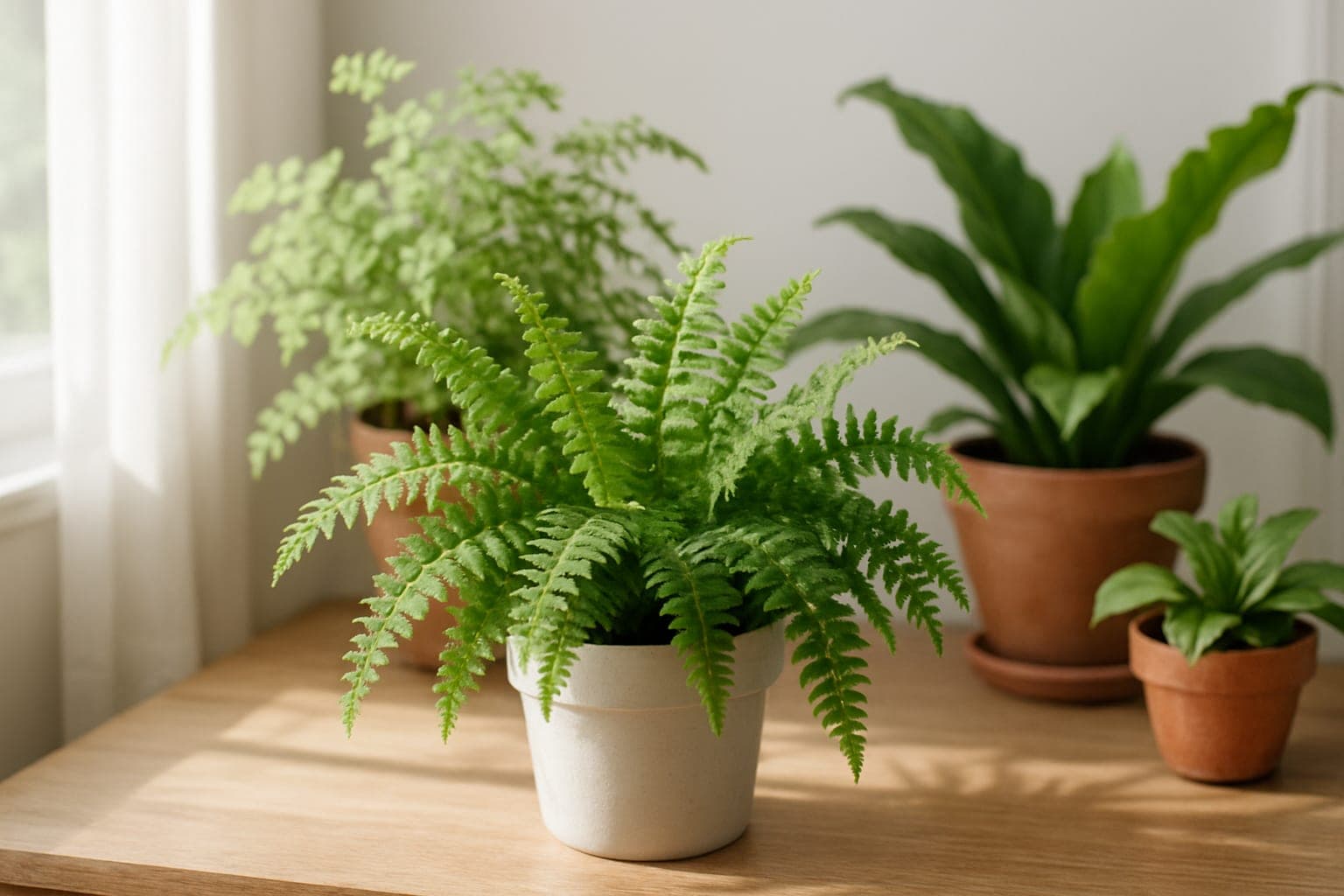
Ferns are some of the oldest plants on earth, evolved for shaded forest floors where the air is damp and the soil never quite dries out. Recreating those conditions inside a centrally heated home is the main challenge of fern care. Get the humidity, moisture and light right, and ferns will reward you with arching, feathery fronds for years.
Meet the three most popular indoor ferns
Boston fern (Nephrolepis exaltata)
The classic hanging-basket fern, with long, gracefully arching fronds. Boston ferns are the most forgiving of the three but still drop leaflets dramatically if they dry out or sit in dry air. They appreciate space around them so the fronds can breathe and arch naturally.
Maidenhair fern (Adiantum)
Delicate, fan-shaped leaflets on wiry black stems. Maidenhairs are the divas of the fern world: they crisp at the slightest dryness, dislike draughts, and need genuinely humid air. Worth the effort for their fine, lacy texture, but best suited to bathrooms, kitchens or a terrarium.
Bird's nest fern (Asplenium nidus)
The easiest of the three. Instead of feathery fronds, it grows broad, glossy, undivided leaves from a central rosette that looks a little like a nest. It tolerates lower humidity better than its cousins and is a good choice if you want a fern that won't sulk in average room conditions.
Light
All three ferns want bright, indirect light. Think of dappled light filtering through a forest canopy. An east-facing windowsill is ideal, or a spot a metre or two back from a south or west window. Direct midday sun will scorch the fronds, leaving pale or bleached patches that turn brown.
They will cope with lower light than many houseplants, but growth slows and the plant becomes leggy and sparse. If a fern is reaching towards the window or producing thin, weak new fronds, move it somewhere brighter.
Watering and humidity
This is where most ferns fail indoors. Their thin fronds and shallow roots cannot tolerate drying out, but soggy compost will rot the crown.
- Keep the compost consistently moist, like a wrung-out sponge. Check every few days by pressing a finger into the surface.
- Water thoroughly until it runs from the drainage holes, then tip away any water left in the saucer after ten minutes.
- Use tepid water. Cold water from the tap can shock the roots.
- Maidenhair ferns in particular hate going dry even once — a single missed watering can crisp the whole plant.
Humidity matters just as much as soil moisture. Most homes, especially in winter with the heating on, sit at humidity levels far below what ferns enjoy. Signs of dry air include crispy frond tips, browning edges and dropping leaflets.
To raise humidity:
- Group ferns with other plants so they share transpired moisture.
- Stand the pot on a tray of damp pebbles, keeping the pot itself above the waterline.
- Run a small humidifier nearby — by far the most effective method.
- Site the plant in a steamy bathroom or kitchen if light allows.
Misting helps briefly but is not a substitute for genuinely humid air.
Soil and potting
Ferns want a light, airy compost that holds moisture without becoming waterlogged. A peat-free houseplant mix with extra perlite works well, or you can blend standard houseplant compost with a handful of coco coir and a little orchid bark for structure.
Always pot into a container with drainage holes. Ferns hate sitting in water, despite their love of moisture — there is a difference between damp and saturated. Repot in spring every couple of years, or when roots are circling the pot. Bird's nest ferns prefer to be slightly snug; avoid jumping up more than one pot size at a time.
Feeding
Ferns are light feeders. From spring through early autumn, give a balanced liquid houseplant feed at half the recommended strength roughly once a month. Strong fertiliser will burn the delicate roots and scorch the frond tips. Stop feeding in winter when growth slows.
Why are the fronds going brown and crispy?
This is the single most common fern complaint. The likely causes, in rough order:
- Low humidity — brown, papery tips on otherwise green fronds.
- Underwatering or inconsistent watering — whole fronds crisp from the tip inwards.
- Direct sun — bleached or scorched patches in the middle of fronds.
- Cold draughts or hot radiators — sudden browning, often on one side.
- Overfeeding or hard tap water — brown tips with a build-up on the soil surface. Try rainwater or filtered water.
- Overwatering — yellowing fronds and a soft, rotting crown, especially in bird's nest ferns.
Trim crispy fronds off at the base with clean scissors. New growth should appear from the centre of the plant if conditions improve.
Pests and common problems
Ferns are generally not pest magnets, but watch for scale (small brown bumps on stems and the undersides of fronds) and mealybugs (white, cottony tufts in leaf joints). Wipe off what you can with a cotton bud dipped in diluted washing-up liquid; insecticidal sprays can damage delicate fronds, so spot-treat rather than soaking the plant.
If the centre of a bird's nest fern turns mushy and brown, that's crown rot from water sitting in the rosette. Always water around the edge of the pot, never into the nest itself.
The takeaway
Ferns aren't difficult so much as particular. Give them steady moisture, humid air, gentle light and a sheltered spot away from draughts and radiators, and they'll settle in beautifully. Start with a bird's nest fern if you're new to them, work up to a Boston, and only tackle a maidenhair once you've got your humidity sorted.
Tools and supplies for this
Products we'd actually buy for this job. Linking to Amazon — if you buy through these links we earn a small commission at no extra cost to you.
- Weston Mill Pottery Terracotta plant pots, 175mm (pack of 10)
Mid-size workhorse terracotta — perfect step-up for plants outgrowing their nursery pots.
- Weston Mill Pottery Terracotta plant pots, 20cm (pack of 5)
Heavyweight 20cm clay for established plants — the porous walls help prevent the soggy roots aroids hate.
- Whitefurze G04012 7.5cm Garden Pot - Terracotta (Set of 10)
Cheap, cheerful plastic propagation pots — what we actually use for cuttings and small offsets.
- Whitefurze G04013 10cm Garden Pot - Terracotta (Set of 7)
Reliable mid-size nursery pots with proper drainage holes — the boring essential every plant parent runs out of.
BotanicBuddy Editorial Team
Plant Care Team
Passionate about helping plant parents succeed with expert tips and proven techniques.
Related Articles
Monstera Deliciosa Care Guide
The Monstera deliciosa, or Swiss cheese plant, is a rewarding tropical climber prized for its dramatic split leaves. This guide covers everything from light and watering to moss poles and the secrets behind those iconic fenestrations.
Seasonal Plant Care: Adjusting for the Changing Year
Adapt your plant care routine throughout the year to keep your houseplants healthy and thriving.

Comments(528)
I've learned the hard way that ferns really do need that humidity—I killed my first maidenhair by treating it like my other houseplants. Now I keep a couple of ferns on a pebble tray with water, and they're finally thriving alongside my other tropical plants. Thanks for the reminder on the specific needs for each type, because Boston and bird's nest are definitely more forgiving than maidenhair.
I appreciate the focus on humidity—that's where most people struggle indoors. I've had better luck with *Nephrolepis exaltata* (Boston fern) when I stopped obsessing over constant moisture and instead used a pebble tray with water underneath, which gives steady humidity without waterlogging the roots. Maidenhair ferns (*Adiantum*) are trickier in temperate climates though, and I've mostly accepted they need more coddling than my other herbs and houseplants.
The pebble tray approach is solid—I've had the same experience with Boston ferns thriving on that steady ambient humidity rather than daily misting. That said, I'd push back slightly on maidenhair being impossible in temperate climates; I grew one successfully for a couple years by keeping it in a bathroom with warm showers and spotty bright light, though honestly it wasn't worth the fussing compared to my other fifteen plants. In tropical conditions they'd barely need attention, but they're definitely the high-maintenance choice indoors if you're not in the right climate.
I've kept one succulent for years in tropical humidity, so I'm honestly curious whether ferns would actually thrive in my setup—though they seem like the opposite of what I'm used to managing. The humidity part I get, but I've heard maidenhair ferns especially will drop leaves if the soil dries out even slightly between waterings, which sounds exhausting. Does the post cover how often that actually needs to be, or is it more general advice? I'd rather know the real frequency than another "keep consistently moist" situation.
Maidenhair ferns *are* genuinely demanding—I learned that the hard way when mine shed half its fronds in a week during my first winter here in the cold climate! For me, checking the soil every other day and watering when just the top feels slightly dry has been the sweet spot, but honestly, it depends so much on your pot size and air circulation. Since you're used to tropical humidity, the good news is that's actually the harder part to nail down indoors—have you considered grouping plants together or misting, or does your setup already stay pretty humid?
I'd push back gently on the "fussy" label—I've found ferns are actually pretty straightforward if you match the right species to your setup. Boston ferns genuinely want consistent moisture and humidity, but maidenhair and bird's nest are far more forgiving than they're given credit for. I killed my first maidenhair trying to recreate a rainforest; once I accepted my apartment's dryness and backed off the misting, it thrived. Soil that stays evenly moist (not wet) and indirect light sorted both mine out.
I've been battling with a maidenhair fern for two years now—it's definitely the pickiest plant in my collection of 15! My game-changer was moving it away from my heating vent and misting it almost daily, which sounds excessive but honestly made all the difference in my dry climate. Are you finding that one species is easier than the others to keep happy indoors, or do they all need basically the same TLC?
I've learned the hard way that consistency matters more than perfection with ferns—I killed two maidenhair ferns (Adiantum raddianum) before realizing they just needed steady moisture and humidity rather than the dramatic swings I was giving them. Now I keep mine on a pebble tray with water and mist every couple days, and they're finally thriving alongside my other tropical plants. The bird's nest fern (Asplenium nidus) is honestly more forgiving if you can nail the humidity part.
Ferns are honestly harder work than they're worth for me—I'd rather spend my energy on my orchids, which are way more forgiving in my cold apartment. That said, if someone's dead set on ferns, the bird's nest varieties are genuinely the easiest of the bunch; they're less neurotic about humidity swings than maidenhair. I'd be curious what your take is on watering frequency in winter, since that's where most people seem to mess up.
I've killed more maidenhairs than I care to admit—they really do hate inconsistent moisture and dry air. The one thing that actually worked for me was grouping my ferns together on a humid corner shelf away from vents, which creates a microclimate they seem to tolerate. Boston ferns are more forgiving in that setup, but honestly, after a decade of plant care I've accepted they're just not my thing and stick with my orchids instead.
I've killed more maidenhair ferns than I care to admit—turns out my arid climate is basically their kryptonite! I've had much better luck grouping my three plants together on a pebble tray with water; the collective humidity they generate actually keeps them from staging their usual dramatic collapse. Definitely worth trying before you give up on them.
I've always found ferns challenging in my arid climate, so I really appreciate posts like this that break down the humidity piece. My two orchids do fine with my dry air, but I know *Nephrolepis exaltata* and the maidenhair varieties need something quite different. Are you finding that a pebble tray actually makes a meaningful difference for your indoor setup, or do most people end up needing a humidifier to make it work?
I'm with you on the arid climate challenge—my Mediterranean setup favors orchids too. From my experience, pebble trays help but honestly won't solve the core issue for *Nephrolepis* or maidenhair ferns in truly dry air. They're more of a supplementary boost than a replacement for consistent humidity. I found that grouping ferns together and misting regularly gets better results than relying on trays alone, though a small humidifier nearby makes the real difference if you're serious about keeping them thriving.
I've had mixed success with ferns over the years—my maidenhair (Adiantum raddianum) nearly died twice before I realized it needed consistent moisture without waterlogging, which is honestly a tightrope walk. I've had better luck with bird's nest ferns (Asplenium nidus) since they're more forgiving about drying out slightly between waterings. Have you found one of these three species notably easier to maintain indoors than the others?
I'd push back a bit on the "fussy" label—I've found they're more forgiving than people think if you stop overthinking the humidity part. A regular misting routine honestly does less than just placing the pot on a pebble tray with water does, and I water mine when the top inch feels dry rather than sticking to some rigid schedule. That said, maidenhair ferns genuinely do seem pickier than the others you mentioned, so fair warning there.
I've had mixed luck with ferns honestly—my maidenhair basically gave up on me, but the bird's nest fern in my kitchen actually thrives, probably because I use it to catch the humidity from steam when I'm cooking with my herbs. Are you covering the watering schedule in detail? That's what I struggled most with, since I kept second-guessing whether the soil was too wet or too dry.
I've killed more maidenhair ferns than I'd like to admit before realizing they just need *consistent* moisture—not soggy, but never fully dry either. My best luck came from grouping them together in a corner where they create their own little humid microclimate, honestly. It's made a bigger difference than my frequent misting ever did!
I've killed more maidenhair ferns than I'd like to admit before realizing mine just needed to sit on a pebble tray with water—the humidity made all the difference. Boston ferns are more forgiving in my tropical space, though they still sulk if I let the soil dry out completely. Thanks for the reminder about bird's nest ferns too; I keep meaning to try one since they seem less dramatic than their cousins.
I've always found ferns challenging in my arid climate, though I picked up one Boston fern a few years back just to see if I could crack the humidity puzzle. Your point about them being fussy really resonates—they seem to demand so much more attention than my orchids do. Have you had better luck with any particular species, or do you find they all need pretty similar conditions indoors?
I've killed more maidenhair ferns (Adiantum) than I care to admit—they really do hate drying out between waterings, and my cold, dry winters make it nearly impossible without a humidifier running constantly. I've had better luck with bird's nest ferns (Asplenium nidus) in the same conditions since they're a bit more forgiving. Did you find one of these three species easier to maintain than the others when you were testing them out?
I've been wanting to try maidenhair ferns for ages but kept chickening out—they have such a reputation for being dramatic! My one plant collection is mostly herbs like Ocimum basilicum and Mentha spicata, so I'm used to things that are a bit more forgiving in a temperate climate. Do you find that one of those three species is genuinely easier to keep happy, or are they all equally needy about humidity? I'm curious if there's a trick I'm missing since I see them thriving in some homes but struggling in others.
I killed two maidenhair ferns before realizing the real problem wasn't humidity—it was water quality. My tap water has too much mineral content, and the fronds just browned no matter what. Switched to distilled water and suddenly it thrived. Worth mentioning alongside the usual humidity advice since it's such a common stumbling block in dry climates.
I've had mixed luck with ferns indoors—my maidenhair (Adiantum raddianum) was a total drama queen until I figured out that misting alone wasn't cutting it. Have you found that a pebble tray with water underneath actually makes a difference, or is consistent soil moisture really the main thing? I'm in a pretty dry climate, so I'm always looking for realistic humidity tricks that don't require me to basically live in the bathroom!
I appreciate the focus on humidity since that's genuinely the make-or-break factor indoors, though I'd gently push back on the "fussy" label—I find ferns are more predictable than finicky once you understand they're essentially asking for consistent moisture and air circulation rather than the drama people often assume. Coming from an arid climate myself, I've had better luck grouping them together to create their own little microclimate than fussing with individual misters.
I've got a Boston fern that nearly died on me before I realized the issue—I was watering on a schedule instead of checking the soil first, which is a mistake with ferns in a cold climate like mine. Now I mist mine a few times a week and keep the soil consistently moist (not soggy), and it's finally thriving. Do you have any tips for maidenhair ferns specifically? They seem even more dramatic about humidity than my Boston, and I'm wondering if there's a trick I'm missing with those.
I've been trying a maidenhair (*Adiantum*) for a few months now and it's been humbling—mine keeps getting crispy despite misting daily. I'm wondering if the issue is something else, like air circulation or mineral buildup in my tap water? Also, I'm curious whether the humidity needs are really the same across all three species you mentioned, since bird's nest ferns (*Asplenium nidus*) seem structurally so different from the feathery ones.
I've learned the hard way that ferns really do need that humidity boost—I killed a maidenhair fern by just misting it occasionally, which honestly felt like a waste! Now I keep one on a pebble tray with water underneath, and it's been so much happier. Do you find that certain ferns do better in bathrooms, or is that just a myth I picked up somewhere?
I've been struggling with my maidenhair fern for months, so this is perfect timing! I'm curious though—you mention they're fussy about humidity, but I live in a pretty dry Mediterranean climate. Do you think a pebble tray with water would be enough, or am I fighting an uphill battle with these particular ferns?
Honestly, a pebble tray helps but won't fully solve it in a truly dry climate—I learned that the hard way with my maidenhair. What actually worked for me was grouping plants together to create a humid microclimate, and misting every couple days (I keep a spray bottle right next to mine now). If you're set on maidenhair, it might stay stressed, but bird's nest ferns are way more forgiving in dry air, so you could swap if you're tired of fighting it.
I've been wanting to try ferns for a while but got intimidated by the humidity thing—do you find a pebble tray actually makes a noticeable difference, or is it more of a minor help? I'm in the desert so I'm already struggling with my tomatoes drying out, and I'm wondering if ferns are just a losing battle for my space.
I totally get the intimidation—I killed my first maidenhair fern spectacularly! That said, the pebble tray genuinely helped me more than I expected, especially since I'm in a drier climate too. I'd say it's worth trying before you give up, though maybe pair it with grouping your ferns together (they create their own little humid microclimate) rather than scattering them around. If you're already managing tomatoes in the desert, you've got the discipline for ferns—it's just a different watering rhythm!
I'd push back slightly on the "fussy" label—in my experience, most indoor ferns fail because of *inconsistent* watering rather than the plants themselves being difficult. I keep a Nephrolepis exaltata in a bright bathroom where it gets passive humidity from showers, and it thrives with zero fussing. The real trick is matching the species to your actual conditions: maidenhair ferns (*Adiantum*) genuinely want consistent moisture, but bird's nest (*Asplenium nidus*) tolerates drier air better than people think. Picking the right one for your home beats fighting the plant's nature.
I've struggled with ferns more than anything else in my collection—maidenhair especially seemed determined to crisp up on me! The humidity thing finally clicked when I started grouping mine together on a pebble tray with water; I noticed the difference within days. Are you finding that certain fern types do better in specific room locations, or is consistent humidity the real game-changer regardless of placement?
I've learned the hard way that ferns are basically tiny humidity drama queens—my maidenhair went crispy within a week of bringing it home! I'm curious whether you find that grouping ferns together actually helps maintain that humidity they crave, or if a pebble tray under each one does the trick?
I've had mixed success with ferns over the years, honestly. My maidenhair (Adiantum raddianum) always seemed to dry out no matter what I did, but I've found that grouping plants together helps create that microclimate they crave—especially in my arid climate where humidity can dip below 20%. I'm curious whether you've found certain fern species more forgiving than others, or if it really just comes down to nailing the watering routine?
I've had better luck with my *Nephrolepis exaltata* once I stopped obsessing over daily misting and instead grouped it with my other tropical plants on a pebble tray—the collective transpiration keeps humidity steady without the constant fussing. The maidenhair (*Adiantum*) is still finicky with me, but the bird's nest (*Asplenium nidus*) has been surprisingly forgiving as long as the soil stays consistently moist, never soggy.
I'd push back slightly on the "fussy" reputation—I've found ferns are really just finicky about *consistency* rather than complicated care. The biggest shift for me was accepting that they want soil that stays slightly moist (not soggy, not dry) and grouping them together so they create their own humidity pocket, rather than obsessing over misting. That's honestly easier than babying a temperamental succulent.
I've been wanting to try ferns for a while now, but I'm honestly a bit nervous about the humidity thing. My collection is mostly succulents that thrive on neglect, so the opposite approach feels daunting. Do you find that misting really makes a difference, or is there a simpler way to keep them happy in a drier home?
I've been eyeing a Boston fern for months but kept talking myself out of it—humidity sounds intimidating when I'm barely keeping my basil alive! But this makes it sound more manageable than I expected. Quick question: would misting daily actually work for someone in a drier climate, or is that a losing battle? I'm in a mediterranean zone where everything wants to crisp up, so I'm wondering if a pebble tray might be my secret weapon here.
I've got three plants at home and honestly ferns seem way harder than my orchid, which I'm still figuring out. The humidity thing is what's throwing me—I live in a temperate climate so it's pretty dry most of the time. Do you find a pebble tray actually makes a real difference, or is that just something people say works? I'd love to try a Boston fern but I don't want to kill it in a month.
I love this focus on the specific species—so many people lump all ferns together and then wonder why their maidenhair dies within weeks! I've had better luck with Asplenium nidus (the bird's nest) than the others, honestly, especially in my dry Mediterranean climate where I basically have to mist constantly or use a pebble tray. Are you finding that humidity management is the biggest hurdle for your readers, or do you see watering frequency trip people up just as often?
I appreciate the focus on humidity—that's really the crux of indoor fern success, especially with *Adiantum* species, which are notoriously finicky about dry air. My collection leans toward succulents adapted to Mediterranean conditions, so ferns have always been my opposite challenge, but I've had decent results misting *Asplenium nidus* regularly and grouping it with other plants to create a microclimate. Would be curious to hear your specific recommendations for maintaining moisture without creating root rot issues.
I've been struggling with ferns—had a maidenhair that basically dissolved on me after a week. My place is pretty dry (Mediterranean climate), so I'm curious whether a humidity tray would actually make enough difference or if I should just stick to the hardier types like bird's nest? I have 6 plants total and most do fine with my watering schedule, but ferns seem to need something completely different. Would love to know if anyone's had success with them in drier conditions.
I'd honestly skip the maidenhair in a dry climate—humidity trays help a bit, but they're fighting a losing battle without consistent moisture in the air. Bird's nest ferns are genuinely the move for you; they're far more forgiving and still give you that texture without the daily stress. I've found the real trick with any fern in drier conditions is watering more frequently but lighter, rather than deep soakings—keeps the soil consistently moist without waterlogging, which is usually what finishes them off.
I get it—maidenhair is basically impossible in dry air. I killed mine trying to mist it constantly, which apparently wasn't even enough. A humidity tray might help a bit, but honestly, if your place is consistently dry like that, bird's nest ferns are probably your best bet. I'm still learning myself (only got 3 plants), but I've read that bird's nest actually tolerates lower humidity way better than the delicate types. If you really want to try ferns again, maybe start with that one and see if it sticks around longer?
I've been wanting to try ferns for ages but kept hearing they're difficult, so this is really helpful. My apartment is pretty dry though—I have a Mediterranean climate setup that works great for my succulents, but I'm wondering if ferns would even survive in the same space? Would grouping them together actually help with humidity like I've read, or should I just stick with what I know.
Ferns and succulents are honestly tough roommates in an arid climate—they want opposite things. Grouping ferns does help with humidity, but in a dry Mediterranean setup you'd likely need to mist regularly or invest in a humidifier to keep something like Adiantum capillus-veneris truly happy. Have you considered trying just one fern in a more controlled spot, like a bathroom, before committing to changing your whole setup?
I've been slowly converting my apartment into a fern graveyard—mostly maidenhairs that looked at me funny and decided to crisp up anyway. The humidity piece is what finally clicked for me; I realized I was watering them fine but basically keeping them in the Sahara. Since you mention specific varieties, I'm curious whether you've found Boston ferns easier to keep alive than the maidenhairs, or is that just my imagination?
I've had mixed luck with ferns over the years—my maidenhair is honestly still temperamental despite being in my collection for almost three years now. The humidity thing is real; I finally got mine to stop browning at the tips once I moved it closer to a humidifier in winter. Are you finding that one of those three types is easier to manage than the others, or do you have tricks for all of them? I'd love to know because I'm thinking about trying a bird's nest fern next and I want to set myself up for success this time!
I've killed more maidenhairs than I'd like to admit before I realized mine needed constant moisture but *not* waterlogging—I now keep mine on a pebble tray with water that never touches the pot directly, and it's made all the difference. The humidity thing is real, especially in tropical climates where people assume it's automatic, but even here my ferns do better clustered together than scattered around.
Oh man, the pebble tray trick is genius—I'm stealing that! I've got a Boston fern that's been borderline dramatic, and I think I've been overwatering out of guilt. Your point about clustering really resonates with me too; I grouped mine with a pothos and a nerve plant last month just for space, and honestly everything perked up. Do you find the humidity boost helps enough that you need to mist less, or are you still doing both? I'm in a pretty dry Mediterranean climate, so I'm always hunting for low-effort humidity solutions.
I've killed more maidenhair ferns than I care to admit—they seemed to wilt the moment I looked at them in my dry Arizona apartment. Eventually I learned that grouping them together actually helps trap humidity around each plant, and now I keep mine on a pebble tray with water underneath. Ferns are definitely the opposite of my orchids, which honestly prefer neglect, but there's something satisfying about finally getting one to thrive after so many brown frond casualties.
I killed my first maidenhair fern by watering it on a schedule instead of checking the soil first—lesson learned the hard way. Now I keep mine in a bathroom where the humidity stays naturally high, and it's finally thriving. I'm curious to try a bird's nest fern next since I've heard they're a bit more forgiving, so this post came at the perfect time.
I appreciate the focus on humidity since that's where so many people stumble with ferns indoors. I grow orchids in an arid climate, so I've had to get creative with microclimates—clustering plants together and using pebble trays has made a real difference. Do you find that misting helps as a temporary fix, or does it mostly just give a false sense of progress?
I've had mixed success with ferns over the years—they're definitely one of the pickier plants in my collection. The humidity piece is real, especially in my dry climate where I'm constantly misting or grouping them together to create a moister microclimate. I'm curious whether you found one of those three types easier to manage than the others, or do you think it really comes down to individual growing conditions.
I've had decent luck with my bird's nest fern, but maidenhair is honestly still my nemesis—I feel like it drops fronds if I so much as look at it wrong! Do you find that misting actually helps, or is it more about ambient humidity? I'm in a pretty dry climate, so I've been considering moving my ferns to a bathroom setup, but I'm curious if that's overkill or if you've seen real results from that approach.
I appreciate the focus on humidity—that's where most indoor fern keepers struggle. Though I'll say, coming from a succulent background where I'm basically fighting *against* moisture, I've found that ferns aren't quite as needy as their reputation suggests if you nail the watering rhythm. The real trick seems to be consistency rather than constant misting, which I see recommended everywhere. Have you found that works better in your experience with these three species?
I'd gently push back on the "fussy" label—I find they're more predictable than finicky if you match humidity to the species. Nephrolepis exaltata (Boston fern) genuinely needs 50%+ humidity, but Asplenium nidus tolerates drier air better than most people think. The real trick is consistent moisture without waterlogging, which honestly applies to most houseplants. I keep three ferns and they're among my most reliable growers once you stop overthinking it.
You've hit on something I really appreciate—the species-specific approach makes all the difference. I've had similar success with Asplenium nidus once I stopped expecting it to want the same conditions as my Nephrolepis, and you're right that consistent moisture without soggy soil is the real game-changer. My Mediterranean climate actually works against me here, so I'm curious how you manage that balance with humidity indoors without it becoming a chore—do you rely on grouping, pebble trays, or something else entirely?
I've got to admit, ferns have humbled me more than any other plant in my collection—I killed two maidenhairs before I finally figured out they actually *like* staying consistently moist, which totally goes against my instinct with my succulents. Now I keep mine in a bathroom where the shower steam does half the work, and it's thriving! This post would've saved me so much grief back then.
I've had decent luck with ferns over the years, but honestly I find them more finicky than they're worth in my tropical setup—I grow vegetables mostly and just don't have the consistent humidity control those things demand. That said, if someone's committed, a pebble tray with water underneath actually works better than I expected, and I'd skip misting entirely since it just breeds fungal issues. My bird's nest fern lives, but my maidenhair gave up the ghost within months, so I'd love to see a post on which varieties are genuinely low-maintenance versus which ones need babysitting.
I've learned the hard way that ferns are basically tiny humidity divas—I killed a maidenhair by giving it the same care as my other tropicals, which was apparently a crime against nature. Since then I've had decent luck grouping my Boston and bird's nest ferns together on a pebble tray, which at least makes me feel like I'm doing *something* to raise the moisture around them. Have you found that consistent moisture matters more than the actual humidity level, or is it really both-or-nothing?
Ferns have never worked out for me, honestly—I've got four succulents thriving in my south-facing window, and that's where my skills lie. The constant humidity ferns demand just doesn't match my arid climate or my watering style, which is basically "neglect until they're bone dry." That said, I appreciate this post because it's realistic about the fussiness; too many guides gloss over how much babying *Adiantum* species actually need indoors.
I've had my share of crispy maidenhair ferns over the years before I figured out that they really do need that consistent moisture and humidity. Now I group mine together near a bathroom window where the air stays naturally damp, and they've finally stopped dropping leaves on me. Boston ferns are more forgiving, at least in my experience, so those made a good starting point before I tackled the pickier varieties.
I really feel you on the maidenhair casualties—I've definitely contributed to the crispy leaf pile myself! Your grouping trick is genius though; I've borrowed that idea for my orchids in this dry Arizona climate, and it's made such a difference. Even though orchids are my thing, I respect ferns for being honest about what they need rather than just silently suffering like mine did before I figured out they wanted more air circulation around the roots.
I've killed more maidenhair ferns than I care to admit before learning this the hard way—they absolutely despise drying out between waterings, even for a day. I now keep mine on a pebble tray with water and mist it every other day, which has been a game-changer in my cold, dry apartment. Have you found any particular fern species that's more forgiving than the others, or do they all pretty much demand consistent humidity?
I've learned the hard way that ferns are basically tiny drama queens—my first maidenhair fern looked like it had survived a desert before I realized it was screaming for humidity! I'm excited to try the tips here since I'm growing most of my tropical collection in a pretty dry climate. Do you find that one of these three species is significantly more forgiving than the others, or are they all equally fussy about their conditions?
I've killed my share of maidenhairs, so I really appreciate the straightforward approach here! My one concrete tip: I stopped obsessing over misting and instead grouped my ferns together on a pebble tray with water—they seem to prefer the ambient humidity boost over the fussy daily spray routine. It's made a real difference with my Boston fern especially.
I've had mixed luck with ferns—they're honestly not my go-to for a cold climate like mine since the dry air from heating just fights against what they need. That said, I've kept a bird's nest fern alive by grouping it with my herbs near a humidifier, which actually helps both. Did you find one variety significantly easier to maintain than the others, or do they all pretty much demand the same humidity level?
I've found ferns are less fussy than they're made out to be—the real issue is that most guides overemphasize humidity. What actually matters is consistent moisture in the soil and air circulation; I've kept a Boston fern healthy for years just by misting weekly and keeping it away from heating vents, no pebble trays needed.
I'd agree with that take. I killed my first maidenhair (Adiantum) by obsessing over a pebble tray, but my second one thrives on a shelf where it gets incidental humidity from a nearby bathroom and consistent watering. The air circulation point is spot-on too—I've noticed my ferns actually struggle more in still, damp corners than in slightly drier spots with decent airflow, which seems counterintuitive but makes sense for preventing fungal issues.
I've kept ferns in my tropical setup for years and honestly, the humidity thing is overblown—they just need consistent moisture at the roots and good air circulation. Maidenhair is genuinely difficult though; I've had better luck with bird's nest, which tolerates drier air better than people think. My main tip: underwater less frequently than you'd guess, but when you water, actually water it rather than just misting the leaves. I could show you a photo of my bird's nest from last month if you wanted to see what healthy fronds look like.
I completely agree about the maidenhair—I killed two before giving up on that one. My bird's nest has actually thrived since I stopped fussing with it and switched to thorough watering on a schedule instead of constant misting. The frond growth is noticeably better, and it's way less fussy than I expected. Would love to see that photo of yours; mine's finally putting out some solid new growth and I'm curious how it compares.
I've had mixed success with ferns over the years—they really do demand that consistent humidity, which isn't easy in my arid climate. I've found that grouping them together helps create their own little microclimate, and I'm curious whether you recommend misting as a primary humidity strategy or if you find other methods work better for these species indoors.
I've learned the hard way that ferns really do need that humidity—I killed my first maidenhair by just misting it occasionally! Now I keep mine on a pebble tray with water underneath, and it's made such a difference. Are you finding any of these three are easier to start with for someone just getting into ferns, or do they all demand roughly the same conditions?
Oh, the pebble tray trick—I need to try that! I've been struggling with my maidenhair (Adiantum) too, and honestly didn't realize how much humidity it actually needed. My bird's nest fern seems more forgiving so far, which makes me wonder if the Asplenium nidus is just naturally more adaptable, or if I'm just lucky. I'm curious whether you've found one of these three is genuinely the easiest to start with, since you seem to have worked through the learning curve!
I'd gently push back on the "fussy" label—ferns are really just adapted to specific conditions, and once you understand that, they're quite predictable. I keep a *Nephrolepis exaltata* in a bright bathroom where humidity naturally stays high, and it thrives with minimal fuss. The real issue is matching the species to your home's actual microclimate rather than forcing a maidenhair into a dry living room and wondering why it struggles.
I've had mixed luck with ferns honestly—they're beautiful but way thirstier than my herbs! My maidenhair kept dropping fronds until I started misting it daily and moving it away from my radiator. Do you find humidity domes help, or is consistent misting enough? I'm curious because I've got a bird's nest fern that's been doing okay on a pebble tray, but I'm wondering if I'm just getting lucky.
I totally relate to the fussiness—my maidenhair (Adiantum) was dropping fronds constantly until I realized my space wasn't humid enough either. I haven't tried humidity domes, but I've had better results combining daily misting with a pebble tray than relying on either alone, so I think you're onto something solid with yours! The radiator issue is huge; I moved mine farther away and that made a real difference. Curious if you've noticed whether the pebble tray alone keeps your bird's nest fern happy, or if you still mist it regularly too?
I love that you're tackling ferns—they really do transform a space! Though I'd gently push back on the "fussy" label; I've found they're less finicky than people think, just *different* from typical houseplants. I keep a Nephrolepis exaltata and a couple others, and honestly the biggest shift for me was accepting they don't want to dry out between waterings the way succulents do. My question: are you finding the humidity piece harder to manage in a drier climate, or is that mostly a winter issue for you?
I'd gently push back on the "fussy" label—I've found that ferns aren't so much demanding as they are *consistent* in what they need. The real trick is that Nephrolepis exaltata and Adiantum species genuinely prefer evenly moist (not soggy) substrate and ambient humidity around 50–60%, which most homes can achieve with a pebble tray or grouping plants together rather than misting alone. I keep three ferns in my temperate zone and honestly find them more forgiving than people expect once you dial in those two factors.
You're absolutely right about the consistency angle—I've killed more ferns by being *inconsistent* with watering than anything else! I keep an orchid in my arid climate (alongside 13 other plants that tolerate the dry air better), and I've learned that ferns are just fundamentally different beasts. The pebble tray trick has been a game-changer for me; I wish I'd tried it years ago instead of futilely misting every other day.
You've nailed it—I really appreciate reframing "fussy" as "consistent," because that's exactly what I've experienced too. The pebble tray method has been a game-changer for me in my arid climate; I honestly struggled with misting until I started grouping my plants and letting them create their own microclimate. It makes such a difference with humidity-sensitive species like Adiantum. Have you found that the grouped arrangement affects your watering schedule at all, or does the soil moisture stay pretty stable for you?
I've been wanting to try a fern for ages but honestly got intimidated by all the humidity talk. Your post makes it sound more doable though, which is encouraging since I have limited space in my cold climate apartment. Do you find that misting actually makes a real difference, or would a pebble tray work just as well?
I've killed more maidenhair ferns than I'd like to admit—turns out my idea of "consistent moisture" was wildly inconsistent! I've had much better luck grouping my ferns together (currently nursing three of them) since they seem to appreciate the collective humidity and keep me honest about not forgetting to mist. Are you finding that certain fern varieties forgive the occasional dry spell, or is humidity really non-negotiable for all of them?
I'm right there with you—I've definitely left a maidenhair (Adiantum capillus-veneris) looking like sad brown lace more than once! The grouping trick really does work; I keep mine clustered near a tray of pebbles and water, and it's made a huge difference. That said, bird's nest ferns (Asplenium nidus) are genuinely more forgiving of slightly drier air than maidenhairs, so if you're looking to expand your fern squad without constant anxiety, those might be worth trying alongside your current trio.
Oh, I totally get that! I've got a Boston fern that's been my biggest challenge so far—I keep thinking I'm watering enough and then it gets all crispy anyway. Your grouping idea is genius though, I'm definitely stealing that! I've heard bird's nest ferns are supposed to be a bit more forgiving than maidenhair, but I'm still too nervous to test it out since I'm only at 11 plants and don't want to lose any. Have you noticed if your three grouped ferns actually need less frequent misting now, or does humidity still feel like the constant battle for you?
I've learned the hard way that consistency matters more than perfection with ferns—I killed two maidenhair ferns (Adiantum raddianum) before realizing I was letting the soil dry out between waterings. Now I keep mine on a pebble tray with standing water and check the soil every couple of days instead of on a fixed schedule, and they've finally stopped dropping leaflets. The bird's nest fern (Asplenium nidus) has been more forgiving in my collection, but it still appreciates that same humid, evenly moist setup.
I've killed exactly two ferns before learning that my arid climate was basically a fern death sentence—turns out those humidity needs are no joke! I ended up grouping my remaining potted plants together on a tray with pebbles and water to create a microclimate, which has honestly saved my Adiantum capillus-veneris more than any misting ever did. Really appreciate seeing Boston and bird's nest ferns covered here, since they seem more forgiving than maidenhair if you can't maintain that constant moisture.
That pebble tray trick is gold—I did the exact same thing after my maidenhair turned crispy in my apartment! I'm in a cold climate too, so humidity is always my biggest battle. Have you found that grouping really does make a noticeable difference for your other plants, or is it mainly just keeping that one Adiantum happy? I've got about ten plants clustered together now and I'm curious whether the effect compounds or if each plant just benefits from its own little microclimate.
I've been struggling with my maidenhair fern—it kept dropping fronds no matter what I did—so I'm really hoping this post has the answer! I'm guessing humidity is my problem since my apartment is pretty dry, but I'm curious whether the three types mentioned need different levels of care or if they're all equally fussy about watering. I have a Boston fern too and it seems happier than the maidenhair, so maybe there's a species-specific thing going on?
I've been struggling with a maidenhair fern (*Adiantum raddianum*) for months now—the fronds keep browning at the tips despite misting regularly. Does humidity from misting actually penetrate enough, or should I be thinking about a pebble tray or humidifier instead? I'm in a mediterranean climate so the air's pretty dry indoors, and I'm wondering if that's just fighting an uphill battle with tropical ferns when I could be growing something more suited to my conditions.
I've killed more maidenhair ferns than I'd like to admit—they seem to thrive on ignoring me until suddenly they don't! My mediterranean climate is basically their kryptonite, so I've learned to keep mine clustered in a bathroom where the shower creates that humidity pocket they crave. Curious if you've found any fern varieties that tolerate drier air, since my orchids certainly don't need the babying these guys do.
I've been meaning to try ferns indoors, but honestly the humidity thing intimidates me—my place gets pretty dry, especially in winter. Are you finding that misting alone cuts it, or do you really need to invest in a humidifier? I've had way better luck with my herbs (I'm mainly growing Ocimum basilicum right now), which are so much more forgiving about moisture levels. Would love to know if there's a particular species that's actually less fussy than the ones you mentioned!
Misting alone rarely cuts it for ferns long-term—it's more of a morale boost than functional humidity. I'd honestly skip the humidifier investment and instead group ferns on a pebble tray with water, or cluster them together so they create their own microclimate. If your winters are truly dry, though, you might find *Asplenium nidus* (bird's nest) more tolerant than maidenhair, since it's less prone to crispy frond tips. That said, basil is forgiving for a reason—ferns genuinely have different priorities, so it's fair if they're just not your plant style.
I've learned the hard way that ferns really do need that humidity—my maidenhair was dropping leaves until I started misting it every couple of days and moved it away from heating vents. The indirect light part was key too; I had mine too close to a bright window at first and it just wasn't happy. They're worth the extra attention though, because when they're thriving they really do transform a space.
Your maidenhair recovery sounds familiar—I went through the same thing when I first brought mine home. The heating vent issue is so real in tropical climates too, since air conditioning can be just as drying. I've found that grouping my ferns together helps maintain ambient humidity without constant misting, which has been a game-changer for keeping them happy long-term.
I've got a Boston fern (Nephrolepis exaltata) that's been my biggest challenge so far—the fronds keep getting crispy at the edges even though I mist it regularly. I'm in a tropical climate so humidity shouldn't be the issue, but I'm wondering if I'm actually overwatering the soil instead? I'd love to see what your setup looks like for maintaining those moisture levels without waterlogging.
I've kept maidenhair ferns twice and both times they dried out despite my best efforts—they're honestly not worth the frustration for me. Boston ferns are way more forgiving if you can commit to consistent moisture, but I've found herbs like basil and parsley actually thrive in the same humid conditions with a lot less drama. Did you find one variety significantly easier than the others, or do they all need that constant attention to humidity?
I've always found ferns tricky in my arid climate, so I'm curious how you handle the humidity challenge without a pebble tray or humidifier. My 13 plants are mostly orchids that actually prefer drier air, so ferns have been my white whale—do you have any tricks for making them work in low-humidity homes, or are they just not compatible with certain climates?
I totally get it—I've got four plants total and my maidenhair fern was basically a crispy stick until I started misting it daily, which honestly felt ridiculous at first. But here's what actually helped: I moved mine into my kitchen where there's natural humidity from cooking and steam, and that made a huge difference. If your orchids are thriving in arid air though, you might just have a climate that's genuinely better suited to them, and that's okay! Have you tried grouping ferns together to create their own little microclimate, or does your space just not allow that?
I've been growing Nephrolepis exaltata for a few years now and finally cracked the humidity puzzle—turns out a pebble tray with water underneath makes all the difference in my drier Mediterranean climate. The maidenhair ferns are still my greatest challenge though, especially keeping those delicate fronds from browning. Do you find one of these three tends to be more forgiving for beginners than the others?
I've always found ferns a bit trickier than my succulents, honestly. The humidity demand really does separate the casual plant parent from the committed ones—I tried keeping a Nephrolepis in my arid setup and it was a losing battle. That said, grouping them together or keeping them in a bathroom has genuinely transformed how well they do for people I know. Curious if you've found one species more forgiving than the others on that front.
I just killed my second maidenhair fern by letting it dry out—apparently "keep it moist" doesn't mean "check it once a week and hope for the best"! I'm definitely bookmarking this because I'm determined to actually succeed with one of these, especially since I live somewhere cold and dry. Do you have any tricks for maintaining humidity without turning my apartment into a greenhouse?
I feel this in my soul—maidenhair ferns have humbled me more than once! What finally helped me was grouping my ferns together on a pebble tray with a bit of water underneath; they seem to create a little microclimate for each other, and it's honestly less fussy than it sounds. The cold, dry thing is real though, so I also keep mine away from heating vents and mist them when I remember (which, let's be honest, isn't always, but they're more forgiving of *that* than of drying out).
Ferns aren't really my thing—I'm much more comfortable with succulents where underwatering is the bigger risk. That said, I've killed enough maidenhair ferns to respect them; they seem to want constant ambient humidity without waterlogged roots, which is a frustrating balance indoors. Have you found a setup that actually works long-term, or do most people just accept they're temporary plants?
I've learned the hard way that ferns really do demand consistency – I killed my first maidenhair fern by assuming "moist soil" meant the same thing every day, when what it actually needed was that careful balance between damp and soggy. Now I keep mine on a pebble tray with water and mist regularly, and it's honestly thriving better than most of my other houseplants. Thanks for putting together this guide, since humidity is really the make-or-break factor that a lot of people overlook.
I've killed more maidenhair ferns than I'd like to admit—they seemed to resent my every attempt at care until I finally figured out the humidity part. Now I keep mine on a pebble tray with water, and it's actually thriving instead of dropping leaves dramatically. Boston ferns I've had better luck with, though they still feel a bit moody compared to my other tropical plants. Do you find one of these three is more forgiving than the others, or do they all demand basically the same fussy treatment?
I totally get the maidenhair struggles—Adiantum capillus-veneris really does seem to punish you for looking at it wrong. Your pebble tray setup is spot on. I'd actually push back gently on lumping all three together though: bird's nest ferns (Asplenium nidus) are surprisingly more forgiving than maidenhair, and they need less fussing overall. Boston ferns fall somewhere in between for me. After a few years of trial and error, I've found that consistent moisture matters more than perfect humidity for two of them, which has been a game-changer.
Oh, this is so timely—I've killed more maidenhair ferns than I'd like to admit before finally accepting that my arid climate is basically their sworn enemy! I've had much better luck pivoting to orchids, which honestly feel more forgiving in my dry air. That said, I keep one Boston fern in a bathroom corner where it gets the moisture it actually craves, and it's thriving now. Would love to see more tips on humidity hacks for those of us not blessed with naturally damp homes!
I've found ferns to be surprisingly resilient once you stop overthinking the humidity part—my Boston fern (Nephrolepis exaltata) actually thrives in my dry Arizona home with just a weekly misting and consistently moist soil, whereas the maidenhair (Adiantum) genuinely hates that approach and prefers drying out slightly between waterings. The real game-changer for me was realizing they're not all created equal in terms of their fussiness, so grouping them by water preference rather than assuming one routine fits all three species saved me a lot of dead fronds.
I've learned the hard way that ferns really do need that humid air—my maidenhair almost died before I started misting it regularly and grouping it with my other plants so they create their own little microclimate. The watering part took me a while to dial in too, but I found that keeping the soil consistently moist (not soggy) makes all the difference between a happy fern and a crispy disappointment.
I appreciate the focus on humidity—that's really where most people struggle indoors, especially in arid climates like mine. I've found that grouping plants together helps create a microclimate, and I'm curious whether you've had better luck with misting versus other humidity methods, or if it depends on the species?
I'm with you on grouping—it genuinely works better than misting alone, which I've found mostly just wets the fronds and evaporates. For ferns specifically, I've had the best results with a pebble tray under the pot rather than relying on air moisture, though maidenhair is still finicky enough that it might just prefer a bathroom or kitchen where humidity naturally stays higher. Species definitely matters here—bird's nest tolerates drier air better than the others in my experience.
I've had two maidenhairs absolutely shrivel on me before I figured out they really do need that constant humidity—I now keep mine in the bathroom where the shower steam does most of the work for me! Are you finding one species easier to maintain than the others, or do they all demand pretty similar conditions once you nail the humidity part?
I appreciate the focus on humidity since that's where most people struggle—I killed two maidenhair ferns before I realized they needed consistently moist (not soggy) soil and actual air moisture, not just occasional misting. My Boston fern finally thrived once I moved it away from the heating vent and started grouping it with other plants to create a microclimate. That said, I've found ferns aren't really my thing compared to herbs, which are more forgiving in my cold climate. Do you have experience with any cold-hardy fern species, or are these pretty much indoor-only for most people?
I've been trying to keep a Boston fern alive for about three months now, and I'm realizing I probably wasn't misting enough—the fronds kept getting crispy despite watering regularly. This post is helpful because it sounds like humidity matters more than I initially thought, but I'm curious: is there a difference in how often you need to mist versus just keeping the soil consistently moist? I want to try again without overcomplicating things.
I appreciate the focus on humidity—that's where most people fumble—but I'd push back slightly on the "fussy" label. In my experience, ferns aren't temperamental so much as they need consistency; a single dry spell or cold draft does real damage, whereas orchids (my main thing) actually bounce back from occasional neglect. The key is accepting that ferns want their spot and rewards you for leaving them alone once you get it right.
I've been struggling with my maidenhair fern — the fronds keep turning brown at the tips no matter how much I mist it. Is that a humidity thing, or could it be the water itself? I'm in the Mediterranean so the air's pretty dry, and I'm wondering if I need to do something more than just spraying. I'd love to see what works for people in similar climates because all the advice online seems to assume you're in a rainforest!
I totally get the frustration—I had the same browning issue with my maidenhair (Adiantum) until I realized misting alone wasn't cutting it, and I wonder if water quality might be part of your problem too since our tap water can be pretty harsh. I started grouping my ferns closer together and placing them on pebble trays with water, which seems to create a more consistent microclimate without relying on constant spraying. Have you noticed whether the brown tips appear right after dry spells, or is it more constant?
I've killed more maidenhairs than I care to admit before figuring out they actually need consistently moist soil, not soggy. Boston ferns are more forgiving in my experience—I keep mine in a spot with morning humidity from the kitchen and it's thrived for years. The bird's nest fern is the easiest of the three I've tried, though I'm curious whether you find humidity spray actually effective or if you've had better results with other methods?
Ferns have never worked for me indoors, honestly—I've got a succulent setup that suits my space better. That said, I've watched friends struggle most with inconsistent watering rather than humidity itself; they'd let the soil dry out completely, then overcompensate. The trick seems to be keeping it evenly moist without waterlogging, which takes more attention than my Echeveria ever demand.
I totally get that—ferns really aren't for everyone, and succulents are frankly more forgiving! Your point about inconsistent watering is spot-on though; I've killed more *Adiantum* (maidenhair) that way than I care to admit. I've had better luck bottom-watering mine once a week rather than overhead, which keeps the soil evenly moist without me second-guessing whether it needs a drink.
I've been struggling with maidenhair ferns for years until I realized mine was basically suffocating in dry air—I now keep mine on a pebble tray with water and mist it every couple days, which has made all the difference. Are you finding that the humidity trick works better than frequent watering alone, or do you recommend doing both?
I've killed exactly two maidenhair ferns trying to keep them "consistently moist" before realizing my cold apartment just doesn't hold humidity the way the posts assumed—so I'm curious whether you have tips for ferns in drier climates, or if I should stick to my orchids that seem weirdly unbothered by my heating system? It sounds like humidity is the real hurdle here rather than watering difficulty itself.
I appreciate the focus here, though I'll be honest—ferns have never stuck around in my collection for long. I'm much better with succulents like *Echeveria* and *Aloe*, where neglect is actually the strategy. That said, I borrowed a friend's humidifier setup for a *Nephrolepis* once and it made a real difference; the constant fiddling just wasn't worth it for my arid-leaning setup, but if someone's got the patience, this is solid advice.
I totally get that—ferns seem like they demand so much attention. I've killed a couple myself before realizing humidity might be the real issue rather than me just being forgetful. Your point about the humidifier is really helpful though; I'm wondering if there's a middle ground, like grouping them together or using a pebble tray? I'm in a pretty dry climate too, so I'm still figuring out what actually works for my space.
I've killed more maidenhairs than I care to admit—they seem to wilt just from me *looking* at them the wrong way! But this makes me curious: do you find that ferns do better in bathrooms where humidity is naturally higher, or have you had success keeping them thriving in drier rooms with regular misting?
I killed my first maidenhair fern within two weeks—turns out I was watering it like a succulent. Once I started misting and keeping the soil consistently moist (but not waterlogged), it came back beautifully. The humidity trick really made all the difference for me, especially since I live in a tropical area where the air is naturally damp. I'd love to try bird's nest ferns next since they seem a bit more forgiving.
I totally get that maidenhair learning curve—they're dramatic! Since you're in a tropical climate, you're actually in a great spot for bird's nest ferns, though honestly I find them less finicky about misting than maidenhairs. The real thing is keeping them out of direct sun and making sure they have decent air circulation, otherwise they get a bit sulky. Have you had trouble with spider mites in your humidity-heavy setup, or does the tropical air work in your favor there too?
I've been wanting to add a fern to my little herb-focused collection, but I'm honestly intimidated by the humidity thing—my Mediterranean climate is basically the opposite of what they love! Do you find that misting really makes a difference, or is a pebble tray actually the way to go? I'm curious whether the maidenhair (*Adiantum* species) is as dramatic as people say when conditions aren't quite right, since I've heard they can look pretty rough pretty quickly.
I appreciate the focus on those three classics—they really are the gateway ferns for most indoor gardeners. I've found that maidenhair (Adiantum) especially demands that humidity sweet spot, though I'll admit it's been my trickiest species to keep consistent in my arid climate, even more finicky than some of my orchids. Do you find that grouping ferns together helps create that microclimate, or do you rely more on a pebble tray setup?
Maidenhair is definitely the drama queen of the bunch! I've had better luck grouping mine together too—there's something about that collective humidity that individual pebble trays just don't quite match, though I still use trays as backup. Since you're in an arid climate like I am (Mediterranean here), have you tried clustering them near your kitchen or bathroom where there's natural moisture? That's been my secret weapon for keeping them from getting those crispy edges.
I've had mixed success with ferns—killed a maidenhair once by overthinking the watering schedule—but I've found they're honestly less fussy if you stop trying to guess what they want and just commit to a routine spray bottle by the window. My bird's nest fern actually thrives on neglect compared to my herbs, which is oddly humbling!
I totally get that—I killed a maidenhair too before I realized I was basically waterboarding it! The spray bottle routine is genius though. I've had better luck with my herbs by treating them more like ferns actually, especially basil and mint in winter when the air gets dry. Do you find your bird's nest fern prefers being left alone completely, or does it still want that occasional misting?
I've been meaning to give ferns another shot after a couple of failed attempts years ago—they always seemed to dry out on me, probably because I live in such an arid climate. I'm curious whether you've found any tricks for keeping humidity up in drier environments, or if certain species from your list tolerate lower moisture better than others?
I've been struggling with my maidenhair fern for weeks—it keeps dropping fronds no matter what I do. I'm in a mediterranean climate so humidity is basically nonexistent in my apartment, which I'm guessing is the real problem? Would love to know if there's a practical workaround that actually works, or if I should just accept that some ferns aren't for me here.
I love this focus on the humidity-sensitive ones. Boston ferns are so rewarding once you dial in that sweet spot, though I've found they're less forgiving than Nephrolepis exaltata *deserves* to be. My maidenhair has honestly been my trickiest plant—do you find the misting approach works better than the pebble tray method, or does it depend on your local climate?
I've been wanting to try a fern indoors for ages since they'd fit my cold climate setup, but I'm nervous about the humidity thing. Do you find that misting works, or do you use a pebble tray method? I have a small collection going right now and I'm still getting the hang of watering frequency, so I'm curious if ferns are forgiving if you mess up occasionally.
I've had exactly zero luck with ferns—my arid climate seems to actively mock them—but I've picked up that the misting trick everyone mentions only works if you're *consistent* about it, which I decidedly am not. That said, I wonder if there's a middle ground for those of us in drier homes; maybe clustering them together creates enough of a microhumidity pocket? I'd love to hear if anyone's made that work without basically turning a corner of their house into a terrarium.
I'd push back gently on the "fussy" label—I've found they're less finicky than people think, just different. The real game-changer for me was stopping the daily misting nonsense and instead grouping mine together on a shelf; they create their own microclimate and seem happier. My maidenhair especially thrived once I quit obsessing over it and just kept the soil consistently moist (not wet). Worth trying before you assume they won't work in your space.
I appreciate the focus on ferns, though I'd gently push back on the "fussy" label—they're really just straightforward once you stop overthinking the humidity angle. I keep an orchid in a humid growing space and tried ferns there too, expecting them to thrive, but they actually did better in a regular room with consistent watering and better air movement. The real trick is steady moisture without waterlogging, not necessarily misting every other day like people tend to assume.
I totally agree—I've got a succulent-heavy collection and initially thought ferns would be a hard sell in my tropical climate, but consistency beats fussiness every time. Your point about air movement is spot-on; I was surprised how much better mine perked up when I stopped babying it with misting and just let water drain properly and air circulate. Waterlogging kills them faster than low humidity ever will.
I've killed more maidenhairs than I care to admit before figuring out that these guys need *consistent* moisture—not wet, but never fully dry. My game-changer was grouping my ferns together on a pebble tray with water; the humidity they create for each other is way more effective than me misting them daily like I used to. Have you found one species easier to manage than the others, or do they all give you grief?
I've learned the hard way that ferns really do need that humidity! I killed my first maidenhair fern by watering it on a normal schedule—turns out it needed way more moisture in the air, not just the soil. Now I keep mine in my bathroom where it's naturally humid, and it's thriving. Do you find that misting works just as well, or is a pebble tray really necessary where you live?
I appreciate the focus on humidity since that's where most people stumble with ferns indoors. I've had better luck with bird's nest ferns (Asplenium nidus) than maidenhair—honestly, the latter still intimidates me after a few crispy failures. My setup now includes a pebble tray under the pot, which helps maintain moisture without waterlogging the soil. Do you find that grouping ferns together helps create that microclimate, or does it just look nice?
Grouping does genuinely help, but I'd say the pebble tray is doing most of the work for you—I've seen ferns thrive solo with one and wilt in a cluster without humidity support. Maidenhair really does require that consistent moisture and air circulation sweet spot, so honestly, if bird's nest is thriving for you, there's no reason to wrestle with the fussier option.
I appreciate the focus on humidity—that's honestly the make-or-break factor I've found. I've had better luck with bird's nest ferns (Asplenium nidus) than maidenhair because they tolerate my temperate climate's drier air better, though I do mist them weekly. My one tip: instead of guessing at watering, I let the soil surface dry slightly between waterings rather than keeping it constantly moist, which helped me avoid root rot that plagued my earlier attempts.
I've always found ferns to be the trickiest plants in my collection—honestly more finicky than my orchids in some ways, especially those maidenhair varieties. The humidity requirement is real, and I think a lot of people underestimate how much moisture they need compared to other houseplants. Did you find one of these three species easier to maintain than the others, or do they all demand pretty similar care once you dial in the humidity level?
I've killed more maidenhair ferns than I care to admit—turns out my "water when dry" routine works great for succulents but terrible for ferns! I'm finally getting somewhere with a humidity tray under my Boston fern, though I'm still figuring out the watering sweet spot in my cold, dry climate. Did you find that one of these three species is more forgiving for beginners, or do you think it just depends on your home's conditions?
I totally relate—I've had the same struggle with my maidenhair fern (*Adiantum* species), and I think you're onto something about the humidity tray. I'm in a tropical climate so I have better baseline humidity, but even I found my Boston fern (*Nephrolepis exaltata*) rebounds way faster when I keep the soil consistently moist rather than waiting for it to dry out. Have you noticed whether your cold, dry air is the main culprit, or is it tricky to dial in the watering frequency on its own? I'm curious if a pebble tray alone is enough or if you've had to adjust your watering schedule too.
I've been wanting to try a fern for ages since my mediterranean apartment is so dry, but I keep reading they're humidity nightmares! Do misting or a pebble tray actually make enough difference, or am I better off sticking with my herbs that forgive my neglect? I'm curious whether any of the three types you mentioned handle lower humidity better than the others—my basil and oregano thrive here, but I suspect ferns would just sulk at me.
I've been eyeing ferns for ages but always talk myself out of it—my track record with humidity-loving plants is pretty rough, honestly. That said, I'm genuinely curious whether the watering tips here might finally be the thing that keeps one alive, since my succulents have made me pretty cautious about overwatering. Maybe a fern is the push I need to branch out from my current collection of thirteen!
I've been trying to keep a maidenhair fern alive for months now and it keeps dropping fronds no matter how often I mist it—I'm wondering if humidity alone isn't enough, or if I'm watering wrong? I have nine plants total and the fern is definitely the pickiest. I'd love to see if there are any tricks for maintaining that consistent moisture these need in a tropical climate where the air feels dry indoors despite the heat outside.
Oof, maidenhair ferns are *brutal*—I killed two before I realized mine weren't just thirsty, they were literally drying out between mistings because the water wasn't reaching the soil consistently. Now I water mine thoroughly (not just a spritz), let it drain completely, and keep it on a pebble tray with water so the humidity stays constant around the pot. The frond drop might be a combo of watering timing plus air circulation, so I'd also check if it's in a spot with any drafts. It took me way longer than I'd like to admit to figure this out with my 13 plants!
I've been eyeing ferns for my collection but kept hearing they're finicky—this is helpful! Question though: I'm in an arid climate and my apartment is pretty dry, especially in winter. Would a pebble tray with water actually make enough of a dent, or am I better off picking a different plant for now? I've got 5 houseplants going and honestly don't want to set myself up for failure.
Pebble trays help, but honestly, in a truly arid climate they're more of a band-aid—I learned that the hard way with my maidenhair fern! If you're not keen on misting regularly (and I mean *regularly*), you might be happier with an herb like oregano or thyme for now and revisiting ferns when your humidity situation changes. That said, if you love them, a small humidifier near the plant does work wonders and takes the guesswork out of it.
I've learned the hard way that maidenhair ferns (Adiantum) really do need that consistent moisture—I killed two before realizing the soil can't fully dry out between waterings the way most tropicals tolerate. My game-changer was moving mine onto a pebble tray with water; the humidity boost made a visible difference in frond unfurling within weeks.
I've killed exactly two maidenhair ferns trying to figure out the humidity thing—turns out my bathroom wasn't actually humid enough, which felt like a personal betrayal. I'm curious whether you have tips for keeping them happy in a genuinely dry climate, or if I should just stick with the hardier ones like bird's nest ferns? I've had better luck grouping my tropical plants together so they create their own little microclimate, which has been a lifesaver.
I've had mixed luck with ferns myself—my maidenhair has made me question my plant-parenting skills more than once! That said, I've found that grouping mine together in a corner with a pebble tray underneath works better than fussing with a humidifier, especially in my drier Mediterranean climate. Curious to see what you recommend for watering frequency, since that's where I always seem to go wrong.
I've had mixed luck with ferns over the years—my maidenhair always seems to crisp up no matter what I do, but my Boston fern actually thrives in a corner of my kitchen where it catches humidity from the sink. Have you found one variety is genuinely easier to keep happy than the others, or is it more about nailing the right spot in your home?
I've killed two maidenhairs before realizing the issue was my tap water—they hate the chlorine and minerals. Switched to filtered water and suddenly mine thrived. The humidity part is real too, but honestly a pebble tray with water under the pot does more than I expected. Boston ferns are the forgiving ones in my collection of six; bird's nest needs less fussing once you dial in the watering.
I'd push back gently on the "fussy" label—I've found ferns are actually pretty straightforward if you nail the watering rhythm, which honestly matters more than obsessing over humidity. I killed my first maidenhair by misting constantly; turns out consistent moisture in the soil (not soggy) and decent air circulation did the real work. They're less temperamental than people think once you stop trying to recreate a rainforest.
I really appreciate that perspective—I've been nervous about my maidenhair (Adiantum raddianum) for the same reason, worried the dry air in my place would kill it. So hearing that consistent soil moisture matters more than constant misting is actually reassuring. Did you find a particular watering schedule worked best, or does it depend more on pot drainage and how quickly your soil dries out?
I've killed more maidenhair ferns than I care to admit before I figured out the humidity thing! My turning point was misting mine twice daily and moving it away from the heating vent—such a simple fix but it completely changed the game. Are you finding that one of those three types is easier to keep happy indoors, or do you have tricks for all of them?
I've found that humidity is really the make-or-break factor for me—I keep a *Nephrolepis exaltata* in the kitchen near a humidifier and it thrives, but my maidenhair (*Adiantum raddianum*) still drops fronds if I miss even a few days of misting. Have you had better luck with one species over the others, or do you find they all need essentially the same conditions?
I've had the same frustrating experience with *Adiantum*—it's genuinely the pickiest of the three you mentioned. My maidenhair eventually ended up in a terrarium where I could maintain consistent humidity without daily misting, whereas my *Nephrolepis* is way more forgiving on my kitchen counter. The *Polystichum* (bird's nest) falls somewhere in between for me, tolerating slightly drier air than maidenhair but not quite as easygoing as Boston fern. Have you considered moving your *Adiantum* to a higher-humidity microclimate, or are you set on keeping all three in the same general spot?
I've had mixed luck with ferns indoors—they're honestly trickier than most of my herbs! My maidenhair fern basically sulked until I moved it away from the radiator and started misting it daily. Have you found that consistent humidity matters more than the actual watering schedule, or do you think they're equally fussy about both?
I've been wanting to try a fern indoors but got intimidated by all the humidity talk—glad to see there's actually a guide for this. I'm in a pretty dry climate, so I'm curious whether those three types have different humidity needs, or if they all want basically the same conditions?
I'm curious about this too! I'm in a cold, dry climate and mostly stick with my orchid, which honestly seems way happier than my one fern attempt was—I killed it pretty quickly by overthinking the misting schedule. I've heard maidenhairs are supposedly the fussiest of the bunch, but I'm not sure if that's just fern mythology at this point!
I've had mixed luck with ferns—they're honestly a bit outside my usual wheelhouse since I mostly grow herbs, but I've found they really do need that humidity thing to be non-negotiable. My maidenhair fern basically gave up on me until I moved it to the bathroom where it gets steam from the shower. Have you found any tricks for keeping them happy in drier rooms, or is it pretty much humidity or bust?
I've had a bit of a fern graveyard myself—maidenhair especially seemed to mock my efforts until I stopped overthinking the watering schedule and started checking the soil daily instead. The humidity thing is real, but I found that grouping my ferns together (I have a little corner with three now) actually helps them support each other's moisture needs without me having to mist constantly. Would love to hear what the post says about Boston ferns specifically, since they've been the most forgiving in my care so far.
I'm struggling with maidenhair too—mine keeps dropping leaves no matter what I do. Daily soil checks sounds way more practical than the misting routine I've been doing. That grouping idea is genius though; I have five other plants scattered around my place, so maybe consolidating them would actually save me time instead of making my apartment look like a jungle. Did you find that grouping them helped with watering consistency, or was it mainly the humidity that improved?
I've had good luck with Nephrolepis exaltata in my bathroom where humidity naturally stays higher, but I learned the hard way that maidenhair ferns really do need that consistent moisture—I lost one to dry air before moving it closer to my kitchen where steam from cooking helped. The bird's nest fern (Asplenium nidus) has been the most forgiving of my three, surprisingly hardy compared to what people say about ferns being difficult.
I've got a Boston fern that's been borderline since I brought it home, so this is timely—though I'm curious whether the humidity advice changes much if you're in a drier climate like mine. I've read that misting helps, but I've also heard it's more of a band-aid and that grouping plants together or using a pebble tray actually does more. Are those approaches worth the extra effort, or am I overcomplicating it?
I'd push back a bit here—ferns aren't actually fussy if you stop treating them like delicate objects. The real issue is that most homes are too dry, not that ferns are difficult. I keep a Boston fern in a bathroom corner with a saucer underneath that I refill every few days, and it's thrived for years. The maidenhair, though? That one genuinely needs consistent moisture and I've given up on it twice. Have you found any particular placement in the home that works better than others, or is it really just about humidity management across the board?
I really agree with your point about home humidity being the real culprit. I killed my first maidenhair by moving it around too much, thinking I was helping it, when what it actually needed was a stable spot with moisture. Now I keep mine on a shelf near my bathroom exhaust vent where there's ambient humidity without direct spray, and it's been much happier. The Boston fern does fine almost anywhere in my tropical home, but I've learned that even small placement shifts can stress the maidenhair—consistency matters more than perfection.
I've been struggling with my maidenhair fern for months—the fronds keep browning at the tips—so I'm really hoping this post has some answers about humidity levels. I've got it on a shelf near a window, but I'm wondering if I'm misting enough or if I should try a pebble tray instead? I also have a Boston fern that seems to be doing better, though I'm still figuring out the watering schedule since it feels fussy compared to my other three plants.
I've killed more maidenhair ferns than I care to admit before I figured out the humidity thing—turns out my cold apartment's dry winter air was the real culprit! I've had better luck grouping mine with my herbs (I have like 15 plants crammed on my kitchen shelves) since they kind of create their own little humid microclimate. Do you have tips for keeping humidity up without misting constantly, or is that just part of the fern deal?
I've had mixed success with ferns in my arid climate—they're really not my natural habitat like my orchids are—but I've found that grouping them together and misting regularly helps trap that moisture they crave. Are you finding that one of those three species (Boston, maidenhair, or bird's nest) tends to be more forgiving than the others for people who live in drier regions?
Maidenhair ferns (Adiantum) are honestly the trickiest for dry climates—I've killed more of those than I care to admit. Boston ferns (*Nephrolepis exaltata*) seem more resilient to the humidity swings, though they still sulk if the air gets too parched. Bird's nest ferns (*Asplenium nidus*) have been my relative success story in my cold, dry region since they tolerate slightly lower humidity than the other two. Have you found one of them actually thriving in your setup, or are you still experimenting?
I've been trying a maidenhair fern for about two months now and it's already looking pretty crispy despite me watering it regularly—honestly I'm not sure if it's the humidity or if I'm overdoing it. My Mediterranean climate is probably working against me here since the air is so dry, but would a pebble tray actually make enough of a difference, or do I need to bite the bullet and get a humidifier? I have a photo of mine that shows exactly what I mean by the brown edges, but curious what others have found that actually works.
The crispy edges on maidenhair (*Adiantum* spp.) are almost always humidity-related, and a pebble tray alone probably won't cut it in a Mediterranean climate—I learned that the hard way with mine. What actually made the difference for me was grouping my ferns together so they create their own humid microclimate, plus misting every couple days. If that feels tedious, a small humidifier is worth it since maidenhair really does struggle below 50% humidity.
I've found maidenhair ferns (*Adiantum* spp.) way more forgiving than people say—the trick is consistent moisture rather than constant misting, which honestly just encourages fungal issues in my experience. My bigger struggle has been with bird's nest ferns (*Asplenium nidus*) in my Mediterranean climate; they seem to despise the dry air even more than the Boston varieties. Do you find humidity domes or pebble trays actually move the needle, or are you more of a "group them together" person?
I've had mixed success with *Nephrolepis exaltata* until I realized my bathroom's morning humidity wasn't quite enough—moving it to a spot with an ultrasonic humidifier made all the difference. The maidenhair ferns are honestly the trickier ones in my collection; they seem to brown at the frond tips if I let the soil dry out even slightly, which is why I keep mine on a pebble tray instead. Looking forward to seeing your specific care tips for these three species.
I've got an orchid as my main plant, so ferns are pretty new to me—I actually just picked up a Boston fern last month. The humidity thing makes sense now; I've been struggling with crispy fronds and didn't realize it was that big of a deal. The pebble tray idea is solid, I might try that instead of guessing with the mister. Did you find the ultrasonic humidifier worth it, or would the tray work just as well for the maidenhair?
I'd gently push back on the "fussy" label—I've found that most indoor fern struggles come down to one thing: inconsistent moisture rather than fussiness about humidity itself. My maidenhair (Adiantum raddianum) actually thrives in my temperate kitchen with standard humidity if I keep the soil evenly moist; the real issue is that people either let it dry out completely or overwater thinking "tropical = wet." The bird's nest fern (Asplenium nidus) is honestly more forgiving than its reputation suggests, though it does appreciate slightly higher humidity than, say, a pothos.
You're totally right about the inconsistent moisture thing—I killed my first maidenhair by letting it dry out, then overcorrected and drowned the next one! Now I keep mine on a pebble tray with water and check the soil every couple days, which has been way more helpful than chasing some impossible humidity number. Do you find the soil dries out faster in your kitchen, or do you have a particular potting mix that helps hold moisture better?
I've had mixed luck with ferns over the years—my bird's nest is thriving, but I killed two maidenhairs before I figured out they really do need that constant humidity! I'm curious whether you have tips for keeping them happy in a drier climate like mine, since I live somewhere pretty temperate and can't just mist constantly. Are there any fern varieties that are a bit more forgiving, or is it really a "get a humidifier or bust" situation?
I'd push back a bit on the "fussy" label—I've found ferns are actually pretty straightforward if you stop treating humidity like a mystery. In my experience, the real issue is overwatering, not the air moisture people obsess over. I keep a Boston fern in a regular room and it thrives with just more frequent watering and good drainage; the maidenhair in my kitchen gets misted occasionally but honestly seems fine either way. The soil staying consistently moist (not wet) matters way more than trying to recreate a rainforest.
I've had mixed success with ferns over the years—they're beautiful but definitely demand consistency, especially with humidity. Since I'm in an arid climate, I've found that misting alone never cuts it; I end up grouping mine together on a pebble tray with water underneath, which helps create a little microclimate. Would you recommend any particular fern species that are more forgiving for drier indoor environments, or do you find they all pretty much need that woodland-level moisture?
I feel your pain—maidenhair ferns have taught me humility more than once in my dry climate! The pebble tray trick is honestly a lifesaver; I do the same thing and group my bird's nest fern nearby since it seems slightly more forgiving than the others. That said, I've noticed Boston ferns are the thirstiest of the bunch, so if you're already battling arid air, they might be the trickiest sell. Have you had better luck with any particular species, or are you still hunting for that mythical drought-tolerant fern?
I've been wanting to add a fern to my collection—currently sitting at 11 plants, mostly veggies—but honestly the humidity thing has intimidated me! Do you find that grouping them together helps, or are you doing something else to keep the air moist around them? I have a humidifier I could move around, but I'm curious what actually works in practice since the maidenhair ferns always seem to crisp up on me at the edges.
I've had mixed luck with ferns over the years—my maidenhair was basically a lost cause, but my bird's nest fern is somehow thriving in my bathroom where it gets that consistent humidity! I'm curious whether you have tips for keeping them happy in a regular living room, since that's where most of my collection lives and the air can get pretty dry. Do you find a pebble tray actually makes enough of a difference, or is that more of a supplement to regular misting?
I've had better luck with ferns since I stopped overthinking the watering—they really just want consistently moist (not soggy) soil and higher humidity, which has been my biggest challenge in the Arizona heat. I'm curious whether you have tips for keeping maidenhair ferns happy in drier climates, or if they're just fundamentally better suited to more humid regions?
I totally get the humidity struggle—maidenhair ferns (*Adiantum* species) are honestly tough in dry climates, though I've had some success grouping mine with other plants to create a moister microclimate. Have you tried misting regularly or setting it on a pebble tray with water? I'm also curious if you've experimented with any of the hardier *Adiantum* varieties, or if you've just decided ferns aren't worth the effort in Arizona?
I've learned the hard way that ferns are basically the opposite of my succulent collection—I nearly killed a maidenhair fern by treating it like my echeveria! The humidity tip is crucial; I now keep mine on a pebble tray with water and mist regularly, which finally stopped the brown crispy edges. Really helpful post, especially the watering guidance since I was definitely overthinking it before.
Ha, I totally get that—I made the same mistake with my maidenhair a couple years back! The pebble tray trick is a lifesaver; I've got one under most of my ferns now and it's made such a difference. Do you find the misting helps during the drier months, or is the tray pretty much doing all the work for you? I'm in a Mediterranean climate so summer humidity is basically nonexistent, and I'm always tinkering to find what works best.
I killed two maidenhairs before realizing they need *consistent* moisture—not wet, not dry. Now I keep mine on a pebble tray with water and mist every few days, and it's finally thriving. Boston ferns are more forgiving in my experience, though they still drop fronds if the air gets too dry. Worth the effort if you're patient with the humidity game.
I've got to be honest—ferns are the opposite of what works for me in my setup. I'm in a really dry climate and my four plants are all succulents, so I've never managed to keep anything like *Nephrolepis* happy indoors. That said, I tried a maidenhair fern once and killed it within weeks because I just couldn't maintain the moisture level it needed. Seems like humidity is genuinely the make-or-break factor with these, not just a nice-to-have.
I've been wanting to try a fern for months but kept hearing they're difficult, so this is really helpful. My place is pretty dry (Mediterranean climate), so I'm wondering if running a humidifier nearby would actually work, or if I'd need to mist constantly? I have a photo of my current setup I'd share if I could—it's honestly just a bright corner with nothing living in it yet. Would a bird's nest fern be easier to start with than a maidenhair, or are they all pretty demanding about moisture?
I'd gently push back on the idea that ferns are universally fussy—it really depends on the species and your climate. You're in a tough spot with Mediterranean dryness, but a humidifier would honestly be more reliable than constant misting, which can actually encourage fungal issues. Bird's nest fern (Asplenium nidus) is genuinely more forgiving than maidenhair in arid conditions since it tolerates lower humidity better, so that'd be my pick for your bright corner as a starting point.
I've had mixed success with ferns—they've honestly been harder for me than any of my herbs, partly because my apartment stays pretty dry in winter. The maidenhair (Adiantum raddianum) basically told me off last year, but I've found that grouping my bird's nest fern with other humidity-loving plants helps create a microclimate without me constantly misting. Are you finding one of these three species more forgiving than the others for people living in drier climates?
I've had mixed success with ferns over the years—my Boston fern thrived for ages, but I struggled hard with *Adiantum* until I finally accepted it needed consistent moisture and higher humidity than I could naturally provide in my Mediterranean climate. I'd love to know if you have any tricks for keeping maidenhairs happy without essentially creating a terrarium, since that's where most of mine have faltered.
I feel that—maidenhairs are honestly not worth the battle in a dry climate, and I finally stopped fighting it. My Boston fern does okay on a pebble tray with regular misting, but I've found the bird's nest fern much more forgiving if you're looking for that soft texture without the constant humidity management. Have you considered swapping maidenhairs for something that gives similar delicate foliage but doesn't demand so much moisture?
Ferns are honestly harder than orchids in my experience—I've got one thriving cold phalaenopsis that basically ignores my neglect, but my Boston fern demands constant attention to humidity. The misting routine works okay, but I found that grouping it with my other plants and using a pebble tray underneath actually made the difference in my cold climate where the air gets bone-dry in winter. If you're struggling, skip the misting theater and just commit to that setup instead.
I've found ferns genuinely easier than their reputation suggests, though the humidity part is real—my maidenhair (Adiantum) thrives on a pebble tray with water, but I've had better luck accepting they're thirsty plants rather than trying to maintain constant dampness. The bigger issue I've noticed is that most ferns dislike tap water with high mineral content, so I switched to filtered or collected rainwater and saw a real difference in frond quality. Curious whether you've addressed water quality in your care routine, since it's often overlooked.
The water quality point is huge—I learned that lesson the hard way with my maidenhair a couple years ago! I switched to collected rainwater too and honestly noticed the difference within weeks. Do you find the pebble tray alone keeps humidity high enough through winter, or do you do anything extra during the dryer months? I'm in a cold climate and struggle keeping my herbs (and ferns) happy when the heat kicks in.
I've been eyeing ferns for ages, but honestly I'm intimidated by all the humidity talk—my apartment is pretty dry, especially in winter. Do you find that misting really makes a difference, or are there tricks beyond the typical "pebble tray" setup? I've got a cold climate here where my orchids are finally happy, so I'm curious if ferns would just be fighting an uphill battle, or if there's actually a way to make it work.
I've been struggling with my maidenhair fern (Adiantum) for months—the fronds keep turning brown at the edges no matter what I do. I'm in a tropical climate, so humidity shouldn't be the problem, but I'm wondering if I'm overwatering or if the issue is something else entirely? Would love to hear more about watering frequency in your full post, since that's where I suspect I'm going wrong.
Oh, I feel your pain—my maidenhair has done that exact thing to me! I finally realized I was being way too generous with watering, even though I was paranoid about drying it out. Now I let the top inch of soil dry between waterings and it's actually started recovering. Since you're in a tropical climate, humidity should definitely be helping you, so I'm wondering if the soil is staying soggy? That's been my biggest culprit so far.
I just picked up my first fern last month and wow, you're not kidding about the fussiness! Mine's a Boston fern and I kept accidentally letting the soil dry out completely—I didn't realize they need consistently moist (but not soggy) soil. Now I'm misting it every couple days and it's already looking way perkier. Do you have any tips for keeping the humidity up without basically turning your living room into a rainforest?
I killed my first maidenhair fern within weeks—turns out I was watering on a schedule instead of checking the soil. Now I stick my finger in daily and water only when it feels barely damp, which in my dry Arizona place means every 2-3 days. The humidity thing is real too; I group mine together on a pebble tray with a bit of water underneath, and it's made a huge difference.
I've killed more *Adiantum* than I care to admit—those maidenhair ferns seem to mock my best efforts at consistent moisture! But I've had surprisingly good luck with bird's nest ferns (*Asplenium nidus*) in my cold climate by keeping them away from heating vents and misting every couple days; the key for me was accepting they'd rather be slightly wet than dry. Boston ferns are still my nemesis though, so I'm definitely bookmarking this one.
I appreciate ferns for their graceful fronds, though I have to admit they're not my strong suit in this dry climate—I've had better luck with my orchids, which are far more forgiving when humidity drops. That said, I'm curious whether you've found any tricks for keeping maidenhair ferns (Adiantum) happy without constant misting, or if consistent humidity is really non-negotiable for them?
I totally get the frustration—I killed my first maidenhair fern by under-misting it, and I'm still figuring out the humidity thing myself. What's helped me is keeping it on a pebble tray with water rather than constant spraying, plus grouping it with my other plants so they create their own little humid microclimate. I'm curious whether you've tried that approach, or if the dry climate where you are makes even that feel like a losing battle?
I've learned the hard way that ferns really do need that extra humidity—my maidenhair nearly died before I started misting it regularly and moved it away from heating vents. The bird's nest fern in my collection has been more forgiving, though, which I appreciate since I'm still juggling care for fifteen plants total. Thanks for breaking down the specific needs of each type; I think that's what trips people up most.
I've found that ferns are genuinely easier than their reputation suggests, but you have to commit to the humidity part—it's not negotiable. I keep my maidenhair (*Adiantum*) on a pebble tray with constant moisture underneath rather than misting, since spraying leaves just invites fungal issues in my experience. The watering schedule matters less than consistent soil moisture; I'd prioritize that over worrying about the exact frequency.
I've had mixed results with ferns over the years—my Boston fern thrives in a corner near the bathroom where it's naturally humid, but I killed two maidenhairs before I finally gave up trying to keep them in my living room. Did you find one variety easier to succeed with than the others, or does it really just come down to finding the right spot in your home?
I've got three plants total and honestly ferns intimidate me—they seem way pickier than my orchid. I'm in a temperate climate so humidity is my biggest struggle, but I'm curious if a pebble tray with water actually makes a real difference or if that's just something people say works. Would love to try a Boston fern since I've seen them everywhere, but I'd probably end up with a photo of dead fronds if I don't nail the watering routine first.
I've had mixed success with ferns over the years—maidenhair in particular seems to know the moment I'm not paying attention. The humidity challenge is real in my mediterranean climate, so I've started clustering mine near my tropical aroids to create a little microclimate. Have you found that grouping plants together makes a noticeable difference for keeping ferns happy, or do you prefer to treat each one individually?
I've had mixed luck with ferns over the years—my maidenhair nearly gave up the ghost twice before I finally accepted that my Mediterranean apartment just doesn't hold humidity like it should. I ended up moving it away from the radiator and grouping it with my other plants, which at least created a slightly damper microclimate, though I'll admit my orchids are much happier in the drier air. Great to see these specifics laid out, since fern care really does feel like a different conversation than most houseplants!
I've had mixed success with ferns over the years—my maidenhair has been both my greatest triumph and most humbling failure, usually within the same season! I'm curious whether you have thoughts on grouping ferns together to create a humidity zone, since that's been my workaround in my tropical setup where orchids actually seem to thrive in the same microclimate. Do you find one of these three varieties more forgiving than the others for people new to the humidity game?
I've had good luck with *Nephrolepis exaltata* in my collection, though I learned the hard way that they're sensitive to chlorinated water—I switched to filtered and saw a real improvement in frond quality. The maidenhair varieties are honestly trickier in my tropical climate than people expect; they want consistent moisture without waterlogging, which takes some finesse. Curious whether you touched on dormancy periods in the full post, since that's been key to keeping mine from declining through drier months.
I've had mixed success with ferns over the years—they're beautiful but definitely demand more attention than my other tropicals. The humidity piece is what got me every time until I grouped mine together and moved them away from heating vents. Do you find that misting alone is enough, or are your readers having better luck with pebble trays or other methods?
I appreciate the focus on these specific ferns rather than generic advice. That said, I'd gently push back on the "fussy" label—in my experience, they're actually pretty forgiving once you stop thinking of humidity as something you have to manufacture. I kept a maidenhair alive for years just by grouping it with other plants and letting the microclimate do the work. The watering thing is real though; I learned the hard way that "keep consistently moist" doesn't mean soggy, and that's probably where most people struggle.
I've been trying to get my maidenhair fern (*Adiantum*) to stop dropping leaflets for months now—I think the issue is humidity, but I'm not sure if I should mist daily or set up a pebble tray instead. Would love to see your take on which method works better, especially since I'm in a tropical climate where you'd think it'd be easier! I have nine plants total and the fern is honestly the pickiest one.
I've had mixed success with ferns—my maidenhair went crispy despite my best efforts in this dry climate—but I've noticed they appreciate a pebble tray with water underneath more than misting ever helped. Since I mostly grow Phalaenopsis around here, I don't have the humidity ferns crave naturally, so grouping them together helped create their own little microclimate. Curious if you have tips for keeping them happy in arid conditions!
I've killed more maidenhair ferns than I care to admit—those fronds just brown the moment I look at them wrong! But I've had better luck grouping my ferns together on a pebble tray with water; they seem to appreciate the shared humidity bubble, and it's way easier than misting individual plants constantly. Definitely worth trying if you've had ferns turn crispy on you too.
I've had such a rough time with ferns honestly—I killed a maidenhair fern pretty quickly when I first started, mainly because I underestimated how much moisture it really needs. My mediterranean climate doesn't exactly help either! I'm only working with a couple of plants right now, but I've learned the hard way that consistency is everything with these guys. Did you find that misting helps, or is it more about keeping the soil consistently damp?
I've killed exactly two maidenhair ferns before learning they actually want *consistency* over perfection—I was fussing with them constantly, which somehow made things worse. My Boston fern finally thrived once I stopped moving it around and accepted that my cold apartment meant accepting slower growth. Do you find that grouping ferns together helps with humidity, or does that risk spreading issues if one gets pests?
I think you've hit on something really important—maidenhair ferns (Adiantum) especially seem to resent tinkering. I've had better luck with mine when I commit to a watering schedule and stick with it, even if it feels less responsive than I'd like. On grouping: I do cluster my herbs and ferns together for humidity, and yeah, pests can spread, but I've found that regular inspection catches problems before they become issues. The humidity benefit usually outweighs the risk if you're paying attention.
I've been wanting to try ferns since I have mostly herbs right now, but I'm nervous about the humidity thing—I'm in a cold, dry climate and my apartment gets pretty arid in winter. Would misting actually be enough, or do I need to do something more involved like a pebble tray setup?
I'd gently push back on the "fussy" label—I find ferns are actually quite forgiving once you stop thinking about them like orchids (my usual obsession). The real issue is that most people underwater, not overwater. I keep mine on a pebble tray with regular misting rather than chasing perfect humidity, and they're far less dramatic than my Phalaenopsis collection. Boston ferns especially seem to just need consistent moisture and airflow rather than fussing.
I've killed more maidenhair ferns than I care to admit—they seemed to resent my Mediterranean climate until I realized I was overthinking the watering. Now I keep mine on a pebble tray and mist regularly, which feels silly but works better than my earlier "drown it in humidity" approach. Excited to see if the tips here help me finally keep a bird's nest fern happy!
I've been struggling with my maidenhair fern (*Adiantum*) for months—the fronds keep turning brown and crispy no matter what I do. I think I've been underwatering it, but I'm also worried my apartment is too dry since I don't have a humidifier. Are Boston ferns (*Nephrolepis exaltata*) more forgiving about humidity, or should I just bite the bullet and get one for my setup?
I appreciate the focus on these three, though I'd gently push back on "fussy"—I find it's less about fussiness and more about matching their native conditions. The real game-changer for me in an arid climate was realizing maidenhair (Adiantum) genuinely struggles here without a humidifier or terrarium setup, whereas bird's nest ferns (Asplenium nidus) are far more forgiving of dry air than their reputation suggests. Humidity matters, but air circulation and consistent moisture at the roots matter more than most guides admit.
You've hit on something I've noticed too—Asplenium nidus really does tolerate drier conditions better than the fuss suggests, especially if you're consistent with watering. I've had better luck with maidenhair in a humid corner with a small fan nearby than sealed in still air, which just invites fungal issues. The native habitat angle is key; most indoor fern troubles stem from treating them all the same rather than thinking about what their ecosystems actually provide.
I've had decent luck with *Nephrolepis exaltata* in my collection, though I learned the hard way that "moist" doesn't mean soggy—I killed my first Boston fern by overwatering. Now I mist mine every other day and let the top inch of soil dry between waterings, and it's thrived for over a year. The maidenhair varieties are trickier in my tropical climate because they actually prefer less humidity than most people think, just more frequent watering, which was counterintuitive to me.
Oh, this is so helpful—I've been wondering if my maidenhair was drowning in all the misting I do! I'm in a Mediterranean climate so humidity is basically nonexistent, which I thought meant constant spraying, but your point about frequent watering instead makes so much more sense. I'm going to try backing off the mist and watering a bit more often instead; fingers crossed I haven't already stressed it too much.
I'd push back slightly on the "fussy" label—I've found ferns are actually pretty straightforward once you stop overthinking the humidity angle. Consistent moisture (not soggy) and indirect light do most of the heavy lifting; the misting routine everyone obsesses over is really just a bonus. My bird's nest fern thrives in normal room conditions, so I'd say the main trick is just not letting them fully dry out like you might with succulents.
I've killed more maidenhair ferns than I'd like to admit—those things are *determined* to crisp up on me out here in the desert! I've had much better luck grouping my ferns together to create their own humid microclimate, and honestly, it's made a real difference. Out of my 14 plants, only two are ferns now, but I'm finally not terrorizing them, so I'm calling that a win.
I've had mixed luck with ferns honestly—maidenhair especially seems to sulk if I so much as miss a watering. That said, I finally got one to thrive by grouping it with my other humidity-lovers near the kitchen window rather than isolating it on a shelf. Do you find that misting helps, or is it more about consistent ambient humidity? I'm curious because my Mediterranean climate is basically fern kryptonite, so I'm always looking for tricks.
I totally relate to the humidity struggle—I'm in an arid climate too, so ferns have never been my thing. But I love your grouping idea. From what I've learned with my succulents, I'd guess consistent ambient humidity matters way more than misting alone, since mist dries so fast anyway. Your kitchen window setup sounds ideal for ferns, even if the rest of your place isn't cooperating with them.
I've learned the hard way that ferns are really not my thing—I killed a Boston fern years ago before I accepted my dry climate. These days I stick to succulents like Aloe barbadensis and Echeveria, which actually thrive in my cold, low-humidity space. That said, I respect anyone patient enough to manage the constant misting ferns need; it's just the opposite of what works for my setup.
I totally get that—I'm in a tropical climate and even I struggle with maidenhair ferns (Adiantum) sometimes because they're so finicky about water consistency. Your point about accepting your environment instead of fighting it makes sense; I've been learning that a humidifier might actually be more realistic for me than misting constantly, since my schedule isn't always reliable. Do you find succulents need much attention once they're established, or are they pretty hands-off?
I'd gently push back on the "fussy" framing—ferns mostly just need consistency rather than fussiness. I've had better luck treating humidity as a symptom to solve (air circulation, pot placement) rather than a target to hit, especially since Nephrolepis exaltata tolerates drier air better than Adiantum if you're realistic about your home. The real variable I've found is water quality; they're often more sensitive to tap minerals than to the watering schedule itself.
I've been wanting to try a fern for months but got nervous about the humidity thing—my apartment is pretty dry. Does anyone here keep ferns in colder climates, or is that basically a lost cause? I have a small collection going and everything seems to prefer it cooler, so I'm curious if ferns would be the exception.
I've been curious about ferns for a while since they'd pair nicely with my herb garden setup, but honestly the humidity thing has always made me hesitant—my place is pretty dry, especially in winter. Are maidenhair ferns (Adiantum capillus-veneris) really as finicky as they seem, or is that reputation overblown? I'd love to hear if you've found any tricks that actually work without turning your whole room into a greenhouse!
I totally get the hesitation—maidenhair ferns nearly broke me before I accepted they're just not my plant! But honestly, Boston ferns have been way more forgiving in my dry apartment, and bird's nest ferns are practically succulent-level chill by comparison. A pebble tray with water helped more than I expected, though I finally stopped fighting my climate and stuck with what actually thrives here (my 13 succulents are much happier with me now, ha).
Honestly, maidenhair ferns *are* pretty dramatic—I killed two before I figured out what I was doing! The trick I finally found was misting daily (takes like 30 seconds) and keeping them away from heating vents, which was my real problem in winter. They honestly don't need a whole-room humidity boost; just that consistent moisture around the leaves makes a huge difference. Have you thought about grouping plants together instead? That's what saved me—the plants create their own little microclimate without any special equipment.
I've killed two Boston ferns before realizing the issue wasn't humidity—it was that my watering was erratic. Now I keep mine on a pebble tray with consistent moisture and it's thriving, though I had to move it away from heating vents. Maidenhair is still my nemesis though; does anyone actually keep those alive long-term, or do they just need greenhouse conditions?
I've killed more maidenhair ferns than I'd like to admit before I realized mine were drying out from heating vents—now I keep one away from any air flow and it's actually thriving. Humidity is the real hurdle indoors; I've had better luck grouping my ferns together and misting weekly than fussing with pebble trays. Would love to see your approach to watering frequency since that's where most people seem to trip up.
Misting is such a game-changer—I learned that lesson the hard way too! I actually started keeping my ferns in the kitchen where they get ambient humidity from cooking, and they're so much happier than when I had them scattered around. Out of curiosity, do you find the weekly misting keeps up with your home's humidity levels year-round, or do you adjust it during winter when my heating kicks in and everything dries out?
I'd gently push back on the "fussy" narrative—in my experience, most indoor fern struggles come down to one thing: underwatering. They do prefer consistent moisture, but that's quite different from needing humidity levels most of us can't achieve. I've had better luck with *Asplenium nidus* in a regular room than the supposedly easier maidenhair (*Adiantum* spp.), which honestly seems more finicky about dry air. The key is keeping the soil evenly moist rather than chasing humidity with a mister.
I've had mixed results with ferns over the years—they really do demand consistency that's hard to maintain indoors unless you're willing to mist religiously or set up a humidity tray. My maidenhair eventually gave up despite my efforts, but I've had better luck grouping plants together to create a more humid microclimate rather than treating each one separately. What's your experience been with these three species—do you find one significantly easier to keep alive than the others?
I've had decent luck with *Nephrolepis* and *Adiantum* in my Mediterranean climate, though the dry air has definitely been my nemesis—I ended up grouping mine together to create a little humidity pocket and it made such a difference. Out of curiosity, does your post touch on whether distilled or tap water matters for these? I switched to distilled for my maidenhair a few months back and I'm genuinely unsure if it's made any real difference or if I'm just being neurotic about it.
I've killed two Boston ferns before I figured out the real issue—it wasn't humidity, it was air circulation. Mine were sitting in still corners, and even with a pebble tray they'd get brown fronds within weeks. Moving them to a spot with gentle airflow (not direct AC) made the biggest difference. Do you find that humidity alone works, or does air movement matter in your experience?
I've been struggling with my maidenhair fern (Adiantum) for months—the fronds keep turning brown at the tips no matter how often I mist it. Does humidity from a pebble tray actually work as well as a humidifier, or am I just not providing enough moisture? I'm in a tropical climate so I'd think it'd be easier, but my apartment's pretty dry. I'm hoping this post has some solutions I haven't tried yet!
I'd actually skip ferns for indoor growing—they demand consistent humidity that's hard to maintain in most homes, and I've found succulents just work better in real-world conditions. That said, if someone's set on it, a pebble tray with water underneath actually does help more than people think, though you'll still battle brown fronds. Have you found a specific variety that's less temperamental than the others you mentioned?
I hear you on the humidity challenge—it's definitely real, especially in arid climates like mine. That said, I've had surprising success with bird's nest ferns (Asplenium nidus) indoors; they're more forgiving than maidenhair in my experience, and they seem to tolerate slightly lower humidity than the others you mentioned. Your pebble tray tip is solid. Have you experimented with grouping plants together to create a more humid microclimate, or do you find that makes things too finicky to manage?
I've had mixed success with ferns over the years, but getting the humidity right really has been the turning point for me. My Nephrolepis exaltata finally thrived once I stopped obsessing over daily misting and instead grouped it with other plants to create a more stable microclimate. That said, maidenhair ferns still keep me humble—they seem to demand perfection. Are you finding that certain ferns are more forgiving than others in your experience, or is it really just about dialing in the conditions for each species?
I've been meaning to try ferns indoors for ages, but honestly I've always been intimidated by the humidity requirements since I'm in such a dry climate. My two orchids keep me busy enough already, and they're much more forgiving of arid conditions than ferns seem to be. That said, your post makes it sound doable—I'm curious whether you've found any particular humidity tricks that don't involve constant misting, or if there's a specific fern species you'd recommend as a starting point for someone in a drier environment?
I've never had much luck with ferns—my one attempt at a maidenhair ended in crispy fronds within weeks—so I'm bookmarking this for when I'm ready to try again! The humidity part especially intimidates me since my place gets pretty dry in winter, but it sounds like there are workarounds. I'd love to see a photo of what a thriving indoor fern actually looks like in someone's home, since I feel like mine looked sad from day one and I couldn't tell if I was doing something drastically wrong.
Ferns are definitely a humidity challenge indoors—I've had better luck grouping mine together on a pebble tray than trying to mist, since the moisture from grouping actually sticks around. That said, they're not really my go-to; I find my succulents far more forgiving in the dry Mediterranean climate where I live. Are you finding one of those three species holds up better than the others in average home humidity, or do they all need basically the same coddling?
I've had mixed success with ferns over the years—my maidenhair has a habit of dramatically dropping leaves the moment I look at it wrong, though my bird's nest fern seems almost forgiving by comparison. Since I'm in a tropical climate, humidity isn't usually my problem, but I'm curious whether you have tips for ferns in spaces that don't naturally stay consistently moist, or if some varieties are genuinely better suited to drier conditions than others?
I totally relate to the maidenhair drama—mine did the same thing when I first got it! I've been reading that they're supposedly the pickiest of the bunch, so at least you're not alone. I'm in a temperate zone so humidity is my constant battle, and I'm wondering the same thing you are—are some ferns just genuinely more forgiving, or is it all about finding the right spot in your home? Have you had better luck keeping any particular variety in drier conditions?
I'd gently push back on the "fussy" reputation—in my experience, ferns are more about consistency than complexity. The real variable I've noticed is that maidenhair (Adiantum) genuinely needs higher humidity than the other two, whereas *Asplenium nidus* tolerates drier air surprisingly well if you're not in an arid climate. Rather than chasing perfect humidity percentages, I've had better luck just finding the right spot: east-facing near a bathroom or kitchen tends to solve half the problem naturally.
I've killed more maidenhairs than I care to admit—they're just too finicky for my setup. Boston ferns have been more forgiving once I stopped overthinking the watering and accepted they genuinely need that humidity. I'd love to see your actual technique though, especially if you've cracked keeping them away from heating vents without moving them constantly.
I've been wanting to try a Boston fern for months now, but I'm nervous about the humidity part—my apartment is pretty dry even with a humidifier running. I already have nine plants going and I'm still figuring out the watering rhythm for my Monstera deliciosa, so I'm worried I'll either underwater or overwater a fern by accident. Do you find that misting helps as much as people say, or is a pebble tray really necessary? I'd love to see photos of your setup to get a better sense of what "lush" actually looks like with these.
I totally get the hesitation—I'm in an arid climate with 14 plants right now, and ferns were honestly my hardest lesson in humility! I'd skip the Boston fern for your setup, honestly; they really do need consistent moisture that's tricky in dry apartments. My maidenhair ferns have been more forgiving, but even they've taught me that misting alone isn't enough (I basically killed two before accepting I needed the pebble tray plus daily attention). If you're still figuring out your Monstera rhythm, a fern might tip you over the edge—I'd wait until your watering confidence is rock solid!
I've always found ferns tricky compared to my herbs—they really do demand that humidity sweet spot! My biggest win was grouping my maidenhair with other plants and misting the whole cluster every couple days rather than fussing over individual plants. Has anyone else noticed their ferns perk up way more with that approach, or do you prefer keeping them separate?
I've been trying the grouping approach too, though I'm still figuring out the humidity angle in my cold, dry climate—misting feels like a band-aid when the air itself is just so desiccated. Your point about maidenhair (Adiantum) responding better clustered is interesting; I wonder if you're getting both direct humidity *and* some moisture retention from neighboring plants' transpiration? Mine still struggle even grouped, so I'm curious whether that's a microclimate thing or if I'm still missing something obvious about watering frequency.
I've been wanting to add a fern to my little Mediterranean herb collection, but honestly the humidity thing has me second-guessing myself—my home is pretty dry, especially in summer. Have you found that misting really makes a difference, or are there tricks beyond that? I'd love to see a photo of your setup if you've got one looking particularly thriving!
I've killed more maidenhair ferns than I care to admit—they really do need consistent moisture without soggy soil, which is harder than it sounds. Switched to bird's nest ferns instead and had much better luck; they tolerate my forgetfulness better and still give that soft texture. Are you finding certain species work better in drier climates, or is humidity the main hurdle regardless of location?
I totally relate—I've had the same struggle with maidenhair ferns (Adiantum, right?), where I'd either underwater them or accidentally create a swamp. Your switch to bird's nest ferns (Asplenium nidus) sounds smart; I've been thinking about doing the same since I live in a pretty dry climate and struggle to keep humidity up consistently. Do you find you still mist yours occasionally, or have you mostly stopped fussing with humidity altogether?
I'd gently push back on "fussy"—I've found that ferns are actually quite forgiving once you stop thinking of humidity as the main lever. In my arid climate, I've had decent success with *Nephrolepis exaltata* and *Asplenium nidus* by focusing on consistent moisture at the roots rather than chasing high ambient humidity, which honestly isn't sustainable indoors anyway. The real trick is frequency of watering in dry air, not misting.
I've been eyeing a Boston fern for months but kept talking myself out of it—I already have a track record of letting things dry out! This is actually making me think I might manage it though, especially if I'm more intentional about the humidity part. Do misting regularly really make that big a difference, or would something like a pebble tray under the pot work just as well?
I've learned the hard way that maidenhair ferns are drama queens—mine kept dropping fronds until I started misting it daily and moved it away from my heating vent. Do you find that a pebble tray with water underneath works better than misting alone, or does it depend on the fern species?
I'd push back slightly on the "fussy" label—I find they're actually pretty forgiving once you accept that they want consistent moisture and air movement, not pampering. The real trick I've found is that most indoor fern struggles come from low humidity *and* stagnant air together. My Nephrolepis exaltata does fine in my Mediterranean climate if I mist it every few days and keep it near an open window, but it hated sitting in a still corner of my flat. Worth mentioning alongside the watering advice, since humidity alone won't save a fern in dead air.
I've killed more maidenhairs than I'd like to admit before realizing my arid climate was the real enemy—turns out daily misting and a pebble tray only go so far when you live somewhere drier than a desert! My one surviving fern lives in a bathroom corner now, which feels like cheating, but I'd rather have it thriving there than crispy on a shelf. Great timing on this post, because I keep eyeing bird's nest ferns and wondering if they'd forgive me any better than their cousins have.
I've learned the hard way that maidenhair ferns (Adiantum) are genuinely temperamental about tap water—the minerals caused mine to brown at the fronds despite perfect humidity. Switching to distilled water made a huge difference, and now I mist mine every other day rather than relying on a pebble tray alone. They're worth the fuss though, because when they're happy, nothing beats that delicate texture in a room.
I'd push back gently on "fussy"—I've found ferns are more about consistency than complexity. The real issue is that most people underwater them or let humidity drop too low, then assume the plant is difficult. I keep a bird's nest fern in a bathroom corner where it gets ambient moisture, and it's honestly one of my lowest-maintenance plants. Maidenhair is trickier, but Boston fern thrives for me with weekly misting and soil that stays evenly moist. Worth trying before giving up on them.
I've killed more maidenhair ferns than I'd like to admit—those fronds just *know* when you've missed a watering day! I've had much better luck with bird's nest ferns since they're genuinely more forgiving about the humidity swings, though I still group mine near my orchids to keep moisture in the air. Does anyone else find Boston ferns actually easier than the maidenhair varieties, or is that just me getting lucky?
I've had mixed success with ferns over the years, honestly—they're so different from my orchids in terms of what they need. My arid climate is basically their nightmare, so I've had to get creative with humidity trays and grouping them together. Would love to hear your thoughts on which of these three is most forgiving for someone in a drier environment, or if you have tips for keeping them happy without turning a corner of the house into a terrarium.
I killed my first maidenhair fern by underwatering it—I learned the hard way that ferns really do need consistent moisture, not just the occasional spray. Now I keep mine on a pebble tray with water underneath, and it's made such a difference. Thanks for this, it's exactly the kind of reminder I needed to check my humidity levels.
I've killed more maidenhair ferns than I care to admit—they're basically my personal humidity humbling post! Living in the desert with 14 plants, I've learned that ferns and I aren't natural partners, though my one surviving bird's nest fern has become my little victory. This post makes me wonder if I should finally try one of those humidity trays, since I have better luck with my orchids in the same arid climate. Would love to see if I can crack the Boston fern code one more time!
I've killed two maidenhair ferns trying to keep them happy in my apartment before I learned the hard way that they basically need a humidifier nearby—now the one I have is thriving next to my bathroom where it catches the steam! Are you finding that boston ferns are more forgiving than maidenhairs, or do they have their own quirks I should watch out for?
I've killed more maidenhairs than I care to admit before realizing my bathroom was the answer—the steam from my shower keeps them way happier than anywhere else in my cold apartment. Have you found a spot that works better than a pebble tray, or do you still recommend those?
I've had better luck with ferns since I stopped overthinking the watering schedule—mine are happier when I just check the soil every few days and water when it feels barely dry. That said, I'll admit maidenhair ferns have beaten me twice now, so I'm curious if you have specific tips for those, since they seem way pickier than the bird's nest I'm growing right now!
I've been eyeing a Boston fern forever but kept chickening out—maidenhair ferns have already humbled me twice! My question is whether the humidity tricks work as well in a drier climate like mine, or if I should just accept that these particular ferns might not be my people. I've had better luck with my rosemary and thyme, honestly, but I'm curious enough to try at least one more time.
I appreciate the focus on humidity—that's where I see most people struggle. Out here in the dry Southwest, I've learned that ferns just aren't my thing, which is why my collection stays happily limited to succulents like my Aloe and Echeveria. I did try a maidenhair fern once as an experiment, and the constant misting felt like a second job. Your post would've saved me that frustration, so I'm sure it'll help folks in more temperate climates actually succeed with these.
I've been struggling with my maidenhair fern for months—it keeps dropping fronds no matter how often I mist it. I'm wondering if humidity alone is really the fix, or if I'm missing something about watering frequency or air circulation? I grow mostly Mediterranean natives that actually prefer drier conditions, so indoor ferns feel like the opposite of what I'm used to, and I'd love to know if there's a simpler approach than constant misting.
I've found ferns challenging in my arid climate, so I really appreciate posts like this that take them seriously. The humidity requirement is honestly what's kept me from building out a proper fern collection alongside my orchids—my Phalaenopsis are thriving in dry air, but I know ferns would struggle in the same conditions. Have you had success growing any of these indoors without a humidifier, or is that pretty much a non-negotiable for keeping them healthy?
I totally get that—I'm in a pretty dry Mediterranean climate too, and ferns were honestly my biggest plant fail when I first started! I've had the best luck with bird's nest ferns since they're a bit more forgiving than maidenhair, but I'll be honest, I ended up grouping mine together on a pebble tray with water to create a little humid microclimate. It's not quite a humidifier, but it's made a real difference. Do you have a bathroom or kitchen with more moisture? That's been my workaround for keeping a small fern collection without running a humidifier 24/7.
I've learned the hard way that ferns really do need that humidity—I killed my first maidenhair by treating it like my other houseplants. Now I keep mine in a bathroom where it naturally gets moisture from the shower, and it's thriving. The trick that changed everything for me was misting consistently rather than relying on occasional watering alone.
I totally relate to that maidenhair learning curve—mine went crispy within weeks until I realized I was basically ignoring its humidity needs. Your bathroom trick is genius; I've been experimenting with grouping my ferns together to create a little humid microclimate, which helps but doesn't quite match what a steamy bathroom naturally provides. Do you find that even with consistent misting, your maidenhair still needs anything special beyond the bathroom humidity, or has that solved most of the struggle?
I'd push back a bit on "fussy"—I've found ferns way more forgiving once you stop overthinking the humidity angle. Honestly, consistent moisture in the soil matters more than misting, and I've had better luck with a pebble tray than anything else. The real trick is picking the right fern for your actual conditions rather than fighting to create some ideal greenhouse environment.
I really appreciate this pushback—you're spot on about the pebble tray making a difference without the constant misting theater. I've mostly stuck to rosemary and basil in my mediterranean corner, but I killed a maidenhair fern by obsessing over humidity before realizing my inconsistent watering was the actual problem. Once I stopped fussing and just kept the soil evenly moist, it actually thrived, which felt like a minor miracle.
I've had rough luck with maidenhair ferns—they seemed to shrivel no matter what I did until I realized my apartment's heating in winter was basically a desert. Now I keep mine on a pebble tray with water underneath, and it's made such a difference. Do you have any tips for maintaining that humidity without constantly misting? I'm curious if you've found a method that works better than others!
I've been thinking about adding a fern to my collection, but I'm honestly a bit intimidated by the humidity thing—my apartment feels pretty dry most days. Do you find that misting really makes a difference, or would something like a pebble tray actually work better? I'm used to succulents that basically ignore me, so the idea of a plant that needs that much attention is new territory for me.
I've had mixed success with ferns—my maidenhair (Adiantum raddianum) nearly died twice before I figured out that inconsistent watering was the culprit, not low humidity like I'd assumed. Now I keep mine on a pebble tray and water when the top inch feels barely dry, and it's finally thriving. I'm curious whether you find one of these three species significantly easier to maintain than the others, or does it really come down to individual growing conditions?
I'd push back gently on the "fussy" label—I've found ferns are actually pretty straightforward once you stop overthinking humidity. Consistent moisture (not wet) and indirect light do most of the work; I keep a Boston fern in my bathroom where it gets natural moisture from showers, and it thrives with minimal fussing. The maidenhair is the real drama queen though, so I appreciate you're calling that out specifically.
I really appreciate you saying that—I've been guilty of overthinking the humidity thing too! My maidenhair basically staged a protest my first year, but you're right that once you accept "consistently moist" as the goal and stop chasing perfect humidity levels, they're so much less stressful. The bathroom trick is genius; I might steal that for one of mine since my succulent-heavy collection doesn't exactly create a moist environment elsewhere in the house.
I've had decent luck with Boston ferns, but honestly maidenhair is where I draw the line—the constant humidity they demand just isn't worth it in my climate. Bird's nest ferns are the real winners though; they're far more forgiving about dry air if you get the watering right. Are you finding one of these three significantly easier to maintain than the others, or do they all need that same level of coddling in your setup?
I'm totally with you on the maidenhair struggle—I tried one and gave up pretty quickly since my apartment is basically a desert in winter. Bird's nest ferns sound like they might be my next move if they're actually forgiving about dry air. Do you find that the watering routine is pretty different between the Boston and bird's nest, or is it mainly just the humidity misting that makes the difference?
I appreciate the focus on those three, but I'd gently push back on the "fussy" label—it often comes down to matching species to your actual environment rather than fighting humidity battles. I grow *Nephrolepis exaltata* successfully in my arid climate by grouping it with other plants to create a microclimate and watering more frequently, whereas *Asplenium nidus* actually prefers drier air between waterings. The real trick is understanding what each species evolved for rather than treating all ferns the same way.
You're spot on—I've learned this the hard way with my Boston fern. Mine actually thrives in my dry Mediterranean climate because I water it more often and keep it near my other plants rather than isolating it on a shelf. The bird's nest fern I picked up last year needed way less coddling than I expected once I stopped assuming all ferns want swamp conditions. Do you find the grouping method works better than the typical humidity tray approach, or does it depend on the species?
I've had mixed success with ferns honestly—they're so different from the herbs I usually grow! My maidenhair is perched in a bathroom where it gets constant humidity, and that's been the game-changer for me. Do you find that misting helps if someone doesn't have a naturally humid room, or is it really just a band-aid solution?
I've had mixed success with *Nephrolepis exaltata* indoors, so I'm really glad you're covering this. The humidity piece is what trips most people up—I've found that grouping my ferns together actually makes a huge difference, even in my drier mediterranean climate. Are you a mister, or do you prefer the pebble tray method?
I've been meaning to try ferns indoors for ages, but I've heard they're pretty particular about humidity—is that really the biggest hurdle compared to the herbs I usually grow? I'm curious whether a regular misting schedule actually cuts it or if you'd recommend one of those pebble tray setups instead. My place gets decent indirect light, so I'm hoping that part would at least work in my favor!
I've had mixed success with ferns over the years—they're so different from the orchids I usually grow. The humidity challenge is real in my arid climate, though I've found that grouping them together and misting regularly helps create a little microclimate. Are you finding that any of these three varieties tolerates drier air better than the others, or do they all really need that consistent moisture?
I'm with you on the humidity struggle—I've killed more maidenhairs than I care to admit! Bird's nest ferns have been the most forgiving in my drier mediterranean setup; they seem to tolerate a bit more air fluctuation than the others. That said, I've had better luck treating all three like they're thirsty without wanting to sit in water, and honestly, grouping them as you're doing probably makes more difference than the variety itself.
I totally get that—ferns are a completely different ballgame from orchids! Honestly, I've found *Asplenium nidus* (the bird's nest) to be the most forgiving of the three when it comes to occasional dry spells, though it still prefers humidity. The maidenhair (*Adiantum*) is basically the drama queen and really does need that consistent moisture you mentioned. Your grouping trick is solid; I do something similar with mine, and it genuinely makes a difference. Have you considered adding a pebble tray under them too, or does the misting routine feel like enough in your setup?
I've killed more maidenhair ferns than I'd like to admit—turns out my Mediterranean climate and their need for consistent moisture are basically enemies! Boston ferns have been kinder to me, especially since I started grouping mine with other humidity-lovers on a pebble tray. This post makes me want to give bird's nest ferns another shot; I've been intimidated by them, but your breakdown sounds manageable.
I've had better luck with ferns than the reputation suggests—the real issue is that most people either underwater them or stick them in dead air. My bird's nest fern actually thrives on the kitchen counter where it catches steam from cooking, and I barely think about it. Maidenhair is honestly the one I'd skip unless you're willing to mist regularly; Boston fern sits somewhere in the middle if you group it with other plants. Did you find one variety significantly easier than the others to keep happy indoors?
I've killed more maidenhairs than I care to admit before realizing they just need consistent moisture—not soggy, but never fully dry. My Boston fern actually thrives in a humid bathroom corner where I barely think about it, which is way easier than misting every other day. The bird's nest fern I have now is the forgiving one of the bunch; if you can keep the soil lightly moist and give it bright indirect light, it'll reward you.
I've had mixed luck with ferns over the years—my maidenhair is honestly temperamental, but my bird's nest fern has been surprisingly forgiving since I moved it away from the heating vent. I'm curious whether you'd recommend grouping them together to create a more humid microclimate, or does that risk spreading problems if one gets pests? I have one thriving in a bathroom with naturally high moisture, but I'm wondering if I could make it work in my living room setup with the others.
Grouping does help with humidity, but honestly I'd separate them—maidenhair and bird's nest have pretty different moisture needs, and crowding them together makes it harder to spot early pest issues. Since you already have one thriving in the bathroom, I'd keep it there and focus on just getting your bird's nest happy in the living room with occasional misting. That's worked better for me than trying to trick temperate air into feeling tropical.
I've had better luck with ferns since moving to a less arid climate—they really do seem to suffer in my dry Arizona home no matter how often I mist. That said, I've noticed my bird's nest fern (Asplenium nidus) tolerates things slightly better than the others if I keep it away from heating vents and group it with my orchids, which creates a little pocket of humidity. Do you find that some species are genuinely more forgiving than others, or is it mostly about nailing the watering schedule?
I've killed more maidenhair ferns than I'd like to admit before I realized mine was basically drying out between waterings! The humidity thing is real—I started misting mine every couple days and it finally stopped being dramatic. Do you find that grouping ferns together helps with the moisture, or is that just wishful thinking on my part? I'm curious if anyone's had better luck with a pebble tray setup since I've got limited counter space in my cold apartment.
I'd gently push back on the "fussy" characterization—it really depends on the species. Boston ferns (Nephrolepis exaltata) do crave consistent moisture, but bird's nest ferns (Asplenium nidus) are surprisingly forgiving if you let the top inch of soil dry between waterings. Maidenhair (Adiantum) is the real humidity stickler in that trio, though I've found a pebble tray works just as well as misting for maintaining moisture around the fronds without wetting them directly.
I've learned the hard way that ferns really do need that humidity boost—my maidenhair nearly died before I started misting it daily and moving it away from my heating vent. Do you find that grouping them together helps create a more humid microclimate, or is that just wishful thinking on my part?
Grouping definitely helps—I've got three ferns clustered together on a shelf, and they're noticeably happier than the lone bird's nest (*Asplenium nidus*) I kept isolated. The shared transpiration does create a slightly more humid pocket, though I wouldn't rely on it alone, especially with heating running. What's worked best for me is combining grouping with a humidity tray underneath; it's less fussy than daily misting and keeps the fronds from getting the brown tips that come with inconsistent moisture.
I totally relate to the maidenhair struggles—Adiantum capillus-veneris really is the drama queen of the fern world! Grouping definitely helps create that humid pocket, though I've found it works best when combined with something concrete like a pebble tray underneath; the water evaporating from below seems to matter more than proximity alone. Since I live in an arid climate, my three ferns basically huddle together near my bathroom for survival, and it's made a real difference.
I've had the same wake-up call with maidenhair ferns—they're dramatic little things! Grouping definitely helps; I keep mine clustered near my orchids (which also appreciate humidity), and I've noticed they genuinely seem happier than when they were scattered around. That said, nothing quite replaces consistent misting or a pebble tray with water, especially in my dry Mediterranean climate where the air works against me year-round.
I'd love to see more about the humidity angle—I've found that most ferns do way better with consistent moisture in the air than with frequent watering, which is counterintuitive for a lot of people. Are you covering misting versus pebble trays versus grouping them together? I have a *Nephrolepis exaltata* that honestly thrives in my kitchen where there's steam from cooking, but my maidenhair (*Adiantum* sp.) in the living room is much pickier.
I love that you've figured out the steam angle—I learned the hard way that my Boston fern was happier near the bathroom than anywhere else in my apartment. I've had mixed results with misting since the moisture evaporates so fast, but grouping my three plants together genuinely made a difference in keeping that ambient humidity up. Maidenhair is definitely the drama queen of the bunch, so it sounds like you're doing all the right things by giving yours a more stable environment.
I've been struggling with my maidenhair fern (Adiantum) for months—the fronds keep turning brown at the tips no matter how often I mist it. Is that a humidity problem, or could it be something else like tap water minerals? I'm in a tropical climate so the air is naturally humid, but maybe indoors it's still not enough. Would love to hear if there's a trick I'm missing, since I've had better luck with my bird's nest fern so far.
I feel your pain—maidenhair ferns have been humbling for me too! From what I've learned the hard way, it's often the tap water minerals more than humidity, especially since you're already in a tropical climate. I switched to distilled water and saw a real difference with the browning, though honestly I only have a succulent now after deciding ferns weren't my calling in this cold climate. If you haven't tried it yet, that might be worth a shot before assuming you need even *more* misting!
I've been eyeing ferns for months but got completely intimidated by all the humidity talk—my Mediterranean apartment is basically a desert! This is really helpful though; I'm wondering if misting would actually cut it, or if I'd need to invest in a humidifier? I've had better luck keeping my herbs thriving by grouping them together, so maybe clustering the ferns might help create their own little humid zone?
I've had mixed luck with ferns honestly—they're so different from the herbs I usually grow! My maidenhair kept dropping fronds until I realized my Mediterranean kitchen air was way too dry, even with regular misting. Do you find a pebble tray actually makes a real difference, or is that more of a band-aid solution?
Pebble trays work, but honestly I'd skip them—they're more hassle than they're worth. The real win for me was accepting that ferns just aren't suited to dry climates. I grow mostly herbs in my tropical setup, so humidity's never been my problem, but when I've tried ferns in lower-moisture rooms, they never thrived no matter what I did. If your Mediterranean kitchen is where you want them, maybe consider grouping them together to create a microclimate, or frankly, switching to something that actually likes dry air.
I feel you—maidenhair (*Adiantum* species) really does need that ambient humidity, and honestly, a pebble tray is more of a localized band-aid than a long-term fix, especially in med climates like ours. What finally helped mine was grouping them with other plants and moving it away from direct air currents. Have you considered a humidifier, or would that feel like overkill for just the one fern?
I've been struggling with my maidenhair fern (Adiantum) for months—the fronds keep turning brown at the tips no matter how often I mist. Is that a humidity issue, or could it be something in my water? I'm in a tropical climate so the air should be humid enough, but maybe my tap water has too many minerals? I'd love to know if anyone else has had this problem with Adiantum species.
I've been wanting to try a fern indoors for ages, but I'm nervous about the humidity thing since I live somewhere pretty dry and cold. Does anyone here have luck with ferns without a humidifier, or is that kind of a non-starter? I'm curious whether misting actually makes a real difference or if it's more of a temporary fix.
I've learned the hard way that ferns (especially *Nephrolepis* like Boston ferns) are less about fancy humidity tricks and more about consistent moisture—I killed my first one by overthinking the misting routine. What actually worked for me was grouping them near a pebble tray with water and letting the pot sit on the pebbles without touching the water directly, which maintains steady humidity without creating conditions for root rot. The maidenhair is still the fussier of my collection, but it's thrived once I stopped moving it around looking for the "perfect" spot.
I've been eyeing a maidenhair fern for months but keep talking myself out of it—they seem genuinely intimidating! My Mediterranean climate is basically the opposite of what they want, so I'm curious whether a bathroom with a shower (hello, humidity!) would actually be their happy place, or if I'd just be setting myself up for sad fronds. Do you find that one spot in the home tends to work better than others, or is it more about getting the watering rhythm right?
I totally get the hesitation—I killed my first maidenhair fern spectacularly! But honestly, the bathroom shower idea is genius for your climate. I've got mine in a chilly bathroom corner (I'm in the cold north, so I need all the humidity help I can get), and it's thrived way better there than anywhere else in my house. The key thing I learned the hard way is that maidenhairs hate both bone-dry air *and* being overwatered, so that bathroom steam helps take pressure off the watering side. Have you got a spot near the shower but not directly getting splashed?
I've always found ferns tricky in my arid climate, so I appreciate you breaking down the specific needs of these three varieties. The humidity challenge is real for me too—I've had better luck grouping my plants together and using a pebble tray than trying to mist constantly. Are you finding that certain species hold up better in drier indoor air, or do you think it's more about the microclimate you create around them?
I've been wanting to try an indoor fern for ages but honestly got a bit intimidated by all the humidity talk—my apartment is pretty dry. This makes it sound manageable though. Do you find that misting really makes a difference, or would a pebble tray work just as well? I'm mostly into succulents right now (9 of them and counting), so the whole "keep it moist" thing is still new to me.
I'd push back slightly on the "fussy" narrative—I've found the real issue is that most indoor ferns want consistent moisture and airflow, not just humidity. My maidenhair (*Adiantum raddianum*) actually does better with a fan nearby than with a humidifier, which seems counterintuitive. Bird's nest ferns (*Asplenium nidus*) are honestly the least demanding of the three if you just keep them out of direct sun and water when the top inch dries.
I really like your point about airflow—that's been my experience too with the *Adiantum* in my study. I think "fussy" misses the mark because it suggests they're unpredictable, when really they just want different things than, say, a pothos. The fan thing makes sense; stagnant air feeds fungal issues faster than low humidity does. Have you found that approach works better in Mediterranean climates too, or is it mainly a humidity-zone thing? I'm curious whether your *Asplenium* setup would translate to my drier indoors here in summer.
I've had my maidenhair fern for about two years now, and honestly it's been my trickiest plant—the browning fronds drove me nuts until I realized it was all about consistent moisture and humidity. I've had better luck keeping it in a bathroom where it gets natural moisture from showers. My bird's nest fern, on the other hand, is surprisingly forgiving compared to what I expected! Are you finding one of these three is easier than the others, or do you have tips for preventing that frustrating crispy-leaf situation?
I've kept a couple of ferns over the years alongside my main orchid collection, and honestly they're not worth the effort for me in a cold climate. The constant humidity management just doesn't align with how I run my space—my orchids need lower moisture in the air to thrive. That said, if someone's serious about ferns, the watering advice matters more than people think; they hate sitting in water but also hate drying out, which is a frustrating middle ground. Boston ferns especially seemed to shed fronds on me no matter what I tried.
I've had mixed success with ferns over the years—they're definitely a step up in care from my orchids, which honestly just want bright indirect light and to dry out between waterings. The humidity thing is what gets me every time in my arid climate, though I've found that grouping them together and using a pebble tray helps more than I expected. Are you finding that maidenhair ferns are tougher to keep alive indoors than the others you mentioned, or is it mostly just the watering consistency that trips people up?
I've killed more maidenhairs than I'd like to admit before realizing they actually need *consistent* moisture, not occasional soaking—my mediterranean climate made me think they'd be forgiving like everything else in my collection. Boston ferns are more forgiving, but that humidity requirement is real; I ended up grouping mine with my other humidity-lovers on a pebble tray instead of fighting it. Are you finding one of these three easier to keep alive than the others, or do they all demand the same fussiness in your space?
I'd gently push back on the "fussy" reputation—I've found most ferns are actually quite forgiving once you understand their real constraint, which is consistent moisture rather than fiddling with humidity levels. I grow several in a Mediterranean climate where air is naturally dry, and they thrive with regular misting or grouping near a pebble tray; the key is never letting the soil dry out completely between waterings, which most people get wrong. The bird's nest fern (*Asplenium nidus*) especially seems to benefit from this approach more than obsessing over ambient humidity percentages.
I've had such a tough time with ferns—killed a maidenhair within weeks because I underestimated how much humidity it really needed. Eventually I moved my bird's nest fern to a spot near my kitchen sink where it gets that ambient moisture, and it's been so much happier since. Do you have tips for keeping humidity up without obsessively misting, or is that just part of the deal with these plants?
I've been eyeing a Boston fern for months but kept talking myself out of it—mostly because I killed a maidenhair fern last year by, uh, loving it to death with watering. Do ferns really need that much humidity, or is there a trick for someone in a drier climate like mine? I'm wondering if a pebble tray would actually help, or if I should just stick with my herbs!
I've killed more maidenhair ferns (Adiantum) than I care to admit—they seemed to prefer my neglect over my attention. Since I mostly grow herbs and live somewhere cold and dry, I've learned that ferns really do need that consistent humidity; I finally had luck grouping mine on a pebble tray with regular misting rather than trying to baby them individually. Curious whether you find Boston ferns (Nephrolepis exaltata) more forgiving than the maidenhair varieties, or do they demand the same fussiness?
I'd gently push back on the "fussy" reputation—ferns are more predictable than people think, honestly. The real issue is that most indoor environments are *too dry*, so folks end up watering erratically trying to compensate. I've had decent success with *Nephrolepis exaltata* (Boston fern) by misting sparingly and instead grouping plants together to raise ambient humidity; it's less maintenance than constant spraying. That said, *Adiantum* species genuinely need more vigilance than the other two mentioned, so that framing might be worth separating out.
Ferns are definitely a humidity challenge in my place—I've killed more maidenhairs than I care to admit! I've had way better luck grouping my ferns together and misting them daily, which also feels less wasteful than running a humidifier. Do you find that certain species are more forgiving than others, or is it really just about nailing that moisture sweet spot?
I've had mixed luck with ferns honestly—they're pretty different from the herbs I usually grow! My maidenhair always seemed to crisp up no matter what I did, but then I moved it away from my heating vent and started misting more consistently, and it finally perked up. Are you finding that humidity is the biggest hurdle for people, or is it more about the watering schedule?
I've learned the hard way that ferns really do demand consistent moisture—I killed my first maidenhair (*Adiantum* species) by treating it like my other tropicals. The tricky part for me in an arid climate is that even with a humidifier running, the soil dries out faster than the fronds can absorb water through misting, so I've had better luck grouping my bird's nest fern with other plants and using a pebble tray. Do you find that certain fern species adapt better to drier indoor environments than others?
I've kept ferns around for years and honestly the humidity thing gets overstated—what actually matters more is consistent moisture in the soil and avoiding hot, dry air from vents. My maidenhair still struggles, but my Boston fern thrives on a simple routine of checking soil every couple days rather than misting constantly. Would've liked to see something about that balance rather than the usual "ferns need a humidity tray" advice.
I've got to admit, ferns have always intimidated me a bit—I killed a maidenhair once by just looking at it wrong, I swear! My one houseplant right now is actually a potted basil (*Ocimum basilicum*), which is way more forgiving, but I've been thinking about branching into ferns since my bathroom tends to stay pretty humid. Do you find that misting helps as much as people say, or is it more about consistent moisture in the soil? I'd love to try a bird's nest fern since they seem less delicate than the maidenhair.
I'd gently push back on the "fussy" framing—most indoor ferns (Nephrolepis, Adiantum, and Asplenium nidus included) thrive once you understand their actual needs rather than treating humidity as this mysterious requirement. I've found consistent moisture and bright indirect light matter far more than misting, which is honestly theater; they appreciate a humid *microclimate* from grouping or a pebble tray rather than daily spraying. That said, arid climates are genuinely harder, and I've had to get creative with placement away from heating vents to keep mine healthy at all.
I've learned the hard way that ferns really do demand consistency—I killed my first maidenhair by letting it dry out even once. Now I mist mine every couple of days and keep the soil consistently moist (not soggy), which has made all the difference. They're finicky, but totally worth it for that delicate, graceful look.
I appreciate how much ferns need that humidity layer—I learned the hard way that misting alone doesn't cut it. What really helped my Nephrolepis was grouping it with other plants and setting the pot on a pebble tray with water, which created that microclimate without the constant upkeep of daily spraying.
I'm completely with you on the pebble tray trick—it's honestly saved my sanity with ferns, though I'll admit I killed a maidenhair before figuring that out! The grouping method works beautifully; I've found my orchids actually benefit from being nestled near my ferns too, since they appreciate the ambient humidity without demanding quite as much fussing.
I've had mixed success with ferns in my dry climate—they're definitely not forgiving when humidity drops. My bird's nest fern does okay tucked into a bathroom corner where it gets ambient moisture, but the maidenhair I tried just wasn't worth the constant misting. Are you finding there are particular varieties that adapt better to lower humidity environments, or do you think they're just fundamentally not suited to arid homes?
I've killed more maidenhair ferns than I care to admit before I figured out they really do need that consistent moisture—not soggy, just never actually dry. My breakthrough came when I moved mine closer to the bathroom and started misting more often, and suddenly it stopped dropping fronds like it was shedding a coat. Boston ferns seem more forgiving in my experience, so I'd definitely recommend those for anyone just starting out with the fern life.
I've had decent luck with *Nephrolepis* indoors, but honestly the maidenhair ferns always feel like a gamble for me—they're so sensitive to water quality. Have you found that filtered or distilled water makes a noticeable difference, or is that overcomplicating things? I'm curious whether you'd recommend any of these over the others for someone still figuring out their humidity sweet spot, since my Mediterranean climate is basically the opposite of what ferns want.
I've had mixed luck with ferns over the years—they're honestly not my go-to since I lean heavily toward herbs, but I picked up a bird's nest fern last year and finally cracked the code! Turns out the humidity thing everyone warns about is less about misting (which I found just invited fungus) and more about grouping plants together so they create their own little microclimate. Are you recommending misting in your full post, or have you found other humidity tricks that actually work?
I'm glad you caught that about misting—it really does create more problems than it solves, especially in drier climates like mine. Grouping is genuinely effective, though I've found it works best when you're also raising the ambient humidity slightly rather than relying on plants alone. With my bird's nest fern (Asplenium nidus), I've had better luck using a pebble tray with water under the pot than any amount of misting, and it keeps the foliage clean too.
I've been growing a maidenhair fern for about three years now, and honestly, it's taught me more about humidity than any other plant in my collection! I keep mine in a bathroom corner where it gets that ambient moisture, which makes such a huge difference. Do you find that misting helps enough for people without a naturally humid space, or have you had better luck with the pebble tray method? I'd love to see if there's something I'm missing, because I know plenty of people who struggle with these beauties.
I've killed my share of maidenhair ferns (Adiantum) before realizing they really do need consistent moisture—not soggy, but never fully dry. I've had better luck grouping mine with other humidity-loving plants on a tray, which seems to create a more stable microclimate than misting alone. That said, I'm curious whether you've found Boston ferns (Nephrolepis exaltata) easier to maintain in colder climates like mine, since the air tends to be so dry indoors during winter?
I totally get the Adiantum struggle—they're dramatic about it! I've actually found the opposite in my temperate climate; my Boston ferns still sulk during winter despite the humidity tray trick, probably because even grouped plants can't compete with central heating drying everything out. Have you tried keeping yours further from heat vents, or do you have a humidifier running in that room? I'm wondering if that might be your real game-changer rather than relying on passive microclimates alone.
I've kept ferns alongside my orchids for years and honestly, the humidity requirement is overstated—they just need *consistent* moisture, not a rainforest. My bird's nest fern does better with regular misting than any fancy humidifier, and I let the soil dry slightly between waterings rather than keeping it perpetually wet like most guides suggest. That said, maidenhair is genuinely fussy; I'd only recommend it if you're willing to troubleshoot, but Boston ferns are pretty forgiving once you dial in the watering routine.
I've been struggling with a maidenhair fern for weeks now—the fronds keep getting crispy even though I mist it constantly. Does misting actually work, or should I be doing something else like grouping plants together for humidity? I'm in a mediterranean climate so the air is pretty dry, and I'm wondering if these ferns are just fighting an uphill battle in my place.
Misting alone rarely maintains the humidity that *Adiantum* needs—the water evaporates too quickly. Grouping plants definitely helps, but in a mediterranean climate you might have better luck with a pebble tray under the pot or running a humidifier nearby; I had the same crispy frond problem until I moved my maidenhair closer to my bathroom where the air stays damper. If the struggle persists, honestly, a bird's nest fern (*Asplenium nidus*) is far more forgiving in dry conditions and gives you that woodland feel without the constant fussing.
I've had mixed luck with ferns over the years—my maidenhair was basically a crispy disappointment until I realized I was letting the soil dry out completely between waterings. Moving it to a bathroom with higher humidity made all the difference, and now it's actually thriving. Would love to hear if you have tips for the bird's nest variety since that's next on my wishlist.
I've honestly struggled with ferns indoors—they always seem to dry out on me even though I live in an arid climate where I'm usually pretty careful about watering. Did you find that misting actually helps enough, or is it more about getting the soil consistently moist? I'm curious whether anyone's had better luck with a pebble tray setup, since that's what finally saved my one surviving fern last year.
I've been meaning to try a fern for ages but always heard they were super high-maintenance! This is helpful because I'm currently struggling to keep my one plant (a pothos, which I know is basically impossible to kill) alive, so I wasn't sure I was ready for something fussier. Do you find that a humidifier actually makes a big difference, or is misting enough? I live in a pretty dry climate and don't want to buy equipment if there's a simpler workaround.
I've killed more maidenhair ferns than I care to admit—they seemed to hate my mediterranean apartment no matter what I did! Boston ferns have been more forgiving for me, though I learned the hard way that they really do need that humidity; I started grouping mine with my other two plants and it made such a difference. Are you finding that one of these three types tends to be the easiest for beginners, or does it really depend on someone's home climate?
I'd gently push back on the "fussy" characterization—I find Nephrolepis exaltata and Asplenium nidus are actually quite forgiving once you stop thinking in terms of constant moisture and start thinking in terms of consistent *humidity*. The real game-changer for me was grouping my three ferns together rather than scattering them; the microclimate they create for each other does more than misting ever could. Maidenhair ferns are legitimately trickier, but that's usually chlorine sensitivity rather than fussiness.
I really appreciate you breaking down the humidity versus moisture distinction—that's such a helpful reframe. I've been struggling with my maidenhair fern and just assumed I was doing something fundamentally wrong, but the chlorine sensitivity angle makes so much sense. Do you use filtered water for yours, or have you found another workaround?
I've always found ferns tricky in my arid climate—they're so different from my orchids, which actually appreciate the drier air. That said, I've had better luck with bird's nest ferns than the more delicate varieties since they seem more forgiving about humidity fluctuations. Do you find that grouping ferns together helps create that microclimate they need, or do you rely more on other methods like pebble trays?
Grouping helps a bit, but I've found pebble trays are actually more reliable—they give you consistent moisture without the guesswork. Bird's nest ferns are definitely the smart choice in dry climates; I'd honestly skip maidenhair unless you're committed to daily misting. The irony is my orchids (I've got five now) thrive on neglect in my cold place, while my one fern constantly reminds me it wants humidity I can't easily provide—so I don't blame you for leaning into what actually works in your space.
I've struggled with maidenhair ferns (Adiantum) more than any other plant in my collection—they seemed to wilt overnight no matter what I did. Eventually I realized I was waiting too long between waterings; they really do need consistently moist soil, not dry-out cycles like my herbs prefer. Have you found that certain ferns do better in drier homes, or do they pretty much all demand that humidity level?
I appreciate the focus on specific fern types—that's way more useful than generic fern advice. That said, I'd gently push back on "fussy." In my experience, the real issue is that most people underwater them. I kept killing maidenhair ferns until I stopped thinking of them as needing constant humidity and started just keeping the soil consistently moist (not wet). Boston ferns have been bulletproof for me with basic attention. The humidity thing matters less than people think if you're actually watering properly.
I've had mixed luck with ferns honestly—they're definitely the drama queens of my collection! The humidity thing is real; I finally got my maidenhair to stop dropping leaves when I moved it away from the radiator and started misting it every couple days (even though I hate the hassle). Are you finding that one type tolerates drier air better than the others, or do they all pretty much demand that woodland moisture level?
I've been struggling with my maidenhair fern for months—it keeps dropping leaves no matter what I do. Does humidity really make that much difference, or am I missing something else? I live in a Mediterranean climate so it's naturally dry here, and I'm wondering if I should just stick with the hardier ferns instead. Would love to know if any of the three you mentioned handle lower humidity better than the others!
I've had mixed results with ferns indoors—they always seem to dry out faster than I expect, even in my arid climate. I'm curious whether you find Boston ferns (*Nephrolepis exaltata*) genuinely easier than maidenhair varieties, or if that's more of a common misconception? I'm thinking about trying one again since my orchids seem to thrive with the humidity I'm already providing them.
I'd say Boston ferns genuinely are more forgiving—they tolerate a bit of neglect where maidenhair will punish you immediately, which matters in drier climates. That said, my real game-changer has been grouping plants together; if you're already babying orchids with humidity, a Boston fern tucked nearby will absolutely benefit from that microclimate without needing constant misting.
I've learned the hard way that ferns really do demand consistent moisture—I killed my first maidenhair by letting the soil dry out even once. Now I keep mine on a pebble tray with water so the humidity stays up without constantly spraying, which honestly saves me time. Are you finding that one of those three types is easier to keep happy than the others in your space?
I've tried ferns a few times and always ended up with crispy fronds—they're just too needy for my mediterranean setup where the air stays bone dry. That said, I respect what they do aesthetically, and I'm curious whether you've had better luck grouping them together to raise humidity, or if that's more of a myth than a practical solution?
I've learned the hard way that ferns really do need that humidity—I killed my first maidenhair by treating it like my other houseplants. Now I keep mine on a pebble tray with water and mist the fronds every couple days, and it's finally thriving. The key for me was accepting that they want consistently moist (not soggy) soil, which honestly takes more attention than my other plants, but when they're happy the payoff is so worth it.
I hear you on the humidity requirement—it's honestly the trade-off with ferns. The pebble tray approach definitely works, though I've found consistent misting alone doesn't cut it in most homes; you really need that ambient moisture. I keep my one succulent nowhere near my ferns for this reason, since they want opposite conditions. Your point about consistently moist soil is spot on—it's not the plant being fussy so much as it actually needing different care than typical houseplants, which most people don't realize until they've already lost one.
I've killed my share of *Nephrolepis* before learning the hard way that consistency matters more than perfection—mine stayed healthier when I stopped obsessing over humidity levels and just committed to checking the soil every few days. The maidenhair (*Adiantum*) was trickier; it really does seem to prefer softer water, so I started collecting rainwater for it specifically, and that made the biggest difference. Would love to see what specific watering schedule works best for the bird's nest fern since that one's still being stubborn in my collection.
I've had better luck with bird's nest ferns than the other two—they're genuinely forgiving if you get the humidity right, whereas maidenhair always seemed to punish me for inconsistency. My approach: group them together so they create their own microclimate, and water when the top inch of soil feels dry rather than sticking to some arbitrary schedule. Are you finding certain ferns work better in specific room conditions, or does it really just come down to matching the plant to your actual habits?
I'm definitely with you on bird's nest being the forgiving one—I've got three herbs struggling in my collection but that fern just... exists happily. The grouping idea is smart; I've been keeping mine isolated and thinking that was fine, but I wonder if clustering them would actually help my maidenhair stop dropping leaves every time the heating kicks on. Do you find the microclimate effect really makes that much of a difference, or is it more about having the humidity source nearby?
I wish I'd read this before I killed my first maidenhair fern—turns out staring at it sadly while it dries out doesn't count as humidity! I'm a succulent person through and through (my single jade plant and I have a good thing going in my cold apartment), so ferns have always felt like a different planet to me. But I'm genuinely curious whether the humidity tricks here might actually work for someone like me who lives in a dry climate. This makes it sound way less impossible than I thought!
I've always found ferns challenging in my arid climate, so I really appreciate posts like this. The humidity piece is what gets me every time—my two orchids do fine with occasional misting, but ferns seem to demand something closer to constant moisture in the air. Do you find that grouping ferns together helps create a more stable microclimate, or does that just concentrate problems if one plant gets stressed?
I've been wanting to try growing ferns indoors for ages, but I've heard they're notoriously finicky about moisture. My tropical climate should help with the humidity side of things, though I'm curious whether you found certain species easier than others to keep thriving indoors—do you find Boston ferns are more forgiving than maidenhair, or does it really come down to getting the watering routine just right?
I've been trying to keep a maidenhair fern alive for a few months now and it's been such a struggle—I think the humidity in my tropical apartment should be fine, but the fronds keep browning at the tips anyway. Is that still a watering issue, or could it be something else? I'd love to see more details on what "consistently moist" actually means in practice, since I'm never quite sure if I'm overdoing it. I have a photo of mine I'd share if I could upload, but the browning is pretty obvious at this point!
I've had mixed luck with ferns over the years—they really do demand consistent humidity, which isn't easy in my desert home. I've found that grouping them together helps create a little microclimate, and misting just isn't enough on its own. The bird's nest fern has been my most forgiving so far, though I'm curious whether you find one of these three notably easier to maintain indoors than the others.
I killed my first maidenhair fern within two weeks—totally dried it out because I thought "indoor plant" meant less water. Now I keep mine in a bathroom where the humidity from showers does half the work for me, and it's one of my healthiest plants. These tips about humidity would've saved me a lot of frustration back then.
That bathroom trick really is the game-changer with maidenhair—I learned the same way, watching mine shrivel before I figured out they need almost constant moisture. Mine lives on a shelf near my shower now too, and I barely have to think about it. The humidity does the heavy lifting once you accept that these ferns aren't like most houseplants.
I've killed more maidenhair ferns than I'd like to admit before I figured out the humidity thing—they genuinely need it more than my herbs do! My game-changer was grouping mine together on a pebble tray with water underneath, which honestly saved me from constant misting. Are you finding one of those three types easier to keep happy than the others, or do they all demand the same level of fussiness?
I appreciate the fern focus, though I have to admit they're my nemesis! My Mediterranean climate makes humidity such a battle—I've killed more maidenhair ferns than I'd like to admit. I'm curious whether you have tips for folks in drier regions, or if ferns are just a lost cause for us? I've had better luck with my rosemary and oregano, which actually thrive on neglect, haha. Would love to see your setup and how you manage the moisture!
I've found that the humidity issue gets overstated—my maidenhair (Adiantum raddianum) does fine on a shelf away from direct air currents without a humidifier, as long as I'm consistent with watering. The real trick seems to be keeping the soil evenly moist rather than cycling between soggy and dry, which most people struggle with more than the ambient humidity itself.
I've had good luck with *Nephrolepis exaltata* once I stopped overthinking the watering—they really do prefer consistently moist soil rather than the wet-dry cycle I was doing. The maidenhair ferns in my collection are admittedly the pickier ones; I ended up moving mine away from my AC vent and that made all the difference with the frond drop. Your point about humidity is spot-on though, especially for tropical species like the bird's nest varieties.
I really appreciate you sharing that AC vent detail—humidity fluctuations can be so brutal for delicate species. My own *Nephrolepis* is doing much better since I moved it away from direct air flow too. The maidenhair ferns still feel like a challenge to me though; have you found a particular humidity range that keeps your fronds from dropping, or is it mostly about avoiding those temperature swings?
I've had mixed results with ferns indoors—the maidenhair is honestly more trouble than it's worth for me in a dry climate, but bird's nest ferns have been surprisingly forgiving if you get the watering rhythm right. The humidity thing is real though; I've found consistent moisture matters more than constant misting. Are you finding that one of these three species adapts better to lower-humidity homes, or do they all pretty much demand that woodland environment?
I've been wanting to try a fern indoors for ages, but I'm honestly a bit intimidated by the humidity thing—I live somewhere pretty dry and cold. Do you find that misting really makes a difference, or would a pebble tray be enough to keep them happy?
I've been eyeing ferns for ages but chickened out every time—I'm in a pretty dry climate and figured I'd just kill it within a week! This post makes it sound way less intimidating than I thought, especially the humidity tips. I've got one succulent that barely tolerates me, so adding something that actually *wants* water feels like learning a whole new language, but I'm genuinely considering a hardy one now. If I take the plunge, I'll be back here rereading this!
I've killed more maidenhair ferns than I care to admit—turns out they really do demand that constant moisture I kept forgetting about! Boston ferns have been kinder to me, though I learned the hard way that my cold apartment's dry winter air was their worst enemy until I started grouping plants together and misting more often. Bird's nest ferns are still new to my little collection, so I'm hoping the humidity tips here help me avoid repeating past mistakes. Do you have a favorite among these three, or do you find one significantly easier for beginners?
I'd push back slightly on the "fussy" label—I've found ferns are actually pretty straightforward once you stop overthinking the humidity part. I keep a Boston fern in my kitchen without a humidifier; it just lives near the sink where it gets incidental moisture and indirect light. The real deal is consistent watering (not wet, not dry) and good drainage, which honestly applies to most plants. Maidenhair is genuinely the pickier one of the three you mentioned, but even that thrives if you accept it'll drop a few fronds when you first bring it home.
I'm with you on this—I killed my first maidenhair by obsessing over humidity levels when the real problem was I wasn't watering consistently enough. My Boston fern actually does better on a shelf away from the sink than it ever did when I was fussing with a mister. The drainage thing can't be overstated; I switched mine to a pot with a proper drainage hole and watering became way simpler.
I learned the hard way that ferns really do need that humidity—I killed my first maidenhair by ignoring it and wondering why the fronds kept browning. Now I keep mine on a pebble tray with water underneath, and it's made such a difference. The bird's nest fern in my collection has been way more forgiving, so I'd definitely recommend that one for anyone just starting out with ferns.
I've had mixed luck with ferns honestly—my maidenhair is basically a drama queen, but my Boston fern finally thrived once I stopped overthinking the watering and just kept the soil consistently moist (not soggy). Do you find that grouping them together helps with humidity, or do you have other tricks? I'm thinking about trying a bird's nest fern since I hear they're a bit more forgiving than the others.
I've killed more maidenhairs than I care to admit before realizing the real issue wasn't humidity—it was air movement. Mine do best in a bathroom corner with no drafts, consistent moisture, and good drainage. Boston ferns are honestly easier if you're willing to water more frequently, but I found they actually prefer drying out slightly between waterings versus what most guides say. Bird's nest ferns I've had better luck with since they're more forgiving. Are you finding humidity alone does the trick, or do you need to dial in watering patterns too?
I've been meaning to try ferns indoors for ages—they seem so elegant but I keep hearing horror stories about them dropping fronds! My place is pretty dry though, so I'm curious whether you found any of the three are more forgiving than the others, or if they all basically need that humid environment to thrive? I've got a collection of Ocimum and other herbs that seem happy enough in my temperate setup, but I know ferns operate on totally different rules.
I've killed more maidenhairs than I care to admit—turns out my "water when it looks dry" approach doesn't work when they need consistent moisture without soggy soil. The real game-changer for me was grouping my ferns together on a tray with pebbles and water; it creates that humid microclimate they crave without me having to mist constantly. Worth trying if you're in a drier climate like mine!
That pebble tray trick is solid—I've found it genuinely useful for my more temperamental orchids in my Mediterranean climate too. Though I'd gently push back on the "consistent moisture" framing: ferns do need steady humidity, but the soil itself shouldn't stay wet. I've had better luck letting the top inch dry between waterings while the air around them stays moist. The grouping helps either way though, since you get some air circulation between plants while maintaining that local humidity.
I've learned the hard way that ferns really do need that humidity—I killed my first maidenhair by treating it like my other houseplants. Now I keep mine on a pebble tray with water underneath, and it's made such a difference. The consistent moisture without sitting in water seems to be the sweet spot for me in my tropical climate.
Your pebble tray method is exactly right—that's the approach I use too, and it's been a game-changer for my Adiantum. The key really is that indirect moisture without waterlogging, especially since maidenhair is so prone to root rot. Have you noticed any difference between your Boston and maidenhair in terms of their humidity needs, or do they seem pretty similar in your setup?
I've found that ferns in arid climates require a slightly different approach than the standard humidity advice suggests—rather than chasing 60–70% humidity, I've had better luck with *Nephrolepis exaltata* and *Asplenium nidus* when I group them together and water more frequently but with shorter intervals, which creates a localized microclimate without constant misting. Maidenhair ferns (*Adiantum*) are genuinely the exception here; they're stubborn enough that I eventually moved mine to a bathroom corner instead of fighting it in my living room.
I've had mixed success with ferns over the years—they're definitely humidity lovers, which can be tricky in my dry climate. My bird's nest fern does best when I group it with other plants to create a more humid microclimate, rather than misting constantly. I'm curious whether you recommend any particular humidity methods in the full post, or if there are any fern varieties that are more forgiving in low-humidity homes.
I've kept ferns before and honestly they're more trouble than they're worth for me—I'm in a tropical climate where humidity isn't the issue, but the *inconsistent* watering is. They want moist (not wet) soil constantly, which I find tedious compared to my vegetables that are way more forgiving. If someone's serious about ferns though, a pebble tray with water works better than misting in my experience, though I'd love to see your specific setup to compare notes.
I'm actually struggling with the same thing—I'm in a tropical climate too and keep nine plants, but my Nephrolepis exaltata seems to dry out faster than I expect despite the humidity. Your point about the pebble tray is really helpful; I've been relying on misting and it clearly isn't cutting it. Do you find you need to check the soil moisture daily, or have you found a watering schedule that actually sticks? I'd love to know if there's a trick I'm missing before I give up on ferns altogether.
I've been eyeing ferns for a while now since my succulents have been going so well, but I'm honestly a bit intimidated by the humidity thing—my apartment is pretty dry. Do you find that a simple humidity tray works, or do most people end up needing to mist regularly? I'm curious because I have nine plants total and I'm wondering if ferns might actually be too high-maintenance for my current setup, but the woodland vibe sounds lovely.
I've had mixed luck with ferns—my maidenhair always seemed to dry out no matter what I did, but I finally figured out that grouping my plants together helped boost the humidity around them. Do you find that works better than misting alone, or am I just lucky with my setup?
I've had decent luck with bird's nest ferns in my collection, but honestly the humidity thing is overblown—what actually matters is consistent moisture in the soil and not letting them dry out between waterings. Maidenhair is the real pain; I'd skip it unless you're in a tropical climate like mine. Boston ferns are forgiving if you get the watering rhythm right, though I'd have a photo of mine to show how much bushier they get with occasional misting rather than obsessing over a humidifier.
I appreciate you pushing back on the humidity angle—I've been wondering about that. I'm in a Mediterranean climate, so naturally dry air is pretty much a given for me, and I've been hesitant about ferns because of all the humidity advice. Are you saying consistent soil moisture alone is actually enough, even without the misting? I haven't tried maidenhair yet (sounds like I shouldn't), but I'm curious whether Boston ferns would even be worth attempting here, or if I should just stick with hardier natives.
I've had mixed success with ferns over the years—my Boston fern thrives, but my maidenhair was basically a crispy disaster until I finally accepted it needed its own little humid corner away from my drying Mediterranean air. Would love to hear if anyone's had luck with bird's nest ferns in drier climates, since that's the one variety I haven't tackled yet with my current collection!
I totally understand—ferns and arid climates are a real challenge. The maidenhair is honestly one of the trickiest, so you did well to find it that humid corner. Bird's nest ferns (Asplenium nidus) are actually more forgiving than maidenhair, and I've had better luck with mine in dry air as long as I'm consistent with misting and don't let the soil dry out completely. They seem to tolerate lower humidity better than Adiantum species. Have you considered grouping them together to create their own microclimate?
Bird's nest ferns are honestly tougher in dry air than maidenhairs, so your instinct about the humid corner is spot on—I'd just give it an even bigger buffer from heating vents. That said, I've found they're more forgiving about watering consistency than Boston ferns, which helps balance things out if you can't maintain steady humidity. Worth trying in your Mediterranean setup, but maidenhair in its own microclimate might still be less fiddly overall.
Maidenhair ferns nearly killed me twice before I figured out the real issue—mine were sitting in the path of heating vents, and no amount of misting fixed that. Moving mine to a corner with indirect light and higher ambient humidity (I keep it near other plants now) made all the difference. The watering part clicked once I stopped overthinking it: I just check the soil every few days and water when the top inch feels dry. Would love to see your setup for these.
I've found ferns honestly more forgiving than their reputation suggests, but you're right that humidity matters way more than people think. I keep a small maidenhair in my cold apartment (around 60°F at night) and it thrives once I stopped overwatering and started misting every other day instead. The key for me was accepting that they need consistent moisture but not wet soil—big difference. I'd love to see how your approach differs, especially if you're working with warmer indoor temps.
I totally agree about the moisture balance—that's been my biggest breakthrough too. I keep a Boston fern in my kitchen and once I switched to misting daily instead of watering the soil heavily, it really perked up. Your point about cold temps is interesting though; I wonder if that actually helps since maidenhair tends to get leggy in warmer rooms. Do you find the lower temps require less frequent misting, or does the drier air from heating still work against you?
I've definitely learned this the hard way—my maidenhair fern and I had a rocky start until I stopped overthinking the watering schedule and just checked the soil every couple days instead. The humidity thing genuinely helped once I grouped my ferns together on a pebble tray; they seem to actually *like* each other's company. Looking forward to seeing what specific tips you've got for each variety!
I've got a maidenhair fern that nearly died on me twice before I figured out the humidity thing—turns out grouping it with my other tropical plants and misting them together actually made a huge difference! My main struggle is that my apartment gets pretty dry in winter, so now I keep a small humidifier running nearby when the heat's on. Are you finding that certain fern types are more forgiving if you can't maintain super high humidity constantly?
I've been struggling with my maidenhair fern (Adiantum) for months—the fronds keep turning brown and crispy—so I'm really hoping this post has some answers! I assumed it was just thirsty, but now I'm wondering if humidity is the real issue since I keep it on a regular shelf away from any water sources. Do you find that misting helps, or is there a better way to bump up humidity without making your whole apartment feel damp?
I've been struggling with my maidenhair fern—the fronds keep getting crispy no matter what I do. My mediterranean apartment is pretty dry, so I'm wondering if those pebble tray tricks people mention actually make a real difference, or if I should just accept that some ferns won't work here? I'd love to see if the post covers humidity solutions that don't require constant misting because my schedule's inconsistent.
I've learned the hard way that ferns and herbs don't mix well in the same room—the humidity they crave tends to make my basil and oregano prone to mildew. That said, I've had decent success with a Boston fern (Nephrolepis exaltata) in my cold climate by grouping it with other moisture-lovers on a pebble tray and misting regularly, though I'm curious whether you've found consistent misting actually works better than that approach for maidenhair ferns, or if it's mostly theater?
I totally get what you mean about the humidity-mildew tension—I've had the same issue keeping my herbs (mostly Ocimum basilicum) separate from moisture-heavy setups. That pebble tray approach is honestly more reliable than constant misting, especially in a temperate climate like ours where you can't sustain the tropical air maidenhair ferns really want. The misting does help psychologically more than practically! Are you finding your Boston fern actually thrives with that grouping, or is it more of a compromise situation?
Ferns aren't really my thing—I've got four succulents that prefer I basically ignore them—but I tried a maidenhair once and killed it within weeks because I couldn't commit to the humidity fussing. Respect to anyone who manages those consistently indoors; I'll stick with *Aloe* and *Echeveria* where my arid climate actually works in my favor.
I'd push back gently on the "fussy" reputation—I've found the three ferns you mention actually have quite different needs, and treating them as a single category can lead to problems. Nephrolepis exaltata (Boston fern) genuinely wants consistent moisture, but Adiantum species are far more forgiving of drier air than people assume, while Asplenium nidus prefers to dry out slightly between waterings. Once you match the humidity to the specific species rather than blanketing them all with a mister, they're surprisingly cooperative.
I've been struggling with my maidenhair fern for weeks now—it keeps dropping leaflets no matter how often I mist it. I'm wondering if the issue is actually my tap water? I read somewhere that ferns prefer softer water, but I'm not sure if that's a real thing or if I'm overthinking it. I'm really hoping this post has some tips on that, because I'd hate to give up on it!
Maidenhair ferns are honestly brutal in dry climates—I killed mine twice before realizing misting alone won't cut it. The tap water thing is real but probably not your main issue; what actually saved mine was grouping it with other plants to create humidity and keeping the soil consistently moist (not soggy). If you're in an arid area like me, a pebble tray with water under the pot makes a bigger difference than anything else I've tried.
I'd push back a bit on the "fussy" label—I've found most of my fern struggles came down to inconsistent watering rather than humidity being this impossible hurdle. A pebble tray with water underneath actually does work, but honestly, keeping the soil evenly moist (not soggy) made more difference than trying to mist constantly. Boston ferns are the real water-seekers in my experience, while bird's nest ferns tolerate drier conditions better than people expect.
You're absolutely right about the watering consistency—I learned that lesson the hard way with a Boston fern that dropped leaves like crazy until I set a regular watering schedule instead of guessing. The pebble tray suggestion is solid; I have one under my maidenhair and it's been the difference between crispy fronds and actually thriving growth.
I've killed more maidenhairs than I'd like to admit before realizing they genuinely need that constant humidity—I now keep mine in a bathroom corner where it finally thrives. The Boston fern (Nephrolepis exaltata) has been more forgiving in my collection, but I learned the hard way that letting the soil dry out completely even once can trigger that awful frond drop. Grouping them together really does help maintain ambient moisture if you don't have a naturally humid spot available.
I've had mixed success with ferns over the years—they're so different from my orchids, which thrive on neglect in my dry climate. The humidity struggle is real though; I'm curious whether you find a pebble tray actually makes a meaningful difference, or if most people end up needing a humidifier to keep something like *Adiantum* happy long-term indoors?
I'd love to see more about the watering specifics here—in my experience, the "keep soil moist" advice trips people up more than humidity does. I've had better luck letting my ferns dry out slightly between waterings than keeping them constantly damp, which just rots the roots. Humidity matters, sure, but honestly a simple pebble tray works just fine for most indoor spaces without needing a humidifier.
I've been wanting to try a fern for ages since I love that feathery look, but I'm honestly intimidated by the humidity thing—my place is pretty dry, especially in winter. Would a humidifier actually make a big difference, or are some fern types more forgiving than others? I've got 11 succulents thriving in my apartment, so I'm clearly better with low-water plants lol.
I've killed more maidenhairs than I care to admit before I figured out the humidity thing! My breakthrough was misting them twice a day instead of once, plus keeping a pebble tray under the pot so moisture lingers around the fronds. Do you find one of these three species holds up better than the others, or does it really depend on your specific setup?
I'd gently push back on the "fussy" reputation—I've found that once you match humidity to the species, they're actually quite forgiving. Nephrolepis exaltata (Boston fern) genuinely prefers consistent moisture, but Asplenium nidus handles drier air better than people expect if you mist occasionally. The real game-changer for me was ditching the idea of daily watering in favor of checking soil moisture before touching the pot—it's made all the difference with my small collection.
I've killed exactly two maidenhair ferns before realizing they basically wanted to live in a terrarium—I finally tucked mine on a bathroom shelf where it actually thrives. My Boston fern is happier now that I stopped moving it around like I was rearranging furniture every week, though I still struggle with that sweet spot between soggy and crispy. Do you have a go-to trick for the humidity thing, or is it mostly about finding the right microclimate in your home?
I've killed more maidenhair ferns than I care to admit—they're honestly tougher than my orchids in some ways! The one thing that finally worked for me in my dry Arizona air was grouping mine with other humidity-lovers on a pebble tray; even just having them clustered together seemed to make a real difference. The microclimate they create for each other is surprisingly effective when you can't mist constantly.
I've always been terrible with ferns—they seem to know the moment I'm not paying attention—but I recently had better luck grouping mine together on a pebble tray rather than misting constantly. The collective humidity from having a few plants clustered seemed to take the pressure off me remembering the spray bottle every single day, which is apparently when I'm most likely to forget!
I've been struggling with my maidenhair fern (Adiantum raddianum) for months—the fronds keep getting crispy at the edges even though I mist it regularly. I'm in a tropical climate so humidity should be on my side, but maybe I'm overcomplicating the watering? I'd love to see if there are specific differences between how often to water versus how often to mist, since I feel like I keep confusing those two things.
I've had decent luck with Nephrolepis and Adiantum in my Mediterranean climate—the key for me has been grouping them together to create a little humidity bubble and misting regularly during our dry summers. Polystichum setiferum has been more forgiving than I expected, though. Do you find one of these three tends to be the easiest starter fern for people new to indoor growing?
I've had the same experience with grouping—my Boston fern and maidenhair actually started thriving once I stopped isolating them. For a real beginner though, I'd honestly push bird's nest fern instead. It's slower growing so it forgives neglect better, and it doesn't sulk as dramatically when humidity dips during our hot months like maidenhair does. That said, your point about Polystichum is spot on; mine's been the least demanding of the three.
I've had decent success with ferns once I stopped overthinking the watering schedule—misting on a routine really does make the difference in my arid climate, even though it feels counterintuitive. That said, I find they're still touchier than my orchids, which I vastly prefer. Do you find one of these three species more forgiving than the others, or do they all demand the same fussiness indoors?
I've learned the hard way that ferns really do need that humidity boost—I killed my first maidenhair by treating it like my other houseplants! Now I keep mine in the bathroom where it actually thrives, and I've had better luck misting my bird's nest fern every couple days than I ever did watering it normally. Do you find that consistent moisture works better than the whole "let it dry out between waterings" rule with ferns?
I appreciate the focus on humidity since that's genuinely the crux with most *Nephrolepis* and *Adiantum* species, but I'd push back slightly on the "fussy" framing—they're honestly just not adapted to dry air. In an arid climate like mine, I've had better luck letting go of the misting myth and instead grouping them together on a pebble tray with water, which creates a microclimate they actually respond to. The watering part matters too, but it's less about frequency and more about keeping the medium consistently moist without waterlogging.
That pebble tray trick is gold—I've been struggling with my maidenhair in my Mediterranean apartment where the air is bone dry, and the constant misting felt like fighting a losing battle. I'm definitely going to try grouping plants together like you suggested. Do you find that even with the microclimate setup, you still have to water more frequently, or does the grouped humidity actually reduce how often you need to water?
I've killed more maidenhairs than I'd like to admit before figuring out they just need consistent moisture—not soggy, but never fully dry either. My bird's nest fern actually thrives on my bathroom shelf where it gets ambient humidity without me fussing over it, so that's been the easiest win in my collection. Would've shared a photo of it, but the humidity trick really is just about placement and checking the soil every few days.
I'd gently push back on the "fussy" label—I find ferns respond really well once you nail the two fundamentals: consistent moisture (not soggy) and ambient humidity above 50%. The species you mention have different sweet spots though; *Nephrolepis exaltata* tolerates drier air better than *Adiantum*, which genuinely does sulk without misting. I keep three ferns on a bathroom shelf where they get natural humidity from showers, and they've thrived for years with minimal fussing.
You're spot on about the humidity threshold—50% is the real marker. I've got a maidenhair that was dropping fronds until I moved it closer to a humidifier, and the difference was immediate. The bathroom trick works brilliantly; I've considered it myself for my collection, though most of mine are in cooler spots where humidity naturally stays higher. Consistent moisture without waterlogging is definitely the non-negotiable part.
I've had mixed success with ferns over the years—my maidenhair is honestly still a bit dramatic about humidity swings in my apartment, even though I've had it for ages. The bird's nest fern has been way more forgiving for me, which surprised me! Do you find one of these three tends to be the easiest starter fern, or does it really depend on someone's specific home setup? I'd love to see a photo of what you're working with, since humidity needs can vary so much.
I appreciate the focus on humidity—that's really the crux of it for most folks—but I'd gently push back on ferns being universally "fussy." Polystichum setiferum (soft shield fern) is honestly more forgiving than its reputation suggests, and I've had better luck with consistent moisture than obsessing over misting. That said, I'm a succulent person myself, so there's probably a reason I gravitate toward xeric plants. Curious whether you've found one species among those three that's notably easier than the others for beginners.
I've learned the hard way that ferns are basically the opposite of my succulents—I killed a maidenhair fern by *under*watering it, which honestly felt cruel after years of neglecting my echeveria collection. The humidity tip is gold though; I've started grouping mine on a pebble tray and they're finally recovering their dignity!
I've had mixed success with ferns over the years, but I find they really reward attention to humidity more than anything else. My Nephrolepis exaltata thrives on a pebble tray with regular misting, whereas my maidenhair (Adiantum) seemed to prefer being in the bathroom where it naturally gets steamy. What's your take—do you find one of these three species significantly easier to maintain than the others?
I've had mixed results with ferns—my maidenhair went crispy within weeks, but my bird's nest has somehow survived my occasional neglect. I'm curious whether you recommend misting or if a pebble tray actually moves the needle on humidity, because I suspect I've been wasting water on the misting ritual when I could invest in something more reliable instead.
I've been meaning to try ferns indoors for ages, but honestly I'm a bit intimidated by the humidity thing—my place gets pretty dry, especially in winter. Do you find that misting actually makes a real difference, or is it more of a temporary fix? I'm curious whether a pebble tray would be enough for something like *Nephrolepis exaltata* or if I'd need to go full humidifier mode to keep it happy.
I've had mixed results with ferns over the years—my maidenhair (Adiantum) basically demanded a pebble tray and constant misting or it'd crisp up, while my bird's nest fern (Asplenium nidus) actually preferred being left alone once I got the humidity right. Since I'm in a cold climate with dry winters, I've found they do better clustered together on a shelf than scattered around. Did you find one of these three species easier to maintain than the others, or does it really come down to individual growing conditions?
I've been wanting to try a fern for ages but honestly the humidity thing intimidates me a bit—my place is pretty dry. Do you think a pebble tray would be enough, or would I need to mist constantly? I have nine plants right now, mostly succulents that love neglect, so ferns feel like the opposite problem I'm used to dealing with.
I've had mixed results with ferns—they're honestly not my go-to because they demand consistent humidity, and in my cold climate that means running a humidifier constantly or grouping them in a bathroom. That said, I've had the best luck with bird's nest ferns compared to the other two; maidenhair especially seems to drop fronds if I so much as look at it wrong. Are you finding any of these three easier to maintain than the others, or do they all need basically the same obsessive attention?
I feel your pain—I'm in a cold climate too, and ferns have been my humbling lesson in knowing my limits! I actually stuck with succulents instead, which forgive my dry air way more readily. But I totally get what you mean about bird's nest being the most forgiving of that trio; it seems to tolerate a bit more neglect than maidenhair (which, as you said, is basically a drama queen about every little thing). I'd be curious if you've found any tricks that actually work without the humidifier running 24/7!
I've been wanting to try ferns for ages since my Mediterranean balcony gets that dry summer heat, but I finally grabbed a maidenhair last year and learned the hard way that they're not forgiving about inconsistent watering! Do you have tips for keeping humidity up without constantly misting, or is that just part of the deal with ferns indoors?
I killed my first maidenhair fern within a month by letting it dry out—such a humbling lesson. Now I keep mine on a pebble tray with water and mist regularly, and it's finally thriving after a few tries. Those woodland vibes really do transform a corner of the house, so I'm glad you're sharing these tips because ferns are worth the effort once you figure out their rhythm.
I totally get the maidenhair struggle—they're dramatic little things! The pebble tray trick is solid. I've found that grouping mine together actually helps create a little microclimate, so they're less demanding individually. Are you keeping yours near a window, or have you found it does better in indirect light away from a heat source?
I'd skip maidenhair ferns honestly—they're humidity divas and honestly not worth the constant misting unless you love fussing. Boston and bird's nest are far more forgiving, especially in tropical conditions where you can actually maintain decent moisture without turning your place into a greenhouse. I've had better luck treating them less like precious specimens and more like they need consistent (not wet) soil and indirect light, which most people overthink.
I've killed more maidenhair ferns than I care to admit before I figured out that they genuinely need *daily* misting in a dry climate like mine—it's been a total game-changer. Are you finding that a pebble tray works better for your setup, or do you go the misting route?
Ferns are such drama queens, aren't they? I actually tried growing maidenhair (*Adiantum*) a couple years ago and it was a losing battle in my dry Mediterranean climate—the fronds just kept crispy-ing no matter how often I misted. I've had much better luck sticking to my herbs (rosemary, oregano, and thyme are basically unkillable for me), but I'm curious: do you find that grouping ferns together helps stabilize the humidity around them, or is that more of a myth?
I've killed more maidenhair ferns than I'd like to admit—they always seemed to dry out on me, even when I thought I was watering enough. Recently I moved one closer to my bathroom where it gets that ambient humidity, and it's finally thriving! I'm definitely going to try a few of these tips with my bird's nest fern too, since it's been looking a bit droopy. Do you find one of these three species is generally more forgiving for beginners, or are they all pretty equally fussy about conditions?
I really appreciate seeing ferns get this attention—they're honestly some of the most rewarding plants once you crack their humidity needs. I've had good success with my Nephrolepis in a bathroom corner where it gets natural moisture from showers, but I'm curious whether you've found one of these three species notably easier than the others for people just starting out with ferns?
I've been wanting to try a fern indoors for ages but got intimidated by all the humidity talk. Your post makes it sound more manageable than I thought, especially since I'm in a cold climate where the air gets pretty dry in winter. I'm curious—do you find that misting works okay as a humidity solution, or is it really more of a temporary thing?
I've had mixed luck with ferns indoors, honestly—they really do prefer conditions I can't easily give them in my dry climate. I kept a Boston fern for a while and it just slowly declined no matter how often I misted it. Have you found that grouping ferns together actually helps with humidity, or is that more of a myth?